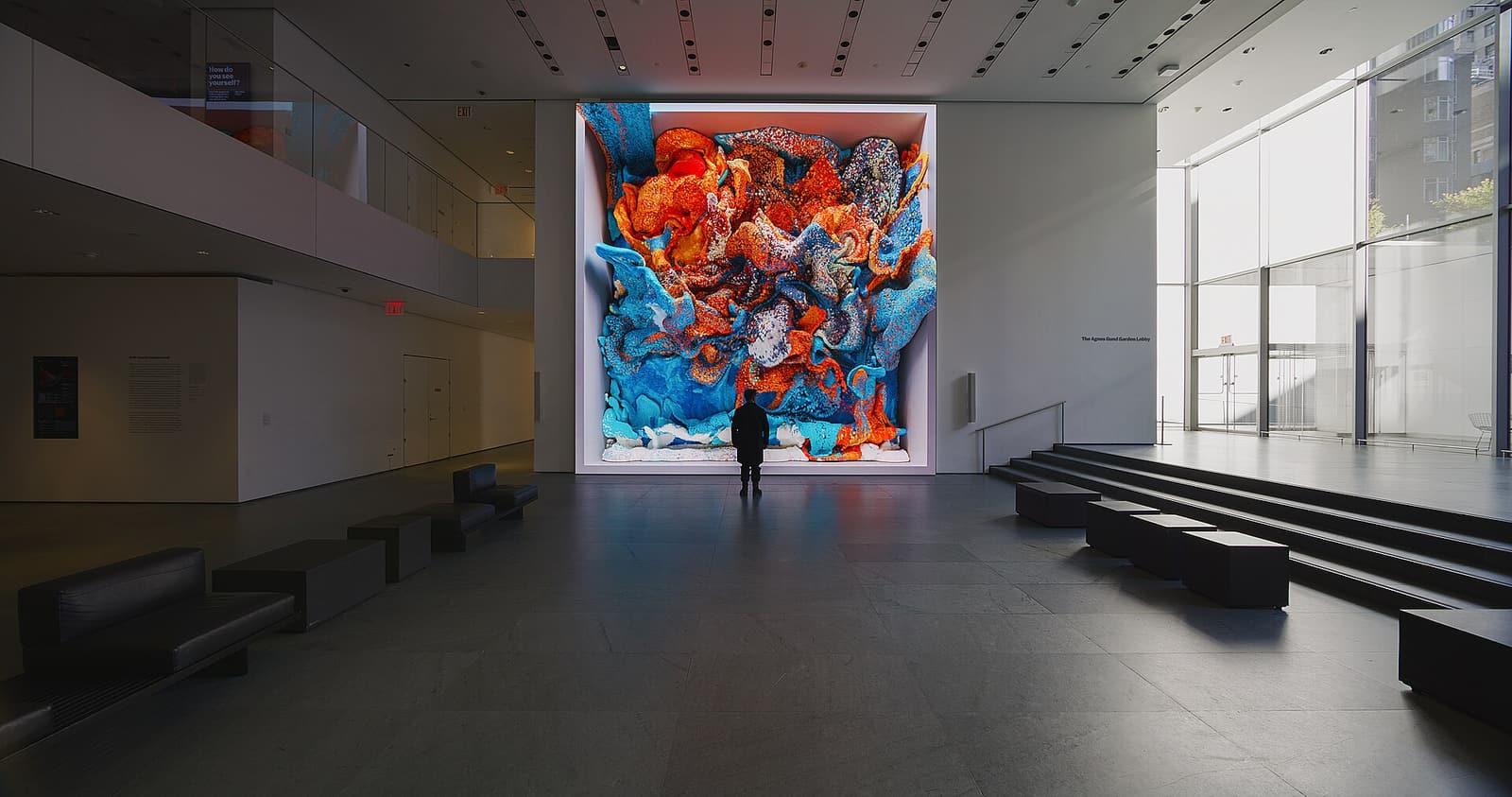
Refik Anadol’s Unsupervised became one of the emblematic AI-art works of the early ChatGPT era, but its durable force was architectural and institutional before it was merely visual. At MoMA, Unsupervised worked because it converted a museum’s collection data, its lobby traffic, and its own curatorial risk tolerance into one continuous public interface.[1][2][3][5]
That distinction matters in 2026 because plenty of AI visuals now look polished. Far fewer artworks have shown how a museum can stage machine learning as a social surface rather than a private screen object. Unsupervised mattered because viewers did not meet it in a black-box media-art chamber or on a collector’s monitor. They met it in the Gund Lobby, where people pass through, hesitate, gather, look up, take photos, and keep moving.[2]
Image context: the hero image shows the actual Gund Lobby installation, because the argument here depends on the work’s placement as much as on its image stream. The piece is not only a sequence of AI-generated forms; it is a lobby-scale encounter staged in a specific institutional threshold space.[2][6]
1) The real raw material is institutional memory, not just style transfer spectacle
Anadol’s own project page is unusually explicit about the data logic. It says Unsupervised processed 138,151 pieces of metadata from MoMA’s collection and built a multidimensional embedding space using StyleGAN2 ADA, with clustering used to navigate semantic relationships inside the archive.[1] That makes the work easier to understand if you stop thinking first about “AI image generation” and think instead about catalog structure, classification, and museum memory.
MoMA’s public collection repository sharpens that point. The museum’s GitHub README describes a research dataset now containing 160,269 accessioned records, with fields such as title, artist, medium, dimensions, and acquisition date, while noting that images are not included in the open dataset.[3] In other words, what MoMA made public was not a ready-made picture archive in the consumer-web sense. It was an institutional knowledge structure.
That is why Unsupervised remains more interesting than generic prompt-era image culture. The work does not simply remix visual style. It turns metadata into a speculative navigation field and asks what happens when an institution’s classification habits become an aesthetic engine.[1][3] The key medium is not “AI art” in the abstract. It is museum data under interpretive pressure.
2) The lobby is part of the artwork’s operating system
The Refik Anadol Studio event description gives the crucial site-specific detail that often disappears in broad AI-art debate: changes in light, movement, acoustics, and the weather outside the museum fed into the continuously shifting imagery and sound in the Gund Lobby installation.[2] That means the work was never only about a trained model generating output. It was also about the way a museum threshold keeps receiving environmental and behavioral input.
This is where Unsupervised separates itself from a lot of screen-based generative art. The Gund Lobby is a transitional civic room. People do not enter it with the same contract they bring to a dark gallery: many are arriving, leaving, waiting, orienting, or passing through. Installing the piece there changed its audience behavior from concentrated viewing to ambient collective watching. The work became something between exhibition object, digital facade turned inward, and institutional mood engine.[2]
That site decision helps explain its scale of attention. The piece could catch a first-time visitor who had no intention of “understanding AI art,” while still giving curators, critics, and repeat viewers a more structural question to sit with: what does it mean when a museum renders its own collection memory as an always-on public surface?[2][5]
3) Why the piece split critics so sharply
ARTnews captured the split cleanly when MoMA acquired the work: crowds kept gathering, while critics divided between dismissal and defense.[5] That polarization was predictable because Unsupervised sits at an awkward junction. It is too visibly spectacular to reassure critics who distrust immersive digital display, yet too historically anchored to be reduced to tech-demo decoration.
Artforum’s Lloyd Wise makes the strongest defense by arguing that the work belongs less to the novelty bucket of AI hype than to older modernist traditions of noncomposition, indeterminacy, and iterative systems.[4] In his reading, the point is not whether the machine “expresses” feeling the way a painter supposedly does. The point is that procedural surrender, chance arrangement, and system-generated form already have a serious art-historical lineage.[4]
That defense is useful because it relocates the argument. The interesting question around Unsupervised is not whether it can imitate human taste well enough to deserve applause. The interesting question is whether a museum can treat machine interpretation of its own records as an artwork with historical dialogue, public legibility, and architectural consequence. Once framed that way, the piece becomes easier to evaluate and harder to dismiss with a one-line “lava lamp” verdict.[4][5]
4) The 2023 acquisition changed the meaning of the work
When ARTnews reported MoMA’s acquisition in October 2023, the detail that stood out was not merely that the museum kept the piece after a high-profile run. It was that the conceptual object included a companion NFT and, as donor Ryan Zurrer put it, the “servers and screens and the other components” that make the work function.[5] That shifts the conversation from exhibition buzz to collection policy.
For older media, museums can often acquire a stable object and sort out display later. Unsupervised makes that harder. The work lives through computation, display architecture, and installation context. Collecting it implies collecting an operational stack, not just a frozen visual result.[5] Put differently: MoMA did not simply endorse a pretty AI image. It accepted a maintenance burden, a preservation problem, and an ongoing question of how runtime conditions would be kept historically legible.
That is where the piece becomes genuinely consequential. It turns the museum from commentator on technological change into custodian of it. The acquisition says that generative, environment-responsive installation is not only something a museum may show for a season; it is something a museum may decide to keep, maintain, and historically narrate.[5]
5) What still feels alive in 2026
The strongest part of Unsupervised now is not prophecy. It is framing. The work staged AI not as a replacement artist narrative and not as a consumer novelty, but as a way institutions externalize their own memory systems. MoMA’s public data, the lobby’s environmental conditions, the curators’ willingness to give premium threshold space to a generative system, and the museum’s later decision to acquire the work all became part of one argument.[1][2][3][5]
That argument still travels. Cultural institutions everywhere now sit on growing metadata systems, digitization layers, recommendation logics, and public-display surfaces. Most have not figured out how to turn those back-end structures into intelligible cultural form. Unsupervised did, even if imperfectly. It made the museum’s database feel spatial, social, and debatable. That remains a rarer institutional achievement than simply producing another stream of seductive generated images.
So the high-value way to remember the work is not “MoMA showed AI art.” That is too small. A better reading is that Unsupervised demonstrated how an institution can make its own archive behave like a public-facing medium. Once you see that, the work stops looking like a temporary hype object and starts reading as a prototype for how museums may stage computational culture in plain view.
A better way to look at the work in one minute
If you come back to Unsupervised through a museum visit, a clip, or a social-media fragment, three checks are more useful than looping through the tired "is this really art?" question.
- Start with the room before the image. Arrival, waiting, circulation, and peripheral attention are part of the work’s logic, not noise around it.
- Ask what kind of archive is being turned outward. The piece is drawing from institutional metadata rather than an endless image soup, so the sharper question is how classification becomes atmosphere.
- End with the preservation problem. Once MoMA acquires servers, screens, and runtime conditions, the work stops being only a spectacle and starts becoming a museum-operations question.
That sequence makes the piece feel less hype-bound and more legible as an artwork about institutional memory in public.
Sources
- Refik Anadol Studio, Unsupervised — Machine Hallucinations — MoMA (project description, date range, metadata count, model/embedding description)
- Refik Anadol Studio, MoMA – UNSUPERVISED (site-specific Gund Lobby description, environmental inputs, curatorial framing, exhibition dates)
- Museum of Modern Art, The Museum of Modern Art (MoMA) Collection GitHub repository README (public collection dataset scope, record counts, metadata fields, image-not-included note)
- Artforum, Lloyd Wise, Refik Anadol (review arguing for the work’s relation to modernist noncomposition, indeterminacy, and iterative systems)
- ARTnews, Harrison Jacobs, MoMA Acquires Refik Anadol’s ‘Unsupervised,’ Other Digital Artworks (acquisition report, crowd response, critical split, donor quote on servers/screens/components)
- Wikimedia Commons, File:Unsupervised by Refik Anadol.jpg (installation image record used for this post, identifying the work as Unsupervised, 2022)