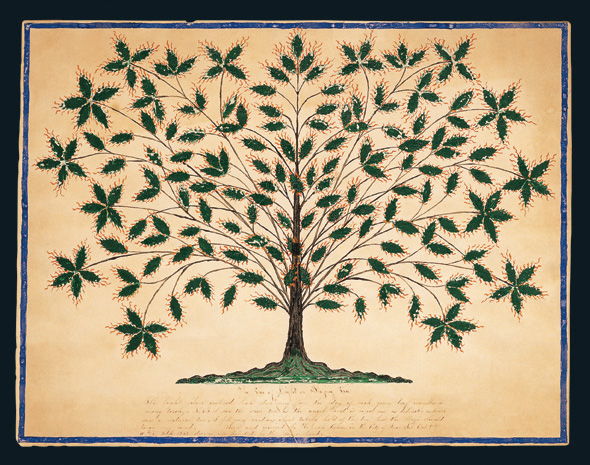
The surprise of Shaker gift drawings is that they refuse the easy version of Shaker taste. The movement is usually remembered through furniture: pale wood, lean lines, pegged rails, oval boxes, disciplined utility. Hannah Cohoon's The Tree of Light or Blazing Tree belongs to the same religious world, but it arrives like a flare. The drawing does not abandon order. It makes order incandescent.
That is why Cohoon's tree deserves to be read as more than charming folk art or sectarian curiosity. It is a picture of revelation that behaves like design. The American Folk Art Museum's 2024-2025 exhibition on gift drawings stressed that these mid-nineteenth-century works, made by women and believed to carry divine messages, sharply depart from the simplicity usually attached to Shaker material culture.[1] Cohoon's 1845 tree is the clearest test of that claim: the image source identifies it as The Tree of Light or Blazing Tree, made at Hancock, Massachusetts, and held in the American Folk Art Museum collection.[5] It is radiant, ornamental, and visionary, yet its force comes from compression: one trunk, one canopy, one frontal emblem, one concentrated act of seeing.
The drawing's visual power begins with its refusal to scatter. Many Shaker gift drawings are elaborate fields of text, emblems, tokens, and coded messages. Cohoon narrows the world to a single tree. The Wikimedia file record identifies the 1845 work as ink, pencil, and gouache on paper, 16 by 20 7/8 inches, made at Hancock, Massachusetts.[5] That modest scale matters. The tree is not monumental by size. It becomes monumental by organization.
Ecstasy Inside A Grid
Cohoon's tree is symmetrical enough to feel almost architectural. The trunk rises on axis. Branches divide with ceremonial regularity. Leaves or flames repeat across the crown until the whole form reads as both plant and lamp. The drawing promises organic growth, but the growth has been disciplined into frontal display. Nothing sprawls. Nothing melts into landscape. The tree stands as if revelation has submitted to arrangement.
That tension is the work's engine. Shakerism prized discipline, labor, communal regulation, and carefully ordered life, yet the Era of Manifestations produced visions, songs, dances, messages, and drawings that could be ecstatic in color and form. The American Folk Art Museum frames the gift drawings as objects from that charged spiritual culture, made in the mid-nineteenth century and associated with divine messages rather than ordinary decoration.[1] Cohoon's achievement is not to choose between restraint and overflow. She makes them depend on each other.
The tree's brilliance would be weaker without its order. If the foliage were merely wild, it would look like fantasy. If the geometry were merely correct, it would look like pattern. Instead, the work makes divine abundance legible by giving it a strict body. The viewer can feel the pressure of visionary excess because the drawing keeps that pressure contained.
A Woman's Vision, Not Anonymous Ornament
The gendered history of these works is not incidental. The Folk Art Museum exhibition emphasizes that the gift drawings on display were made by women, and the New Britain Museum of American Art's exhibition page similarly describes the show as centered on rare Shaker gift drawings and the women who made them.[1][4] That matters because Cohoon's tree is not a neutral community motif floating free of authorship. It is a signed, dated, self-claiming image of spiritual reception.
The 1845 Tree of Light or Blazing Tree was not always an American-art icon. Incollect's account of a related cutwork tree notes that Cohoon's image was unknown to the outside world until Sister Alice Smith at Hancock showed it to Faith Andrews and Edward Deming Andrews not later than 1931, and that Cohoon's signed works entered the Andrewses' Shaker holdings before appearing in the first major museum exhibition of Shaker material at the Whitney in 1935.[2] That afterlife clarifies the stakes. The drawing moved from internal devotional culture to public art history, but it did not lose the pressure of a named woman's vision.
That authorship changes how the tree looks. It is tempting to call the drawing naive because its space is flat and emblematic. But flatness here is not incapacity. It is conviction. Cohoon does not need atmospheric recession, naturalistic bark, or botanical irregularity because the work is not a landscape study. It is a record of a received form. The tree must stand forward, unblurred and undeniable, because its purpose is not to imitate nature but to make a spiritual object visible.
Ornament As Testimony
Modern viewers often separate ornament from seriousness. Cohoon's tree makes that separation collapse. Every repeated leaf or flame looks decorative, yet the repetition also functions as evidence. The eye moves over a surface that seems both lovingly worked and tightly governed. The pattern says: this was not a passing impression; it was attended to, repeated, stabilized, and made shareable.
That is why the drawing's beauty should not be extracted too quickly from its religious setting. Elizabeth Pochoda's 2024 reflection in The Magazine Antiques is useful because it resists overconfidence. Looking at the gift drawings together, she describes their variety, meticulous exuberance, and mystery, while also warning against imposing too much modern certainty on objects whose messages were legible within a specific Shaker world.[3] The caution is right. Cohoon's tree can speak powerfully to modern abstraction, folk art, feminist art history, and design culture, but it was not made as a museum poster for those categories.
Still, the drawing's afterlife is not a misunderstanding. The reason it travels so well is that it solves a durable visual problem: how can a picture make intensity feel ordered without cooling it down? Cohoon's answer is repetition. Repeated marks do not dull the vision. They make it credible. The tree becomes a disciplined field of fire.
Against The Simple Shaker Myth
The American Folk Art Museum's exhibition title, Anything but Simple, is pointed because the phrase corrects a common habit.[1] Shaker objects are often admired for simplicity in a way that can flatten the religious and social life that produced them. Chairs, boxes, and built-ins become a modernist mood board: honest material, clean line, useful form. Gift drawings interrupt that story. They show a Shaker visual culture capable of coded abundance, color, visionary address, and ornate spiritual communication.
This does not mean the drawings are anti-Shaker. It means Shaker simplicity was never the whole aesthetic. The same religious culture that could produce spare furniture could also produce a blazing tree. The contrast is not hypocrisy. It is range. A communal life built around order did not erase longing, grief, joy, or mystical expectation. It gave those forces forms through which they could be handled.
The New Britain Museum's exhibition text notes that Anything but Simple included Cohoon's 1854 Tree of Life and examined gift drawings in relation to women as spiritual "instruments" in Shaker communities.[4] That word, instrument, is essential. It describes a person as a receiver and transmitter, but it also describes a tool capable of producing form. Cohoon's drawing lets us see both meanings at once. The artist is spiritually receptive, but the page is also rigorously made.
Why The Tree Still Feels Modern
Cohoon's work keeps attracting modern attention because it sits uncomfortably close to later abstraction without becoming abstraction. The tree is recognizable, but its purpose is not descriptive. It is frontal, symbolic, repetitive, and diagram-like without being a diagram. It organizes color and shape into a concentrated sign, yet the sign remains emotionally charged. That combination makes it easy to see why twentieth- and twenty-first-century viewers find it unexpectedly fresh.
Adam Gopnik's 2006 essay in The New Yorker catches this double status well by treating Cohoon's surviving signed drawings as unusually concentrated within the broader gift-drawing field, especially because they focus on charged single forms rather than diffuse anecdotal pattern.[6] That judgment is useful because it explains why the tree can feel so immediate to viewers who know little about Shaker theology. The drawing does not ask the eye to decode an entire symbolic system before the image begins to work. It meets the viewer first as a concentrated form, then opens backward into belief.
But calling it modern can also be a trap. The drawing did not need modernism to validate it. Its sophistication comes from its own constraints: paper, pigment, religious testimony, communal symbolism, female visionary practice, and a Shaker habit of form held under pressure. What looks modern is partly the viewer's delayed recognition that design can carry metaphysical weight.
The tree's best lesson is therefore not that Shaker art was secretly maximalist, or that Cohoon anticipated abstraction. It is sharper than that. The Tree of Light or Blazing Tree shows how a devotional image can make structure and ecstasy indistinguishable. The blaze is not added to the order. The order is how the blaze survives.
Sources
- American Folk Art Museum, "Anything but Simple: Gift Drawings and the Shaker Aesthetic" - exhibition page on mid-nineteenth-century Shaker gift drawings, women makers, divine messages, and the contrast with Shaker simplicity.
- Incollect, "A Cutwork Tree of Life in the Manner of Hannah Cohoon" - historical account of Cohoon's tree image, its rediscovery through the Hancock Shakers, Andrews collection context, and early exhibition afterlife.
- Elizabeth Pochoda, "Field Notes: Heavenly Visions," The Magazine Antiques (September 19, 2024) - recent exhibition reflection on Shaker gift drawings, mystery, variety, and interpretive caution.
- New Britain Museum of American Art, "Anything but Simple: Shaker Gift Drawings and the Women Who Made Them" - exhibition page identifying Cohoon's The Tree of Life and the role of women as Shaker spiritual instruments.
- Wikimedia Commons, "File:Gift Drawing The Tree of Light or Blazing Tree, Hannah Cohoon (1788-1864).jpg" - image source and object metadata for the 1845 artwork used as this post's cover image.
- Adam Gopnik, "Shining Tree of Life," The New Yorker (February 13, 2006) - critical essay on Shaker aesthetics, gift drawings, and Cohoon's concentrated signed works.