Bronze sculpture is usually introduced through permanence. Stone breaks, wood cracks, paint flakes, but bronze survives and takes on the authority of something that has outlived its maker. That is only part of the story. A bronze is durable in the gallery, yet its making depends on a sequence of vanishings. The wax model is meant to be destroyed. The clay investment is broken apart. The channels that carried molten metal are cut away. Even the bright metallic surface that first emerges from the mold is often altered through polishing, chemicals, burial, weather, or time.[2][4][5][6]
That sequence is why bronze so often feels more alive than its reputation for solidity suggests. The medium is not just metal frozen into shape. It is evidence of heat, flow, pressure, removal, and reworking. The V&A's sculpture guide is concise on the physical attraction: bronze is strong and durable, but it also captures fine, complex detail inside a mold.[3] The Getty's casting and conservation resources make the underlying reason clearer. Bronze records decisions made at several stages rather than only one. Modeling, mold design, gating, casting, finishing, and patination all leave traces, whether or not the final sculpture wants to look seamless.[4][5][6]
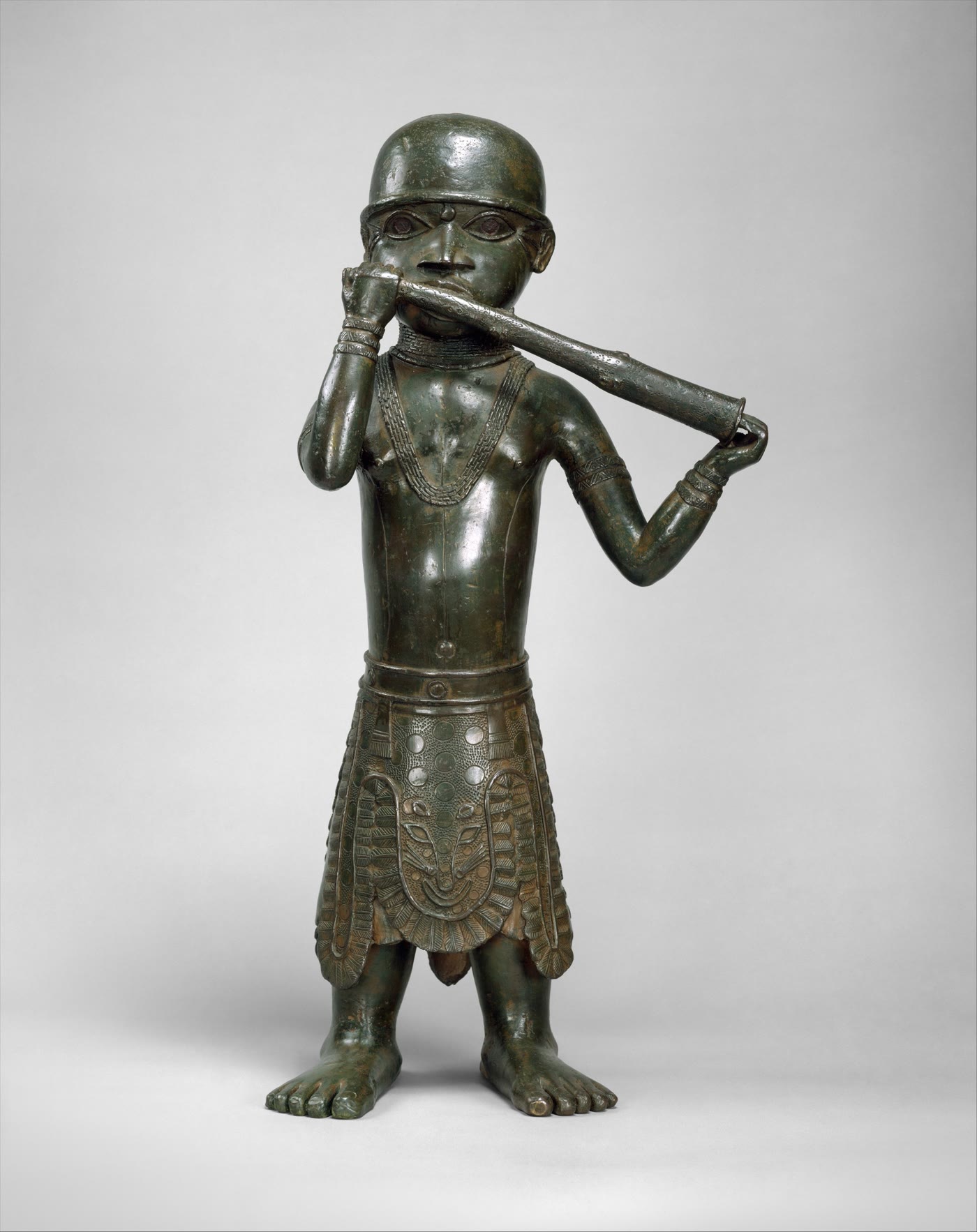
The Met's Edo Horn Player is a good object for holding these ideas in view.[1][2] The figure's trumpet, coral strands, and leopard-textured garment all depend on bronze's capacity for exact relief and crisp contour, while the object's later surface reminds us that casting is only the beginning of a bronze's visual life.[1][2]
Image context: the cover uses The Met's photograph of the Edo Horn Player because the sculpture shows what this medium does especially well. The musician's coral regalia, the instrument held across the body, and the patterned garment all depend on bronze's ability to register small ridges and recesses without turning brittle. A generic foundry photograph would explain process, but it would miss the reason artists keep returning to the medium: bronze can hold delicacy and authority in the same object.[1][3]
The model has to disappear for the sculpture to arrive
Lost-wax casting is such a familiar phrase that it can sound almost ceremonial, but the loss is literal.[2][4][5] In the traditional cire-perdue sequence described by The Met, a model in wax, sometimes built around a clay core, is coated in a fine clay investment and then in additional refractory layers. Heat melts the wax away, leaving a cavity that can receive molten metal.[2] The Getty's Foundry to Finish page emphasizes the artistic risk inside that process. In a direct lost-wax method, the original clay-and-wax model is enclosed in the mold; if the pour fails, the artist has to begin again because the first model is gone.[4]
That destructive step matters aesthetically as much as technically. A carved marble can be thought of as a block gradually clarified. A bronze comes into being through transfer. What the viewer finally sees is not the original modeled surface, but a metallic memory of it. The Getty casting guidelines underline how many distinct process families sit under the umbrella of lost-wax casting, especially direct and indirect methods.[5] An indirect process can produce wax inter-models from reusable molds; a direct process ties the final bronze more tightly to a single sacrificed model.[4][5] The difference matters because it changes what kind of individuality the finished object carries.
This is one reason bronze often feels suspended between uniqueness and reproducibility. The public tends to hear "cast" and think "copy." The medium's history is less simple. Casting can repeat a form, especially in indirect systems, yet the wax stage, the mold assembly, the pour, the fettling, and the patina all introduce variation.[4][5][6] Bronze is reproducible only by passing again through labor, heat, and risk. It is a medium of repetition under pressure, not a button for effortless sameness.
Hollow does not mean empty
A second misunderstanding comes from weight. Because bronze sculpture looks dense, viewers often imagine a solid metal mass. Large bronzes are commonly hollow, and that hollowness is not a shortcut. It is structure.[2][5] The inner core determines the space inside the cast, while the gap between outer mold and core determines wall thickness. Getty's technical guidelines treat that interior evidence, core supports, core pins, drips, and internal sprues, as crucial for identifying how a bronze was made.[5]
Once you picture that internal architecture, many things about bronze sculpture start to make more sense. A successful bronze is not merely an outer silhouette. It is a negotiation between skin and cavity. Too much metal and the sculpture becomes unnecessarily heavy, expensive, and difficult to cast. Too little and the form risks weakness or collapse in vulnerable passages. The medium's elegance lies in getting the wall thin enough to stay lively while keeping enough structural confidence to survive handling, transport, and time.[5]
That interior logic also explains why bronzes often reward close looking at edges, joins, and undersides rather than only at the front. The visible surface may want to read as effortless, but the inside tells a more exact story. Getty's guide notes that hollow casts can preserve evidence of core pins and other features on the inner surface that reveal how the core was secured and how the metal moved through the mold.[5] In other words, the hidden cavity is not empty space after the real work is done. It is one of the places where the work becomes legible.
Sprues, finishing, and the fiction of effortless form
Before the bronze reaches that poised museum state, it passes through an ungainly moment. The Getty exhibition page describes a network of wax rods called sprues plus a pouring cup attached to the model before investment.[4] These additions are not part of the sculpture's intended image, but they are essential to the pour. They guide molten material through the mold and allow air and gases to escape.[4][5] For a brief stage, the future sculpture looks less like an artwork than like an engineered circulation system.
That stage is important because it reminds us that bronze's authority is constructed after the pour, not delivered whole. Once the mold is broken away, the foundry or sculptor removes the unwanted channels and begins the long work of refining the surface. Getty's resources use the practical language of fettling and chasing for those steps: sprues, flashing, and other casting residues are cut back; details can be sharpened; transitions can be softened or clarified; textures can be protected or reasserted.[4][5]
This is where many judgments about quality are actually made. A bronze can lose life if the finish is overworked and every passage is filed into dead regularity. It can also fail if the maker leaves too much accident unresolved. The point is not to erase process absolutely. The point is to decide which traces belong to the sculpture's final speech. In the Horn Player, the patterned garment and the crisp accessories do not feel mechanically stamped. They feel selected, as though the maker knew exactly which ridges needed to remain articulate for the figure's authority to survive in metal.[1]
Patina is part of the form, not cosmetic afterthought
Many viewers speak about patina as though it were a secondary skin laid over the "real" bronze. The Getty's patina guidelines define the term more carefully: it commonly refers to the chemical transformation of a metal surface into a mineral layer with a different color and reduced metallic reflectance, though the word is also used more loosely for applied surface coloration.[6] That distinction matters. Patina is not always damage, and it is not always original finish. It can be an intended chemical surface, a later environmental result, or a dense historical mixture of both.[4][6]
The Getty exhibition makes this vivid by separating deliberate finishing from later weathering. In its discussion of Adriaen de Vries, one surface color is produced through finishing, while the green outdoor patina forms over time rather than being authored at the start.[4] The bronze's appearance therefore belongs to more than one moment. Foundry decisions matter, but so do storage conditions, burial history, ritual use, outdoor exposure, previous cleanings, and conservation choices.[2][4][6]
The Met's essay on conserving a Benin bronze sharpens the point further by challenging the casual idea that reddish-brown surface matter is only loose "red dirt of Benin."[2] Conservation showed a hard, adherent layer instead, making surface study part of historical interpretation rather than simple cleaning.[2] Patina, on that account, is not decorative residue. It is evidence. It tells us how the object lived after casting, how viewers handled it, where it rested, and what later generations thought should remain visible.
Why bronze keeps artists and viewers honest
Bronze has lasted so long in art because it compresses several demands into one medium. It can hold tiny detail, survive outdoor life, scale from tabletop object to monumental body, and still reveal the discipline of its making to anyone who looks patiently.[1][3][5] The Met's Horn Player adds a social dimension to that technical story. The museum notes that in Benin court art, bronze commissions were restricted to the Oba or those with permission, and that mastery of lost-wax casting helped transform imported metal into a royal visual language.[1] Technique here is inseparable from power, workshop knowledge, and patronage.
That is finally what makes bronze more interesting than the cliché of permanence. A bronze is durable, but it does not arrive by simple hardening. It arrives through subtraction, interior engineering, controlled flow, selective repair, and surface transformation.[2][4][5][6] The fire does not disappear from the finished work. It remains there as memory: in the hollow body, in the chased edge, in the sealed trace of removed sprues, and in the patina that keeps the sculpture from ever being only raw metal.
Sources
- The Metropolitan Museum of Art, "Horn Player" - object page on the Edo court sculpture, its royal Benin context, and the technical virtuosity of bronze casting visible in the figure's costume and instrument.
- The Metropolitan Museum of Art, "Recovering the Brilliance of a Benin Bronze" - conservation essay on lost-wax casting, mold investment, and the meaning of the sculpture's red-brown surface layer.
- V&A, "Sculpture techniques" - museum guide explaining why bronze captures fine detail and summarizing the material logic of bronze casting.
- J. Paul Getty Museum, "Foundry to Finish: The Making of a Bronze Sculpture" - exhibition page on modeling, sprues, investment, finishing, and later surface change in bronze.
- J. Paul Getty Conservation Institute, "Guidelines for the Technical Examination of Bronze Sculpture | Casting Processes" - technical guide on direct and indirect lost-wax casting, hollow interiors, core pins, and sprue evidence.
- J. Paul Getty Conservation Institute, "Guidelines for the Technical Examination of Bronze Sculpture | Patina" - technical guide defining patina and explaining how bronze surfaces change through chemistry, finishing, and time.