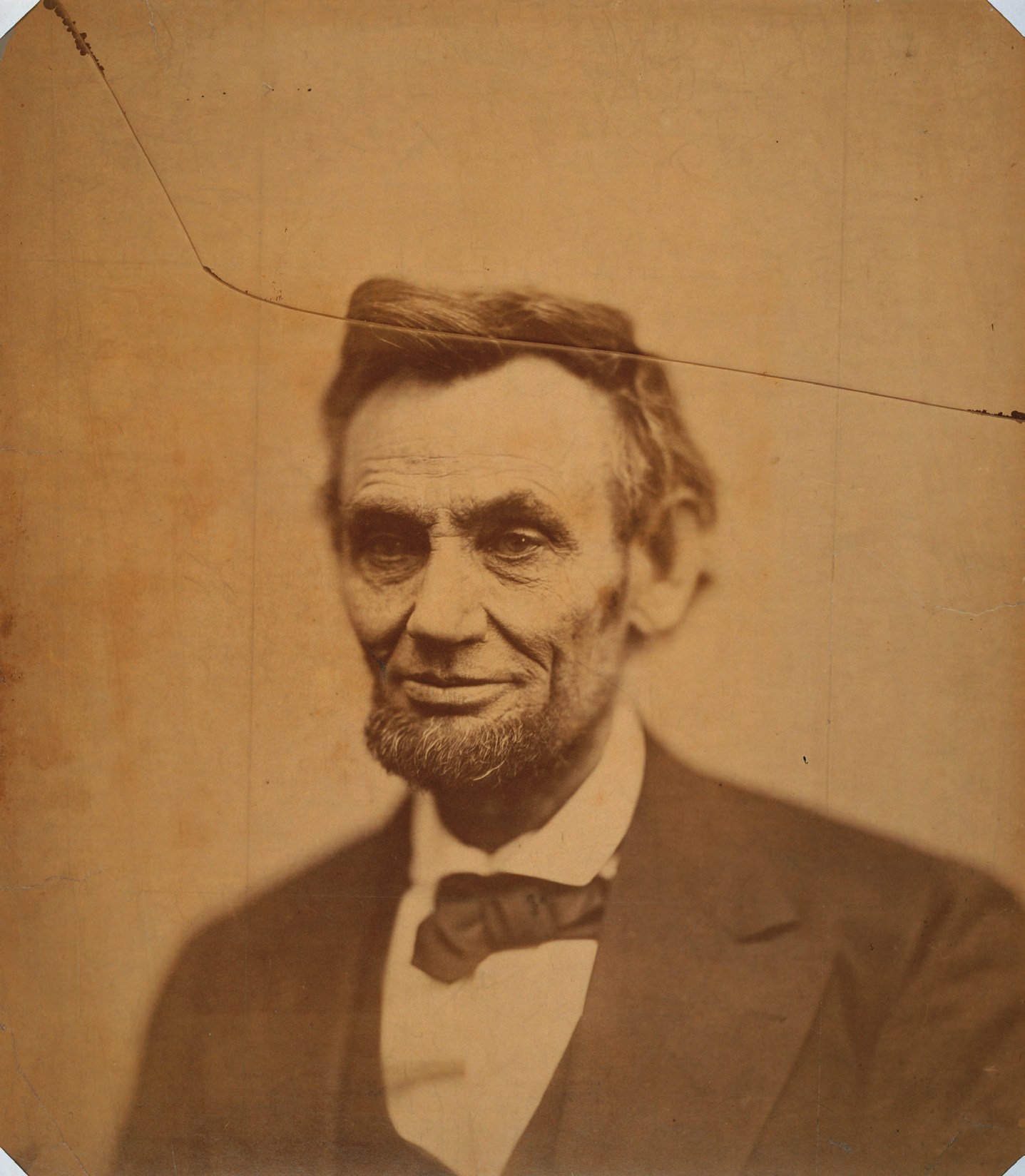
Start at the upper left corner of Alexander Gardner’s portrait of Abraham Lincoln. A dark line drops steeply through the empty space above his shoulder. It takes a turn just before it reaches his head. For a moment you can lose it in the comb marks of his hair. Then it comes out the other side, legible again against the pale wall, and runs clear to the edge. You have just traced the shape of a piece of broken glass. [1][2]
Lincoln sat for Gardner in Washington on February 5, 1865. Gardner used a large glass negative for this exposure. The albumen silver print in the National Portrait Gallery measures about eighteen inches high, large enough for an encounter with something close to a life-size head. At that scale the sitter offers plenty to look at before the crack claims your attention. One eye sits deep in shadow. Light picks up individual hairs along the chin. The mouth has a little upward turn which becomes surprisingly hard to describe once you try to say how happy the man looks. [1][2]
Look down at the bow tie. Its soft folds are broad enough to count from across a room. Now come back up to the much smaller fold at the corner of the mouth. The tie stays a tie however long you look at it. The fold can give Lincoln an air of amusement one minute and weariness the next. Much of the pleasure of the sitting survives in that flicker. It takes some effort to see it once you know what happened to him in April. [1]
The Smithsonian’s educational portfolio invites a viewer to see in the fracture both a divided Union and a premonition of the assassination. The path across Lincoln’s head gives the second reading much of its force. Follow the line in the opposite direction, though, and you end up in an empty patch of studio wall. There the same mark tells a quite specific story about Gardner. He went ahead and printed the damaged negative. Only one print came from it before the glass was destroyed. Every subsequent reproduction that preserves the line also preserves that decision. [1][2]
The print acquired a further distinction in the hands of Frederick Hill Meserve, who bought it in 1913. He believed it was the last photograph anyone had taken of Lincoln. There is an easy way to check. Henry F. Warren photographed Lincoln on the White House balcony on March 6, a month after Gardner’s sitting. Even the captions on surviving copies of Warren’s picture tell a small history of how much people wanted that distinction. One calls Warren’s photograph the “Latest.” A card in Mississippi State University’s collection calls it the “Last.” The extra syllable leaves open the possibility of another sitting. [2][3][4]
Gardner’s picture has a better claim on a viewer than priority in a calendar. Cover the top of the print with your hand, down to the hairline, and spend a moment with the mouth. Then lift your hand. The man has held the same expression throughout. What changes, as that line comes back into view, is how much of his future you bring into the room.
Sources
- National Portrait Gallery and Smithsonian Institution Traveling Exhibition Service, The Mask of Lincoln, portraits 9 and 10.
- Smithsonian Institution, “Abraham Lincoln,” on Gardner’s sitting, the surviving print, and Frederick Hill Meserve.
- Christie’s, Henry F. Warren’s balcony portrait of Lincoln, with the mount inscription describing it as the “Latest Photograph.”
- Mississippi State University Libraries, The Last Photograph of President Lincoln, with a transcription of the card caption.