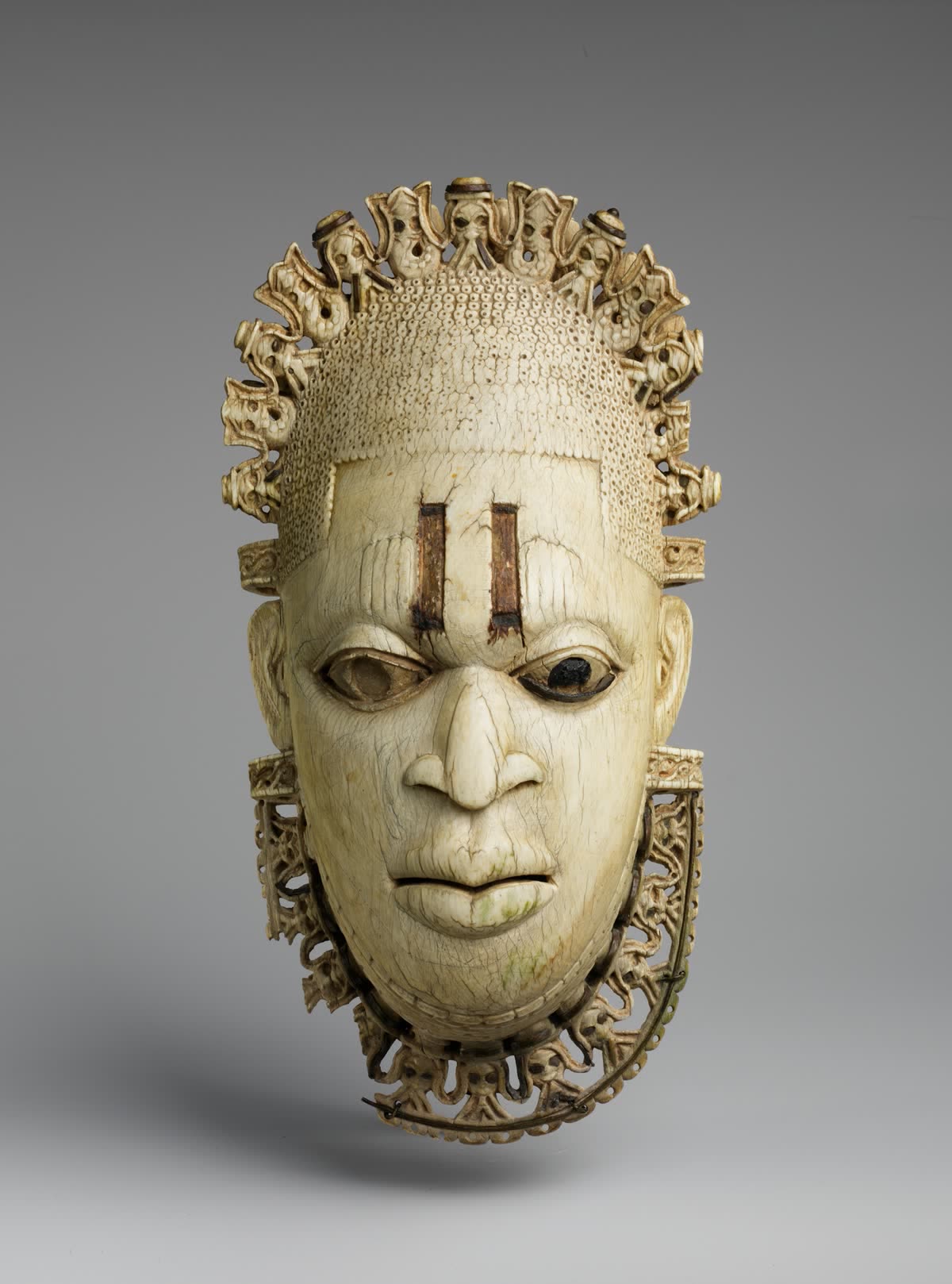
The Benin Queen Mother pendant mask is small enough to be worn and severe enough to stop a room. The Met gives its height as 9 3/8 inches, made in the sixteenth century by artists of the Igbesanmwan ivory- and wood-carving guild at the Court of Benin in present-day Nigeria.[1] That scale matters. This is not a freestanding monument asking viewers to circle it at civic distance. It is a concentrated royal object: a face, a protective amulet, a memory of a specific woman, and a piece of ceremonial dress brought close to the oba's body.
The woman is Idia, mother of Oba Esigie. The Met's audio and Heilbrunn essay frame her not as a decorative court figure but as a political and spiritual actor: Esigie faced dynastic conflict and military threat, credited Idia's counsel and powers as crucial to his success, and created the title of iyoba, or queen mother, in her honor.[1][2] The mask's power begins there. It does not simply depict maternal virtue. It translates maternal authority into a royal instrument.
Image context: this is a real photographic reproduction of the artwork, not a diagram, chart, or generated visual. It belongs here because the work's argument is visual and material: ivory, iron, facial calm, crown detail, and openwork signs have to be read together before the mask's political force becomes clear.[1][5]
A face held in command
The first thing to notice is the mask's control over expression. The mouth is closed, the cheeks are full but not soft, and the eyes do not perform ordinary likeness. The face has the stillness of an office rather than the looseness of a private person. That is why calling it "idealized" does not weaken its portrait quality. In Benin court art, the point is not modern psychological exposure. The point is to make a person visible as a carrier of rank, counsel, protection, and ancestral force.[1][2]
The iron inlays sharpen that authority. Smarthistory notes that the iron in the pupils and eye rims intensifies the gaze, while the vertical depressions on the forehead were also inlaid with iron.[4] The Met's Heilbrunn essay connects those two forehead bars to medicine-filled incisions associated with Idia's metaphysical power.[2] Read together, the marks make the face active without making it theatrical. The mask watches because it protects. Its frontal calm is not passivity; it is disciplined force.
That force would have changed when worn. The Met says the object was a protective amulet and part of the king's ceremonial dress during state rituals.[1] The British Museum's closely related pendant mask is described as one of five stylistically similar ivory hip-pendants made for the oba's use in the sixteenth century, probably representing Idia, and worn on the hip during important ceremonies.[3] In other words, this face did not only sit in a treasury. It moved with the sovereign body. Idia's image became one of the ways royal power appeared in public.
Ivory as substance and signal
The material is not neutral luxury. Ivory's whiteness, rarity, and trade value all matter. Smarthistory stresses that ivory was both a luxury good and Benin's principal commercial commodity, while its white color was linked to ritual purity and to Olokun, the sea deity associated with wealth and fertility.[4] The mask therefore carries several registers at once. It is precious because it required elite access to material. It is luminous because the carved surface keeps light moving across the face. It is symbolically charged because whiteness and sea-linked power belong to the spiritual economy around kingship.
This is why the object should not be read as "a mask plus decoration." The crown, collar, and face are parts of one system. The patterned cap presses the head into ceremonial order. The openwork around the jaw and collar prevents the lower edge from becoming a mere frame; it turns the face into something suspended inside a network of signs. Even the object's small damages and aged surface visible in the photographic reproduction matter. They remind the viewer that this was a handled, collected, displaced object, not an image floating outside history.[1][3][5]
The openwork motifs are especially dense. The Met audio identifies the locks or tiara-like arrangements as alternating miniature Portuguese merchants and stylized mudfish.[1] Smarthistory gives the same pairing and explains the logic: mudfish live on land and in water, symbolizing the king's dual human and divine nature, while Portuguese traders, arriving from across the sea, could be understood in relation to Olokun's realm and to imported wealth.[4] The British Museum's object entry adds that Portuguese heads symbolized Benin's alliance with and control over Europeans.[3]
That phrase, control over Europeans, is crucial. The mask is not merely showing that Benin had foreign contact. It is absorbing foreignness into Benin court iconography. Portuguese faces are miniaturized and set into a royal structure. They do not dominate the object. They help declare the oba's reach.
A portrait after removal
Any close reading also has to face the object's later history. The British Museum records its related pendant mask as looted during the 1897 British Expedition to Benin City; its entry also notes that the Met mask was taken by Sir Ralph Moor during that expedition, passed through collections, entered Nelson Rockefeller's Museum of Primitive Art, and was later given to the Met.[3] The Met object page lists the current accession history without making that violent extraction the visual subject of the piece.[1] The two records need to be held together.
This does not mean the mask can only be read as evidence of loss, but it cannot be read innocently either. Its modern museum presence is part of the work's afterlife. The image once helped make royal renewal visible inside Benin ceremonial life; now it is also one of the most recognizable objects in debates about African court art, colonial seizure, display, and restitution. The British Museum's Hew Locke exhibition guide makes that modern iconicity explicit: it describes how the Queen Mother Idia mask became emblematic through FESTAC '77, when Nigeria requested the mask, the British Museum refused the loan on conservation grounds, and the image spread through posters and replicas in Lagos.[6]
That afterlife does not flatten the carving. It makes the carving's original intelligence more visible. The mask could become a modern icon because it was already designed as a compressed image of authority. The face is calm enough to be repeated. The crown is intricate enough to reward looking. The material is bright enough to carry memory. The signs are specific enough to resist generic "African mask" shorthand.
The Queen Mother pendant mask endures because it makes power watchful rather than loud. Idia's face is not shown commanding troops, speaking in council, or performing ritual. It is made into the condition under which the oba can appear protected. Ivory carries wealth and purity. Iron turns the eyes and forehead into charged points. Mudfish and Portuguese heads link kingship to sea, trade, dual nature, and foreign encounter. The object is portable, but its argument is vast: maternal counsel, royal legitimacy, spiritual force, and worldly exchange can all be gathered into one face small enough to wear.[1][2][3][4]
Sources
- The Metropolitan Museum of Art, "Pendant mask of Iyoba Idia" - object page with date, medium, dimensions, attribution to the Igbesanmwan carving guild, and audio on Idia, ceremonial use, Portuguese heads, mudfish, and protective function.
- Alexander Ives Bortolot, "Women Leaders in African History: Idia, First Queen Mother of Benin," The Metropolitan Museum of Art Heilbrunn Timeline of Art History - essay on Idia, Esigie, the creation of the iyoba title, political power, and the mask's medicine marks.
- The British Museum, "pendant-mask; regalia" - object page for a related sixteenth-century Queen Mother Idia hip-pendant, with notes on ceremonial use, Portuguese heads, the 1897 expedition, and the Met mask's collecting history.
- Smarthistory, "Queen Mother Pendant Mask (Iyoba) (Edo peoples)" - close-reading article on iron inlay, ivory, coral beads, mudfish, Portuguese traders, Olokun, and Benin court symbolism.
- Wikimedia Commons, "File:Queen Mother Pendant Mask- Iyoba MET DP231460.jpg" - source page for the real photographic reproduction used as this article's image.
- The British Museum, "Hew Locke: what have we here? large print guide" - exhibition guide discussing the Queen Mother Idia mask, FESTAC '77, replicas, and the modern emblematic status of the image.