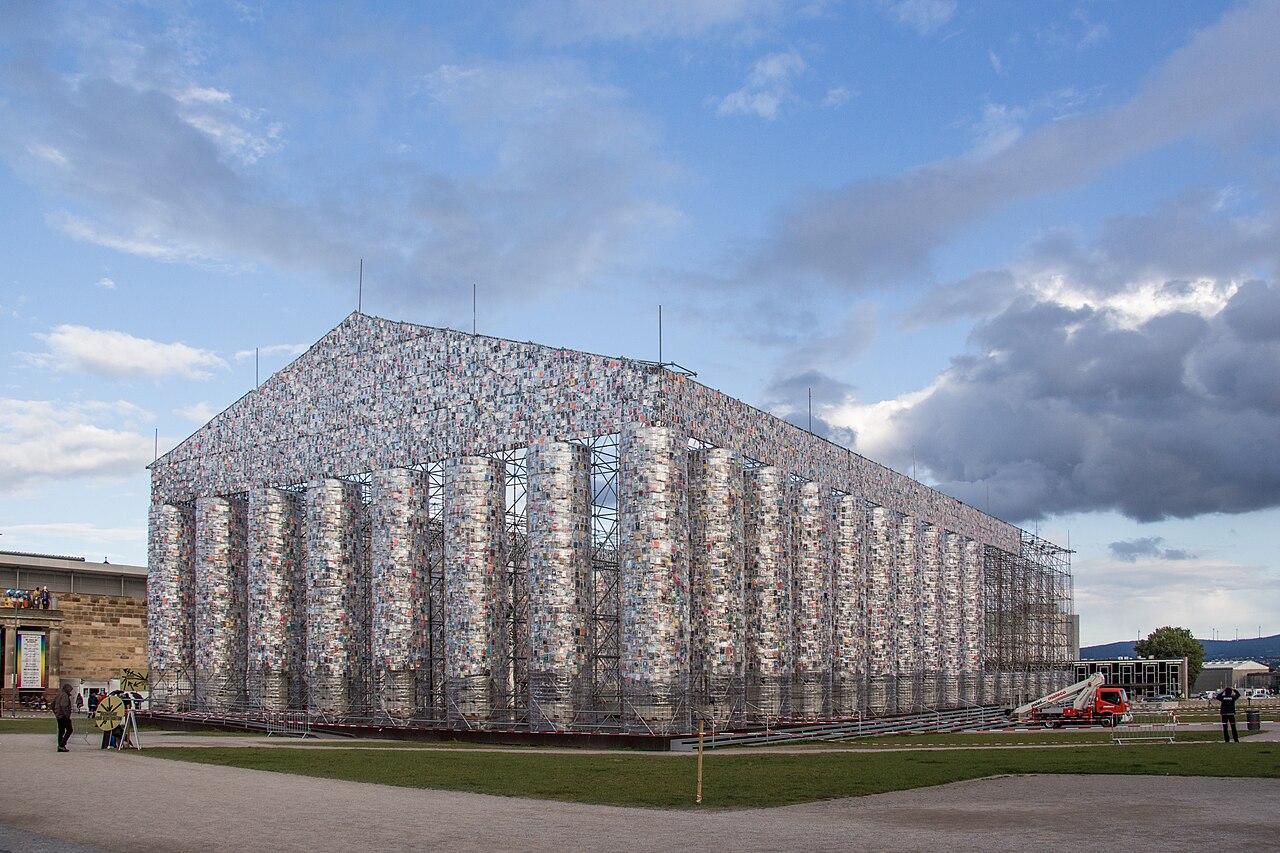
Marta Minujin's The Parthenon of Books looks, at first, like a triumphant reversal: where books had been burned, banned, or locked away, they return as architecture. That reading is true, but it is only the entrance. The 2017 documenta 14 version in Kassel was not powerful because it made a monument to banned books. It was powerful because it made a monument that refused to behave like a monument. Steel, books, and plastic sheeting formed a Parthenon-shaped public object, but the work's end point was not preservation. It was redistribution.[1][3]
That is the key to the installation's intelligence. Censorship often works by removing circulation: a title disappears from schools, libraries, bookshops, borders, syllabi, warehouses, or public legitimacy. Minujin answered that logic with the opposite chain. People donated books. The books were validated and cataloged. They were attached to a temporary civic structure. Then they were taken down and handed back into public movement.[2][3][4] The form was spectacular, but the real medium was circulation.
The Kassel work also carried a sharp site memory. documenta's call for donations placed the installation on Friedrichsplatz, where around two thousand books were burned in 1933 during the "Campaign against the Un-German Spirit"; it also noted the later destruction of the Fridericianum's library holdings during wartime bombing.[2] The square therefore was not a neutral stage for a photogenic book temple. It was a place where culture had already been made vulnerable by public ceremony and by fire. Minujin's answer was not to sanctify the book as an untouched relic. It was to make the book pass through hands again.
Image context: the cover uses Paul Broeker's 2017 Wikimedia Commons photograph of the Kassel installation.[5] It works because the whole argument is visible: the classical silhouette is there, but so are the exposed scaffold grid, plastic-wrapped titles, visitors, service equipment, and open sky. The structure never fully hides the fact that it can be built, handled, weathered, and dismantled.
The temple is a borrowed shape, not an inherited authority
documenta 14's artist page lists the 2017 work plainly: steel, books, and plastic sheeting, 19.5 by 29.5 by 65.5 meters, commissioned for Friedrichsplatz.[1] Those materials matter. The Parthenon outline supplies instant recognizability, but the installation keeps its borrowed authority unstable. Marble becomes scaffolding. Stone columns become vertical fields of printed paper. Classical permanence becomes a public construction project.
That instability is not a weakness in the work. It is the work's argument. The original Athenian Parthenon has long been used as a compressed image of democracy, Western inheritance, and cultural authority. Minujin takes that loaded silhouette and makes it depend on books that have been exposed to prohibition, pressure, or argument.[1][2] The result is not a clean celebration of democracy as an accomplished fact. It is a more useful image: democracy as a fragile arrangement of access, publication, memory, and return.
The books do not merely decorate the scaffolding. They change what a column means. A column normally promises support, order, and continuity. Here each vertical mass is made from titles that have, at some point, been judged too dangerous, too erotic, too political, too irreverent, too confusing, or too available to the wrong readers.[2][4] The column becomes a stack of contested permissions. It holds because many acts of reading, printing, donating, wrapping, and attaching have been coordinated.
That is why the work resists the easy slogan of "books versus tyranny." Its better claim is more material. A book survives censorship only when systems around it keep re-opening: publishers reissue, readers remember, libraries acquire, schools reconsider, customs regimes loosen, and public culture decides that difficulty is not the same as harm. The Parthenon form lets those slow processes become visible at city scale.
The 1983 origin makes the 2017 version less nostalgic
The Kassel installation was a restaging with a memory inside it. documenta traced the project to Minujin's El Partenon de libros, realized in Buenos Aires in 1983 after the collapse of Argentina's civilian-military dictatorship.[1][2] That earlier work used books banned by the ruling junta and ended with the public removing volumes from the structure.[1][2] The 2017 version therefore was not simply a German reckoning with 1933. It was also an Argentine method brought into a different public square.
That matters because the work's politics are not only commemorative. A memorial can stop at naming damage. Minujin's format asks what happens after prohibition loosens. The banned book does not become free by being admired from a distance. It becomes free by re-entering use. In 1983, that meant leaning the structure and letting viewers remove the books.[2] In 2017, it meant a planned redistribution counter, random allocation, admission-ticket checks, weather contingencies, and the ordinary logistics of moving volumes from an artwork back toward readers.[3]
Those details may sound bureaucratic beside the photograph's grandeur. They are actually the reason the piece works. documenta's redistribution notice specified that visitors could pick up books from September 10 to September 17, 2017, that titles would be distributed randomly, and that the action would continue only while supplies lasted and weather allowed.[3] The anti-monument becomes strongest when it admits dependency on schedules, counters, wrappers, volunteers, and chance.
The point is not that randomness is a perfect democratic mechanism. It is that no visitor could master the work by selecting the most desirable title and converting the event into private acquisition. The book came as a partial gift, an accident, a fragment of a larger public structure. A person received not just a volume but a small piece of the installation's argument: banned culture returns unevenly, materially, and through imperfect institutions.
The list is part of the artwork
The donated-book list may look like documentation after the fact, but it belongs near the center of interpretation. documenta's published PDF states that the Kassel Parthenon used 68,000 banned books donated by the public, and it lists titles with notes on prohibition contexts while warning that any single context may not be the only history of censorship attached to a work.[4] That caveat is important. Censorship rarely has one tidy biography.
The list brings together books banned in dictatorships, challenged in schools and libraries, restricted by religious authorities, censored by states, or attacked across different periods.[2][4] This mix could become vague if handled carelessly: everything controversial might start to look equivalent. Minujin's architecture avoids that flattening by refusing to turn the titles into a didactic chart. The books remain individual objects, but they also become a crowd. The viewer has to hold both scales at once.
At close range, a visitor could recognize titles. At distance, those titles blurred into a skin. That double vision gives the installation its moral pressure. Censorship is always specific to a title, author, edition, jurisdiction, school board, regime, or moment. Yet the damage also aggregates. One prohibited book is a case; thousands of them become an atmosphere. The Parthenon of Books gives that atmosphere a body without pretending that all bans have the same cause or weight.[4]
This is also why the plastic wrapping matters. It protects the books from weather, but it also makes access visibly delayed. The reader sees the book before being able to read it. The title is present and withheld at once. In a weaker artwork, plastic might feel like mere event logistics. Here it sharpens the theme: visibility alone is not freedom. A book can be seen, named, photographed, and celebrated while still waiting for circulation.
The work's afterlife is built into its disappearance
Many public artworks become more authoritative by remaining. Minujin's became more precise by leaving. The documenta calendar described the launch of redistribution as an expression of the work's "ephemeral and transitional" status, and connected that status to collective public space shaped by donors, visitors, and institutions.[3] That is not curatorial softness. It is the cleanest account of the form.
If the structure had stayed indefinitely on Friedrichsplatz, it might have become a permanent icon of anti-censorship. That would be legible, but less radical. Permanence would risk turning banned books into symbolic cladding, useful mainly for photographs and civic pride. By sending the books back out, the work sacrificed its own spectacular body in favor of the condition it advocated. A book cannot oppose censorship very well if it remains sealed forever onto a monument.
The secondary reporting around the project often emphasized scale: a replica made from up to 100,000 banned books, a politically charged site, a major documenta centerpiece.[6] Scale drew attention, and attention mattered. But the sharper achievement lies in how scale was made temporary. The huge outline taught viewers to look; the redistribution taught them not to confuse looking with repair.
That is why The Parthenon of Books still feels fresh rather than merely earnest. It does not ask the reader to believe that art defeats censorship by symbolism alone. It stages a more demanding proposition: public memory has to become public motion. Books must be found, named, donated, protected, cataloged, displayed, handled, dispersed, and read.[2][3][4] The installation makes that chain visible, then lets the chain continue without the temple.
Minujin's strongest move was to make censorship look temporary without making it look harmless. The books had histories of suppression; the square had histories of destruction; the classical form had histories of authority and appropriation.[1][2] None of that disappears. But the work refuses to let damage have the final architectural shape. The final shape is a visitor carrying a book away.
Sources
- documenta 14, "Marta Minujin" - artist page with work metadata, dimensions, 1983 origin, and interpretive text.
- documenta 14, "Call for Book Donations for The Parthenon of Books" - project rationale, donation process, Friedrichsplatz history, and 1983 precedent.
- documenta 14, "The Parthenon of Books: Redistribution of Forbidden Books" - public redistribution notice and practical conditions.
- documenta 14, "The Parthenon of Books: List of donated books" - PDF inventory and notes on censorship contexts.
- Wikimedia Commons, "File: Parthenon der Buecher (documenta 14 in Kassel) (12.09.2017).jpg" - photographic source for the cover image by Paul Broeker.
- Jane Morris, "Documenta to restage Acropolis of banned books," The Art Newspaper, October 5, 2016 - contemporary report on the planned Kassel restaging.