Silverpoint often gets introduced as a delicate Renaissance curiosity, as though its main value were historical elegance.[1] The better way to read it is as a medium that forces commitment unusually early. Before the artist can even begin drawing, the surface usually has to be prepared. Once the line starts, it behaves with a narrow tonal range and limited erasure. And as time passes, the mark itself changes, because silver slowly tarnishes from cool gray toward warmer brown.[1][2] What looks fragile is actually a strict technical system.
That is why silverpoint still feels so particular in person. It does not let the artist bluff with velvety charcoal atmospherics or dramatic pressure changes. It asks for calibration. The line is fine, restrained, and persistent. If oil painting often hides its sequence under a finished surface, silverpoint makes sequence visible from the start: ground first, contact second, correction last if it is possible at all.[1][3]
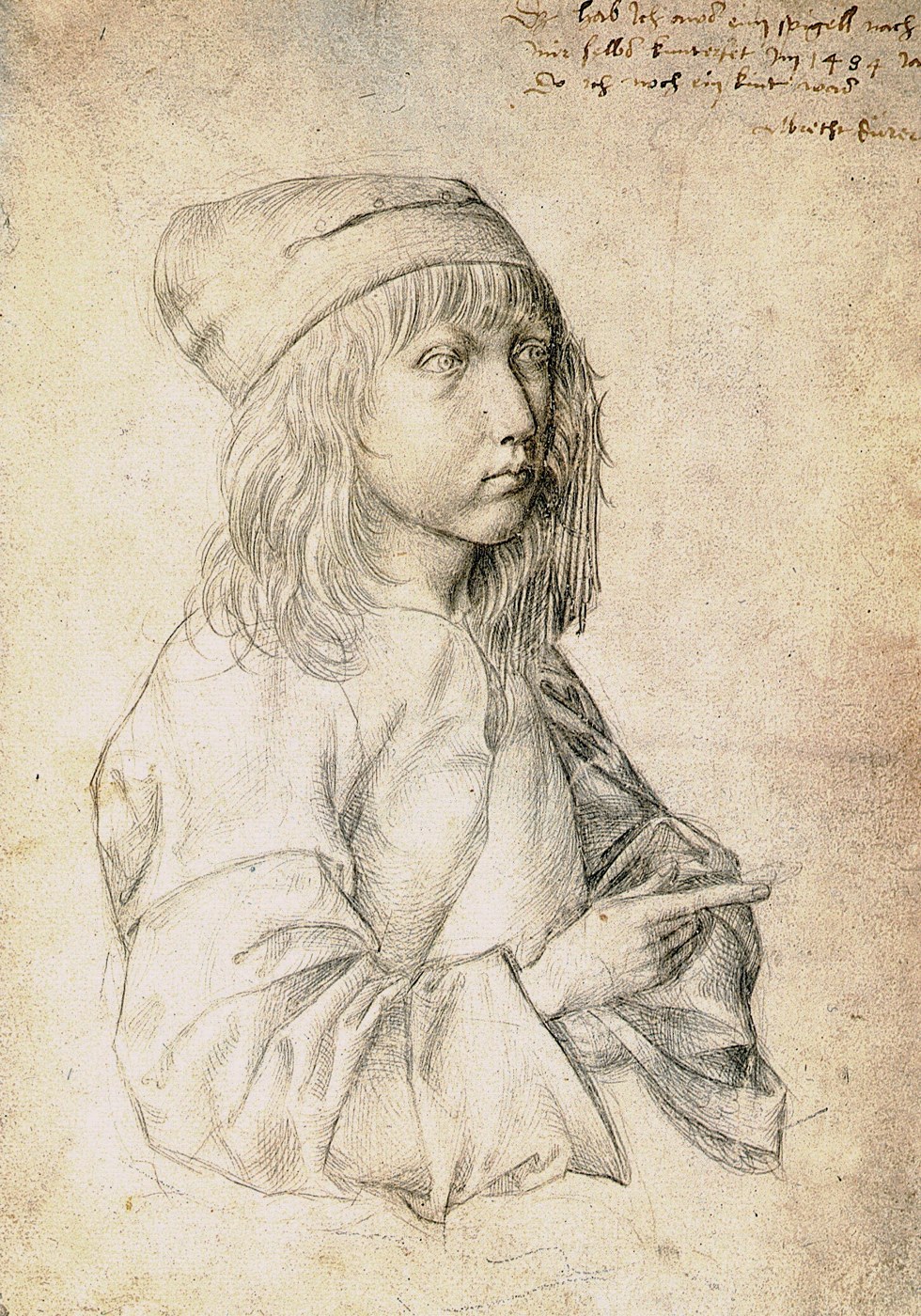
Image context: the article now uses Dürer’s thirteen-year-old silverpoint self-portrait because it gives the medium a stronger visual charge: the line remains pale, but the contour has already made its decision. The cover keeps the technique grounded in a real metalpoint drawing rather than a decorative studio image.[4]
The drawing starts before the drawing
The National Gallery's exhibition overview gives the core technical fact plainly. Metalpoint uses a pointed metal stylus on a surface that has been specially coated so the metal can catch and remain behind as a line.[1] That sequence matters because it reverses an assumption many viewers bring to drawing. With graphite, ink, or chalk, the sheet can often be taken as given. With silverpoint, the sheet is already part of the medium's engineering. The ground is not neutral support. It is the abrasive field that makes the mark possible.[1][2]
Getty's Art and Architecture Thesaurus definition sharpens the chemistry. When a silver mark is made on the prepared ground, the metal particles eventually tarnish into silver sulfide, darkening over time.[2] In other words, the line is not only deposited on the surface; it continues to age on the surface. Silverpoint is therefore a drawing medium that includes delayed transformation inside its basic logic.
This is one reason historical silverpoints are so often made on tinted or prepared sheets rather than on ordinary blank paper. The prepared surface gives the metal something to bite into, while the toned ground lets the artist balance the pale silver line with white heightening and the paper's midtone.[1][3] The British Museum's study sheet by Raffaellino del Garbo is a concise example: silverpoint, white heightening, blind stylus, and gray prepared paper all work together as one system rather than as separate effects.[3]
Silverpoint narrows the line so thought has to sharpen
The medium's difficulty is not only that it is hard to erase. It is also that the line itself stays relatively even. The National Gallery notes that, unlike pen or chalk, silver leaves a nearly uniform mark that does not vary dramatically in thickness or darkness just because the artist presses harder.[1] This creates a very different kind of drawing intelligence. Instead of relying on broad pressure swings, the artist has to build form through repetition, spacing, contour choice, and accumulation.
That is why silverpoint often rewards patience more than flair. A hasty line cannot easily be buried under a thicker correction. A weak contour keeps showing. A misplaced proportion does not dissolve into smudged atmosphere. The medium pushes the artist toward steadier looking because it grants fewer theatrical exits. Even when a silverpoint drawing feels airy, the airiness is earned through discipline.[1][4]
The Dürer sheet used here makes that visible from the other end of the medium's history. The 1484 self-portrait is a teenager's drawing, but it already depends on a severe contract: pale metalpoint line, prepared ground, and a contour that cannot be casually pushed around after the fact.[4] The image looks light because silverpoint is controlled, not because the drawing is hesitant. Dürer coaxes the face forward in narrow increments, accepting that subtlety has to carry the whole structure.[4]
The medium records time twice
Silverpoint ages in two different senses. First, it records the artist's working tempo. Because the line resists revision, the order of attention matters: where the contour locks, where the hatching thickens, where the hand hesitates and returns. Second, it records chemical time after the drawing leaves the studio. The silver does not remain exactly as it first appeared. Getty's note on tarnish and the National Gallery's discussion of oxidation both remind us that the mark is a small metal event still unfolding after the hand has stopped.[1][2]
That slow shift helps explain the medium's special emotional temperature. Fresh silverpoint can look cool and pale. Older silverpoint often takes on a warmer, browner presence.[1][2] The drawing therefore accumulates time not only as style history or provenance, but inside the material of the line itself. What the viewer sees is partly an image and partly an afterlife of contact between metal, ground, and air.
This is also why silverpoint does not fit neatly into the stereotype of "fragile old drawing." The National Gallery emphasizes that the medium has practical advantages: it is portable, convenient, resistant to smearing, and durable enough for sketchbooks because the artist does not need wet ink or an inkwell.[1] The delicacy is real, but it sits on top of surprising physical stability. Silverpoint is exacting in use and durable in survival.
Why artists kept returning to it
The historical arc matters here. Interest in metalpoint peaked during the Renaissance, when artists including Leonardo, Raphael, and Durer used it seriously; then it revived in the nineteenth century and continued into modern practice.[1] That return is revealing. Silverpoint was not kept alive only by nostalgia. Artists came back to it because it offers a specific contract: in exchange for reduced tonal freedom and minimal erasure, it gives precision, permanence of contact, and a peculiar shimmering authority.[1][2]
That contract is visible in museum examples across centuries. In a Florentine workshop study such as the British Museum's sheet, silverpoint helps organize figure construction over a prepared middle tone.[3] In Dürer's early self-portrait, the same material becomes a test of self-description before oil-paint bravura enters the story.[4] The look changes, but the underlying bargain does not. Silverpoint keeps insisting that drawing is not merely expressive release. It is a disciplined agreement between eye, hand, surface, and time.
This is why the medium still matters now. It reminds viewers that delicacy can be structural rather than soft. A silverpoint line is light, but it is not casual. It has to be wanted in advance. The drawing commits early, and then lives with the decision.
Sources
- National Gallery of Art, "Drawing in Silver and Gold: From Leonardo to Jasper Johns" - exhibition overview on metalpoint technique, prepared grounds, tarnish, erasure limits, portability, and historical use from the Renaissance to the modern period.
- Getty Research Institute, Art & Architecture Thesaurus, "silverpoint (technique)" - definition noting drawing with silver on a prepared surface and the later formation of silver sulfide as the mark tarnishes.
- British Museum, "Studies for a Resurrection, with Christ rising from the tomb and hand studies" - object page describing silverpoint heightened with white, blind stylus, and gray prepared paper in a late fifteenth-century Florentine drawing.
- Wikimedia Commons, "File:Durer-self-portrait-at-the-age-of-thirteen.jpg" - file page for Albrecht Dürer’s 1484 silverpoint self-portrait used as the article image.