Kara Walker's A Subtlety looked, at first, like a monumental contradiction: a dazzling white sphinx-woman installed inside a dark, molasses-stained Brooklyn sugar refinery that was about to be redeveloped.[1][2] The visual shock was immediate, but the work's deeper pressure came from how slowly that contradiction turned. Sweetness, whiteness, industrial ruin, racial caricature, and visitor desire all occupied the same room. The installation did not ask sugar to symbolize history from a safe distance. It made sugar behave like history's residue.
Creative Time presented the project in 2014 at the former Domino Sugar Factory in Williamsburg, and Art21 described it as Walker's first large-scale public project.[1][3] That location was not neutral shelter. The Institute for Public Art's case study ties the refinery to the growth of the sugar industry, noting that Domino's nineteenth-century factory became a major player in refining sugar for the United States.[2] Walker's sculpture therefore entered a building already saturated with labor, extraction, trade, and local redevelopment pressure. The artwork did not simply sit in a factory. It used the factory as part of its grammar.
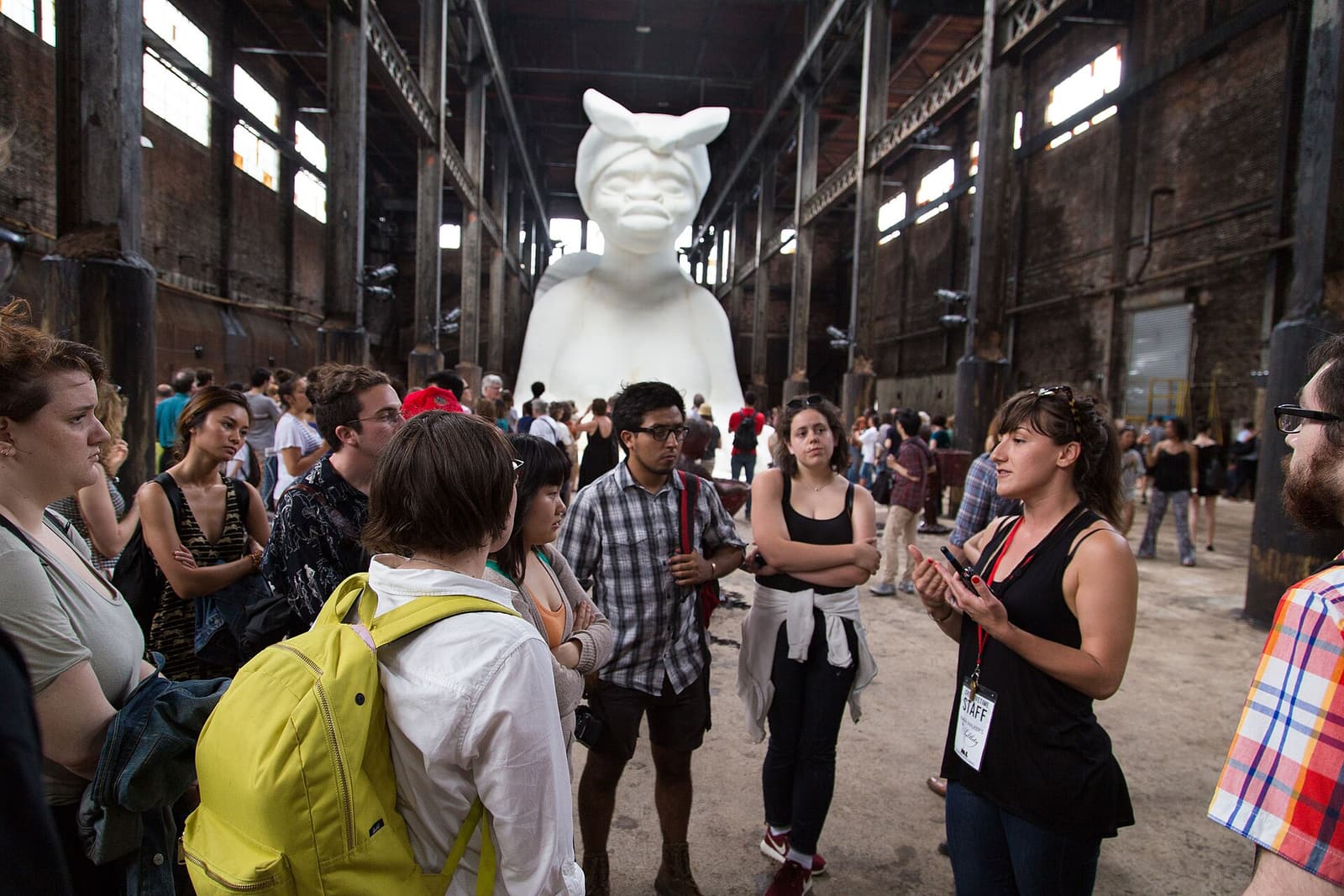
Image context: the cover image is a real photographic record from the 2014 installation, not a diagram, chart, or generated visual. The people in the foreground matter as much as the sculpture in the background because the piece's meaning changed through public viewing, photography, and the body's scale against the industrial hall.[5]
White sugar made purity look manufactured
The central figure of A Subtlety was enormous: roughly 35 feet high and 75 feet long, built around a polystyrene core and coated with about 80,000 pounds of sugar.[2] Those numbers matter because they keep the work from becoming a purely metaphorical object. Sugar was not just a theme. It was mass, surface, smell, and glare.
Walker chose a material whose cultural meanings contradict its production history. Refined white sugar carries a fantasy of cleanliness: crystalline, edible, domestic, celebratory. The factory setting pulled that fantasy apart. Brown industrial residue, demolition dust, and the long history of cane labor sat around the white surface like an accusation.[1][2][3] The sculpture made "purity" look like an effect produced by refining, whitening, and forgetting.
That is why the sphinx form mattered. A sphinx traditionally implies monumentality, riddle, guard, and ancient authority. Walker fused that authority with the racist visual language of the Mammy archetype and with exposed sexualized anatomy.[2] The result was not a simple inversion in which an insult became noble. It was more unstable than that. The figure dominated the room while also exposing the violence of the terms through which Black female bodies have been made visible, consumed, joked about, desired, and disciplined.
The factory kept the work from becoming pure spectacle
The Domino site made the installation unusually hard to detach from infrastructure. A museum gallery might have made the sugar sphinx feel like a contained sculpture about representation. The refinery made it feel like a temporary occupation of an economic system.[1][2] The work's whiteness was surrounded by the place where whiteness had been industrially manufactured.
This is where Walker's earlier silhouette practice helps explain the leap in scale. MoMA's collection text on Gone describes how Walker transformed the eighteenth-century cut-paper silhouette into a sharp vehicle for historical violence, racial stereotype, and epic history painting.[4] A Subtlety shifts that logic from wall to site. Instead of black figures on white walls, Walker gives viewers a white figure in a brown-black factory. The old silhouette contrast becomes spatial, architectural, and bodily.
The reversal matters. In the cut-paper works, the viewer reads flattened black forms against a gallery surface. At Domino, the viewer walked under and around an overlarge white body in a room where labor had left material traces. Walker did not abandon silhouette so much as expand its pressure. The outline became volume; the wall became factory; the polite distance of looking became a crowd moving through an unstable public event.[2][4]
The attendants made melting part of the argument
The sphinx was accompanied by smaller attendant figures based on racist souvenir forms of young servant boys carrying baskets or bananas.[2] The Institute for Public Art notes that these attendants were made of resin and candy, and that some were designed to melt during the exhibition.[2] That detail is not secondary. It prevented the installation from hardening into one heroic central image.
Melting made time visible. The attendants looked more vulnerable than the monumental sphinx, but they carried the sharpest physical reminder that sweetness is unstable. Candy softens, collapses, attracts handling, and loses form. In a work about sugar's historical violence, that instability mattered. It turned the decorative logic of confection into a record of exposure.
The attendants also complicated the visitor's route. A viewer could be overwhelmed by the giant white sphinx and miss the smaller bodies that made service, transport, and consumption legible around her. Walker's scale hierarchy was therefore moral as well as visual. Monumental attention collected around the main figure, while the laboring figures risked becoming peripheral. The installation made that risk part of the experience.
The viewers became part of the afterimage
The most uncomfortable afterlife of A Subtlety was not only critical debate about representation. It was the public behavior around the work. The Institute for Public Art records controversy over visitors using the installation as a stage for selfies and jokes, especially around the sexualized aspects of the sphinx.[2] That response did not sit outside the artwork like bad manners appended afterward. It confirmed how thoroughly Walker had built the piece around consumption.
Public art often hopes for civic encounter. A Subtlety got something harsher: encounter, appetite, mockery, fandom, documentation, discomfort, and spectacle all at once.[2][3] The smartphone crowd did not solve the work, but it revealed the conditions under which the work had to operate. A sugar-coated Black female body, made monumental inside a former refinery, was immediately folded into image circulation. The audience did not merely look at the sculpture. It helped produce the contemporary evidence of what the sculpture was about.
That is why the installation still matters after its physical disappearance. A Subtlety was temporary, but it left behind photographs, essays, production footage, and arguments about who was allowed to look, how they looked, and what pleasures were being repeated.[1][2][3][5] The work's afterimage is not a stable memory of one spectacular object. It is a troubled record of sweetness as material, industry as site, stereotype as form, and spectatorship as a test.
Walker turned sugar against itself. She used its whiteness, its commodity history, its decorative promise, and its bodily appeal to expose the labor and racial fantasy that refinement tries to erase. The result was not a monument to purity but a monument to the violence hidden inside purity's manufacture. Inside Domino's dark hall, sweetness stopped being innocent. It became evidence.
Sources
- Creative Time, "Kara Walker's A Subtlety" - official project page for the 2014 Domino Sugar Factory commission.
- Institute for Public Art, "A Subtlety" - case study on the work's site, dimensions, materials, attendants, and public controversy.
- Ian Forster, "The Making of Kara Walker's Sugar Sphinx," Art21 Magazine, May 23, 2014 - production context for the Domino Sugar Factory project.
- Museum of Modern Art, "Kara Walker, Gone: An Historical Romance..." - collection text on Walker's silhouette practice and historical critique.
- Wikimedia Commons, "File:New York Arts Practicum, A Subtlety.jpg" - 2014 photographic image used as the cover.