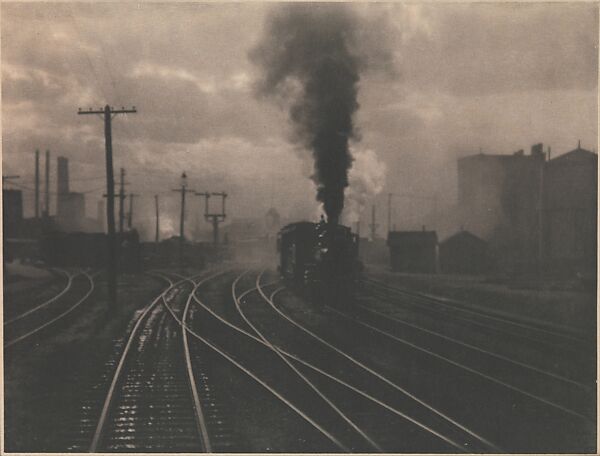
A locomotive pushes a dark plume into a pale sky. Below it, rails curve and divide; telegraph poles keep their uneven rhythm into the distance. Alfred Stieglitz’s The Hand of Man makes a railway yard feel both precisely organized and difficult to see through. Smoke softens the machinery that produces it.
Stieglitz made the photograph in 1902, and it appeared in the first issue of Camera Work in January 1903. The Metropolitan Museum of Art’s impression, reproduced here, was printed in 1910.[1] That gap matters. The railway encounter and the sheet we look at belong to different moments, joined by a process that gave the image another material life.
The medium is photogravure. The visible image is carried by printing ink transferred from an etched plate.[2] Between camera and paper, the photograph has acquired depth in copper.
A gray becomes a depth
In traditional copperplate photogravure, a transparent positive controls the exposure of light-sensitive gelatin tissue. Light hardens the gelatin in proportion to exposure. The tissue is transferred to a copper plate prepared with a fine resinous grain; washing removes its backing and the unhardened gelatin, leaving a resist of varying thickness.[2]
That uneven protection governs the etch. Where the gelatin is thick, the etchant reaches the copper more slowly. Where it is thinner, the metal is attacked sooner. The resulting recesses have different depths and can hold different amounts of ink. Dark passages correspond to deeper ink-holding areas; highlights require less ink.[2]
This is the crucial translation: a difference in photographic tone becomes a difference in the plate’s capacity to carry ink. The V&A contrasts it with halftone reproduction, in which changing dot sizes supplies tonal variation.[2] Photogravure’s delicacy depends on a physically worked surface.
Think back to the smoke. Its uneven density asks a print to sustain many neighboring shades without turning them all into a single dark patch. A process capable of carrying those gradations gives the plume room to remain vaporous while the engine below it holds its weight.
The press completes the image
After etching, the plate is inked and its surface wiped, leaving ink in the recesses. Damp paper is placed against it and printed. Constance McCabe’s account for the National Gallery of Art describes the result as a continuous tonal range with a fine grain visible under magnification.[3]
The distinction between the plate and the impression is useful. Copper holds the reusable printing structure; paper receives one transfer from it. The camera has determined a view, but the photograph must still pass through the conditions of printing. Even before any deliberate alteration, its arrival on paper is a material event.
Photogravure also offered a way to circulate carefully made photographs. The National Gallery documents Stieglitz’s use of editions in Camera Notes, Camera Work, and 291, alongside larger photogravures prepared for exhibition in the early 1910s.[3] A magazine plate and a gallery print could share a photographic origin while offering different encounters with scale and setting.
Reproduction, in this case, carries its own ambition. Ink makes the image repeatable, while the quality of each impression remains available to attention. The process makes it possible to ask two questions together: how widely can this picture travel, and what kind of object will arrive?
Evidence at the edge
A separate photogravure of The Hand of Man at the Art Institute of Chicago makes the printer’s intervention unusually concrete. Its conservation report identifies patterned ink deposits at the upper corners as evidence that the plate was mechanically reworked. The researchers suggest that Stieglitz darkened the upper edge to adjust the composition.[4]
This finding changes how we might look at a border. An edge can participate in the distribution of darkness across the picture. It need not be merely the point at which a camera’s view stops. Here, the technical evidence supports a specific intervention; the proposed compositional purpose remains the researchers’ interpretation.
The same report describes a plate mark around the image and heavily compressed paper fibers inside it. Under magnification, ink rests directly on the paper surface without an intervening binder.[4] These observations belong to the Chicago impression, not automatically to every version of the photograph. They nevertheless make pressure and contact tangible: the sheet preserves evidence of how it met the plate.
A screen reproduction cannot fully convey that encounter. It can show the railway’s sweeping lines, but it flattens the difference between the image, the pressed paper, and the surrounding support. The museum’s material description restores something that a digital view leaves out.
Looking through ink
Return to the thin, bright lines of the rails. They remain distinct against the dark ground even as their curves gather near the engine. Then follow the smoke upward. Its changing density carries the eye away from the hard lines below. The photograph depends on the relation between these two kinds of description: the edge that stays firm and the darkness that spreads.
Knowing the process gives that looking another dimension. Those shades have passed through light-sensitive gelatin, resistance to etching, recesses in metal, and a transfer of ink. The chain does not explain away the image’s atmosphere. It locates some of the work required to make atmosphere survive as a print.
The railway is still there. So is the copper plate’s labor, held in the paper.
Sources
- The Metropolitan Museum of Art, Alfred Stieglitz, The Hand of Man, 1902, printed 1910 — object record, publication history, and image source; accession 49.55.9.
- Victoria and Albert Museum, “An A to Z of photographic processes,” photogravure section — gelatin resist, copperplate etching, tonal depth, and comparison with halftone.
- Constance McCabe, “Photogravures,” in Stieglitz’s Practices and Processes, National Gallery of Art, 2020 — inking, wiping, damp-paper printing, fine grain, and publication and exhibition formats.
- Art Institute of Chicago, The Hand of Man: Object Research, June 2016, pp. 1–2 — technical examination of accession 1949.850, including plate reworking, compressed fibers, and ink on paper.