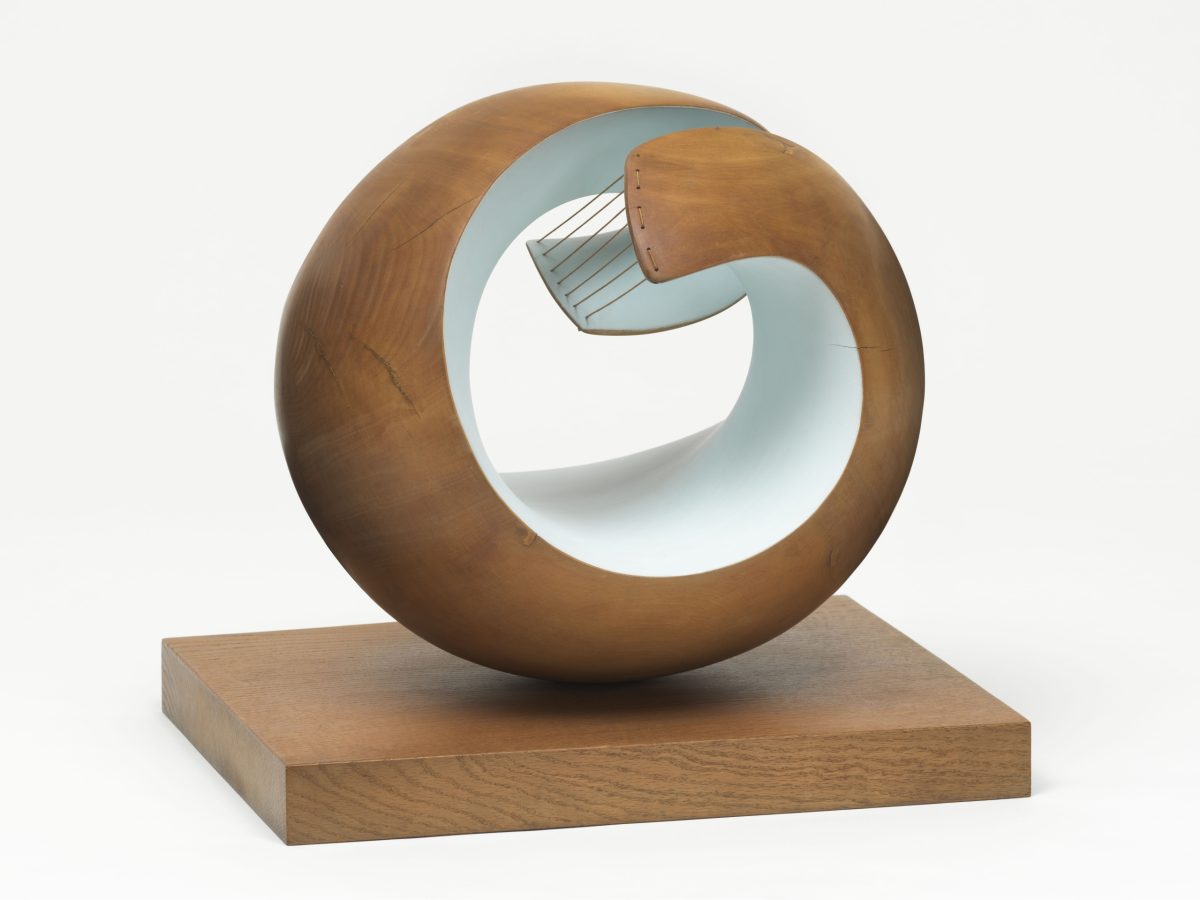
A few lengths of string cross the opening near the top of Barbara Hepworth’s Pelagos. They weigh almost nothing beside the wood, yet they change how the whole sculpture works. Follow the carved rim and the eye travels around a hollow. Follow a string and it cuts across that hollow, taking a shortcut through the air. The two routes belong to the same small object, and they never quite settle into one another.
Hepworth made Pelagos in 1946. Her official sculpture catalogue identifies it as BH 133, an elm carving with colour and strings in the Tate collection.[1] At 43 centimetres high and 46 centimetres wide, it has the scale of something we might lean towards rather than stand beneath.[2] That intimacy matters. The strings invite close inspection of a space too small for us to enter, but large enough for the imagination to occupy.
The sculpture rewards a simple experiment in looking: attend first to the wood, then to the painted interior, then to the lines suspended across it. Each gives a different account of where its surface lies.
The hollow has its own colour
The outer wood declares itself through grain. Its markings continue around the curved body, giving the eye evidence of a material that once grew. Along the opening, the carving turns inward. There, pale blue paint changes the terms of the encounter. The surface becomes more continuous in colour, and the grain no longer dominates our sense of it.
This is a small but consequential interruption. We can follow the physical continuity of the wood while feeling that the interior belongs to another environment. The edge works almost like a shoreline: it joins two conditions while making their difference clear. That is a reading of the visible form, rather than a claim that every contour reproduces a particular stretch of coast.
Hepworth’s own account gives colour an active role. In Carvings and Drawings (1952), remembering her wartime work, she described painted concavities as suggesting water, caves, and “shadows deeper than the carved concavities themselves”.[3] Paint could make a hollow feel more extensive than its measured depth.
Try holding that thought against the photograph. The hollow is plainly finite; its edges remain visible. Yet the pale interior offers the eye somewhere to linger, a different visual climate within the wooden shell. Colour does more than help us identify the surface. It changes the kind of space we imagine beyond the rim.
The Courtauld’s Hepworth in Colour, held from 12 June to 6 September 2026, placed Pelagos among works that made this aspect of her practice explicit.[4] Its emphasis on painted carvings and drawings gives a useful prompt for looking again: what happens if colour receives as much attention as the famous opening?
A bay becomes a relation
The coastal connection has a specific history. Alan Bowness’s account places Hepworth’s family at Chy-an-Kerris in Carbis Bay from July 1942 and her renewed sculptural activity in 1943. He links both Wave and Pelagos to the curve of St Ives Bay as she experienced it from her house.[5] This was a familiar view, available to repeated attention.
A sculpture cannot give us that view in the manner of a window. There is no horizon here to establish a spectator’s position, no sequence of landmarks by which to identify the shore. What it can do is bring enclosure and openness into a relation we feel while looking. The wood gathers around the hollow; the opening keeps that enclosure incomplete.
A shell is an inviting association, particularly when the eye follows the inward turn. But naming it too quickly can shorten the encounter. A shell explains the curl; it does less to explain why straight threads should stretch across it, or why the interior should receive a separate colour. Those decisions keep the sculpture from becoming merely a recognizable natural object.
The strings have their own connection to place. In the same 1952 recollection, Hepworth called them “the tension I felt between myself and the sea, the wind or the hills”.[3] The wording includes a person as well as a landscape. Her account concerns the relationship between them, and that offers a more useful way into Pelagos than hunting for an exact coastal likeness.
The strings make a surface you can see through
Look at the threads together. They suggest a fine screen across part of the opening, though the spaces between them leave the interior visible. The large lower opening stays clear; the threaded interruption gathers higher up, where two wooden edges approach one another. This is an unusual kind of surface: present enough to register, open enough to look through. The hollow acquires another boundary without being filled.
The difference between the strings and the carving is equally productive. The wood turns in a continuous curve. Each thread connects two points by a much more direct route. Seeing them together makes the distance between those points perceptible. We become aware of the interval as something with a shape, rather than merely the place where wood has been removed.
Imagine the same carving with its strings absent. The painted hollow would remain, but the eye would meet less resistance on its way inside. With the strings present, looking involves a small negotiation: we see the lines, see through them, then return to the curved surface behind. Nothing moves, yet our attention repeatedly changes direction.
This is why the strings deserve more than a passing resemblance to a musical instrument. Their work here is visible. They establish a delicate plane that the heavier carving cannot make by itself. Paint extends the imagined depth; string brings part of that depth forward, towards the opening.
Read this way, Pelagos offers the pleasure of a space held open and made tangible at once. Its materials keep their distinct characters: grain, pale colour, slender line. Follow them patiently and the empty centre becomes the busiest part of the sculpture.
Sources
- Barbara Hepworth official website, “Pelagos” — catalogue entry BH 133, date, materials, and Tate collection identification.
- The Hepworth Wakefield, “Pelagos,” Google Arts & Culture — object dimensions, medium, date, and Tate photograph credit.
- Barbara Hepworth, “Quotations from Barbara Hepworth’s Writings” — extracts from Carvings and Drawings (1952), chapter 4, on colour, concavities, strings, and landscape.
- The Courtauld, “Hepworth in Colour,” 12 June–6 September 2026 — exhibition context and official Tate photograph of Pelagos, including material and ownership credits.
- Alan Bowness, “Life and work,” Barbara Hepworth official website — Carbis Bay, the resumption of carving, and the connection of Wave and Pelagos to St Ives Bay.