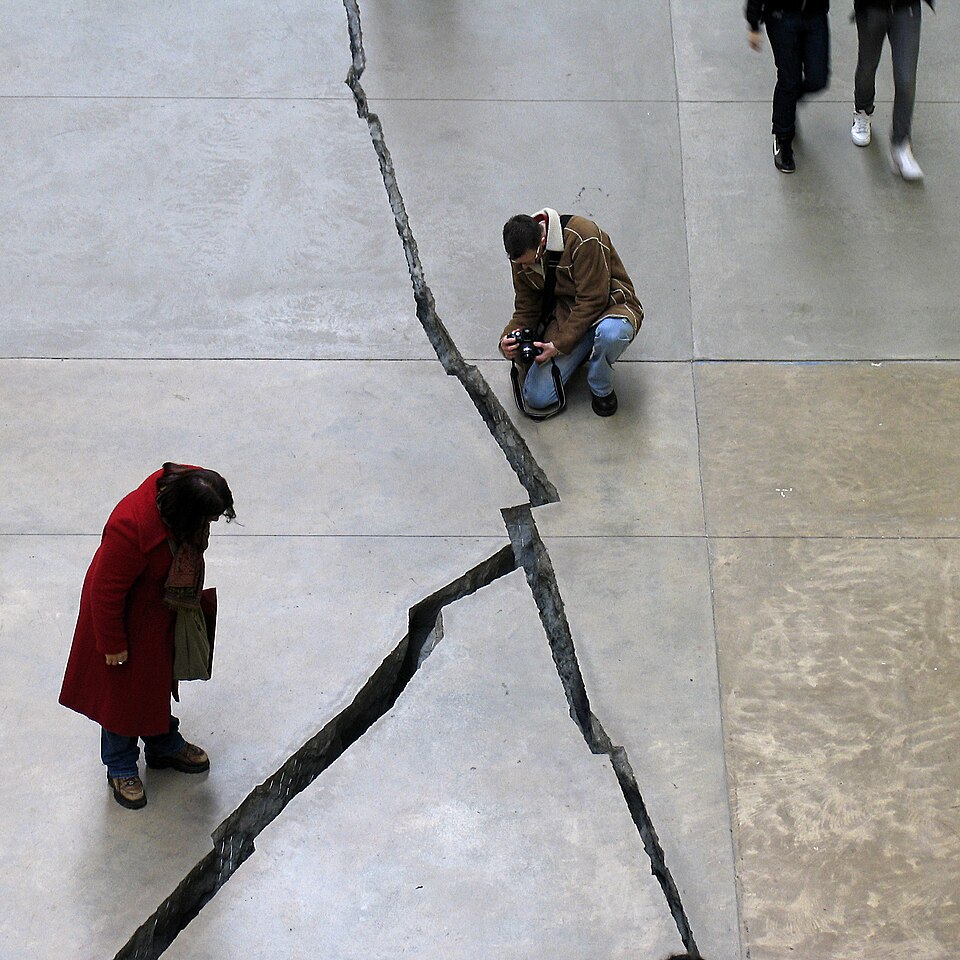
Doris Salcedo's Shibboleth began with an almost unacceptable simplicity: a crack across the floor. In 2007, for Tate Modern's Turbine Hall, Salcedo did not fill the vast industrial space with a sculptural object, a suspended spectacle, or a field of screens. She opened the floor itself. The work ran as a jagged fissure through the concrete, changing the hall from a neutral container into a surface that had been damaged, divided, and made articulate.[1][2][4]
That decision still matters because it reverses the normal museum contract. A visitor usually trusts the floor without thinking about it. The floor is support, infrastructure, the silent plane that lets attention rise toward the artwork. Shibboleth pulled that support into visibility. You could still walk through the hall, but walking now required attention. The body had to notice what the institution normally hides: that every public space rests on exclusions, histories, and thresholds that determine who moves easily and who does not.[1][4]
The photograph used here makes the point with unusual economy. People stand near the line but not quite inside it. Some lean toward it, some walk past it, some are caught at a distance where the crack looks both small and unignorable.[5] The image is not a clean documentation shot of a sculpture. It is a record of a social field reorganized by a cut.
The artwork is the wound and the route around it
Tate's archive records the exhibition as The Unilever Series: Doris Salcedo: Shibboleth, dated from October 9, 2007 to April 6, 2008.[2] The calendar matters because Shibboleth was not a permanent monument in the usual sense. It was a temporary intervention in a building already famous for absorbing large public commissions. Yet Salcedo's move was different from filling the hall. She made the hall unreliable.
Google Arts & Culture's record for Shibboleth I-IV, the photographic proposal prints connected to the project, gives a compact account of the method. The prints were made from real photographs of the Turbine Hall floor and developed as part of the proposal for an installation that would become a fracture in the floor itself.[1] That origin is revealing. Before the crack existed as construction, it existed as an imagined injury to an already photographed surface. Salcedo was not adding symbolic content to the building after the fact; she was identifying the floor as the artwork's first political material.
This is why the piece resists being reduced to an optical stunt. A crack is visually dramatic, but drama is not the main mechanism. The work made visitors choose distances, angles, and routes. It created a small choreography of caution in a room built for confident circulation. The split did not merely represent division. It made division operational. Viewers encountered the artwork as a condition underfoot, not as an object safely ahead of them.
Salcedo's practice gives absence a material body
Shibboleth belongs to a larger practice shaped by testimony, mourning, displacement, and the afterlife of violence. The Guggenheim's retrospective material describes Salcedo's sculptures and site-specific interventions as works that avoid direct representation of atrocity, using disarming materials and labor-intensive techniques to give form to absence, lack, and communal mourning.[3] That language is useful because it keeps the emphasis on form. Salcedo's work does not simply point toward suffering as subject matter. It asks what kind of material can carry the pressure of something that cannot be repaired.
Her earlier and later works often use domestic or bodily traces: furniture, shoes, shirts, thread, hair, tables, rose petals, concrete, steel. The Guggenheim release places those materials inside a sustained effort to address social injury without turning injury into spectacle.[3] In that context, the floor crack in Shibboleth becomes less anomalous. It is another vessel for absence, only scaled to architecture. The domestic object has become the museum floor; the private wound has become a public route.
That shift in scale is crucial. A chair filled with concrete can suggest a life immobilized by grief. A shoe behind a translucent membrane can suggest a person who has disappeared from view. But a crack in the Turbine Hall floor makes the viewer stand inside the metaphor. The damage is not only seen. It interrupts the body's ordinary trust in space.[1][3][4]
The border is not at the edge of the room
The title Shibboleth points toward a word that separates insiders from outsiders, a test of belonging carried by pronunciation, recognition, and social power. Salcedo's installation translated that logic into architecture. The border was not placed at Tate's doorway, at passport control, or at the edge of a nation. It appeared in the middle of a prestigious cultural room, exactly where the visitor expected openness.[1][4]
That placement is what gives the work its force. Many museum installations about migration or exclusion risk keeping the problem elsewhere: on a map, in a documentary image, in a distant tragedy the viewer can acknowledge without being spatially implicated. Shibboleth refused that distance. The crack ran through the shared floor and made difference feel like a structural fact. The Guardian's 2025 interview frames the 2007 work as a jagged fissure 548 feet long and connects it to Salcedo's broader concern with colonial history, migration, and the divisions that produce "us and them" thinking.[4] The number helps, but the important thing is the location. The fissure occupied the common ground.
There is a severe intelligence in that choice. A border often presents itself as a line between two sides, but Salcedo's crack behaves more uneasily than that. It is not a clean stripe. It widens, narrows, splinters, and produces edges that cannot be crossed without noticing. The work therefore avoids the false comfort of symmetry. It does not say that two equal sides have drifted apart. It suggests a deeper fracture in the foundation that was already there before anyone chose to look down.[1][4]
The sealed crack is still part of the work
When the exhibition ended, the crack was sealed. Google Arts & Culture's account notes that it remained under the Turbine Hall floor as a lasting scar, a buried reminder of the people a culture refuses to acknowledge.[1] That afterlife may be the work's most powerful formal decision. The piece did not end by disappearing cleanly. It left a repaired surface with memory underneath.
This matters because repair can become another form of denial. Institutions often prefer closure: the exhibition ends, the floor is fixed, the room returns to ordinary use. Salcedo's work makes closure unstable. A sealed crack is not the same as an unbroken floor. The repair tells a second story about what public culture does with harm. It covers, stabilizes, and continues to function, while the prior fracture remains part of the building's history.[1][2]
That is why Shibboleth still feels current after its physical run. The work understands that many social wounds persist in exactly this form: not as open disaster every day, and not as healed ground either, but as a buried line that shapes movement, memory, and institutional self-description. The museum can keep operating. The scar can stay beneath the surface. Both facts belong to the same artwork.
Why the floor still argues
The durable lesson of Shibboleth is that public space is never only space. It is a contract, and contracts have hidden terms. Salcedo's crack made those terms visible by damaging the one plane everyone had to share.[1][4] That is why the work is stronger than a statement placed on a wall. A wall text can explain exclusion. A floor crack can make the viewer feel how fragile the promise of shared ground has always been.
The piece also clarifies something about political art at its best. It does not become powerful by delivering a louder message. It becomes powerful by finding the one material decision that reorganizes perception. In Shibboleth, that decision was to treat the museum floor as an archive of violence, passage, denial, and repair. The crack did not illustrate history. It made history pass through the soles of visitors' feet.
That is the reason the photograph remains more than documentation.[5] It shows an artwork that refuses to stay at eye level. It asks the viewer to look down, adjust step, and accept that the ground of culture has never been smooth.
Sources
- Google Arts & Culture, "Shibboleth I-IV" - object page for Salcedo's 2007 proposal prints and project context.
- Tate Archive, "The Unilever Series: Doris Salcedo: Shibboleth" - public-record entry with exhibition dates and poster record.
- Solomon R. Guggenheim Museum, Doris Salcedo press release PDF, 2015 - retrospective context on social injury, absence, mourning, and major bodies of work.
- Tim Adams, "'Most of my work is a response to war': Colombian artist Doris Salcedo on violence, Trump and her crack in Tate Modern's floor," The Guardian, January 11, 2025.
- Wikimedia Commons, "File:Shibboleth - Tate Modern 2007.jpg" - source page for the 2007 installation photograph used as this article's image.