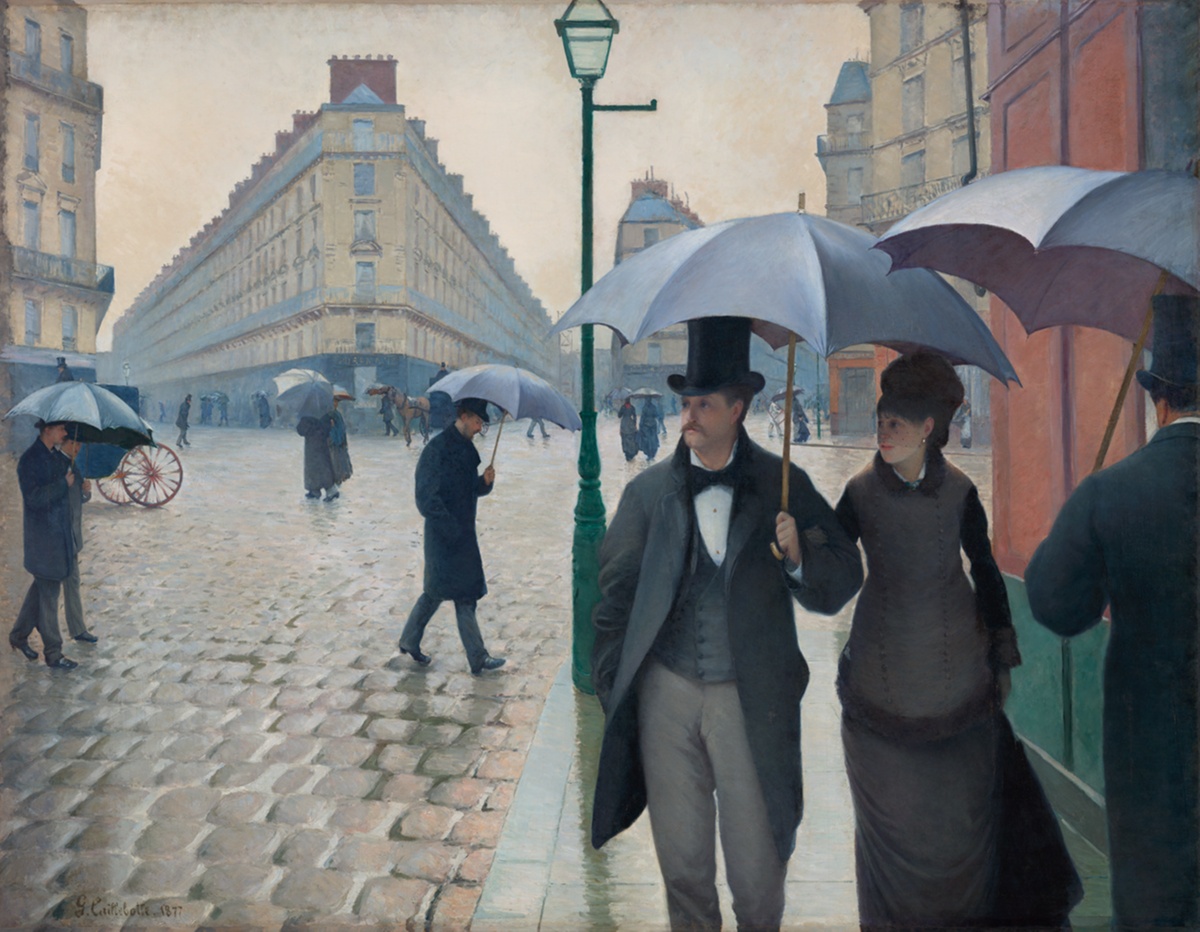
Gustave Caillebotte's Paris Street; Rainy Day does not feel modern simply because it shows umbrellas, bourgeois dress, and a newly rebuilt Paris intersection. It feels modern because the painting makes urban life look coordinated without ever making it look intimate.[1][2][3] The figures are almost life-size, the space is rigorously plotted, and yet nobody truly meets anybody else. Caillebotte turns proximity into distance. That is the picture's deepest achievement.
The Art Institute of Chicago's record places the scene near the Saint-Lazare station and stresses how the district had been transformed by Baron Haussmann's rebuilding of Paris during the artist's lifetime.[2] Britannica's overview adds the larger art-historical point: the canvas merges modern subject matter with a pictorial order that is neither purely academic nor purely flickering Impressionist atmosphere.[3][4] Put those together and the painting starts to read less like a street scene and more like an urban operating system. Weather, paving, dress, sightlines, and crowd spacing all work together to produce a city of disciplined circulation.
1) The scale is the first surprise
The Art Institute's object data gives the painting at 212.2 by 276.2 centimeters, just over seven by nine feet.[1] That size matters immediately. Reproductions flatten the work into a handsome Paris postcard, but in person the foreground couple arrives at something close to bodily encounter. The man in the top hat and the woman at his side do not behave like miniature staffage; they enter your space with the authority of actual passersby.
This is where the painting's psychological structure begins. Life-size scale usually increases empathy. Here it increases estrangement. The couple is near enough to register as social equals, but their expressions do not open toward the viewer. They move through the picture with the sealed composure of people already committed to their destination. Caillebotte gives you the sensory conditions of encounter while withholding the social rewards of encounter.
2) The lamppost does not divide the scene; it calibrates it
Many first readings of the picture notice the black lamppost near the center and treat it as a compositional split. That is true, but incomplete. The pole does not merely divide left from right. It measures the entire field.[2][3] It tells you where the pavement turns, where the umbrellas change spacing, where the foreground couple gains visual weight, and where the farther figures begin to thin into urban pattern.
Because the pole is slightly off the canvas center, the whole scene feels stable and unsettled at once. The geometry is exact, but it never becomes ceremonial. That off-centeredness is crucial. A fully symmetrical city would read as authoritarian display. Caillebotte instead gives a city whose order is real but lived through drift, sidestep, and interruption. The painting's perspective is disciplined enough to hold the crowd together and flexible enough to let modern life feel contingent.
This is one reason the canvas still feels current. Contemporary cities rarely appear to us as grand plans in the abstract. They appear as local negotiations inside systems that are already in force. Paris Street; Rainy Day understands that difference.
3) Rain is not atmosphere here; it is social choreography
The weather in this painting is often described as mood. It is more exact to call it a coordination device.[2][3] The wet pavement sharpens reflections and keeps the ground plane legible. Umbrellas create portable zones around each figure, setting the rhythm of distance between bodies. Coats, hats, hems, and the broad boulevard all register as practical answers to rain, but together they do something larger: they turn the city into a pattern of moving enclosures.
That is why the picture never dissolves into soft Impressionist weather. Caillebotte uses rain to make boundaries clearer, not blurrier. Each person carries a small climate. Each umbrella marks a private radius. Even when bodies cross the same intersection, they remain enclosed within separate units of movement. The result is a vision of urban modernity in which public space expands at the same moment private space becomes portable.
4) The painting makes class visible through ease, not spectacle
Britannica and the Art Institute both emphasize the modern fashions of the pedestrians and the broad new boulevards produced by Haussmannization.[2][3] Caillebotte, who was academically trained and financially independent enough to support fellow Impressionists, knew exactly what world he was painting.[4] Yet the canvas does not present bourgeois life as triumphant pageantry. Its class confidence appears through effortlessness.
Nobody in the scene seems hurried, burdened, or theatrically self-announcing. The wealth is in the cut of the coats, the cleanliness of the boulevard, the fact that everyone seems to know how to move here. This is one of the painting's sharpest observations: class power in the modern city often appears as frictionless navigation. The people who belong do not need to declare that they belong. The street does it for them.
That is also why the farther figures matter so much. They are not background filler. They prove that the painting's social logic extends beyond the foreground couple. The whole intersection has learned the same code.
5) Why the picture stays slightly cold
For all its beauty, Paris Street; Rainy Day keeps an emotional reserve that viewers often register before they can name it.[2][3] Part of that reserve comes from the faces, which do not invite narrative intimacy. Part comes from the boulevard itself, which is broad enough to let movement happen without collision. But the deepest source is structural: the painting is organized around coexistence, not communion.
That distinction matters. Plenty of nineteenth-century city pictures celebrate bustle by implying contact, exchange, flirtation, or crowd energy. Caillebotte gives something quieter and harder. He gives co-presence under shared conditions. Everyone is exposed to the same weather and uses the same new street, but each pedestrian remains socially sealed. Modern life becomes visible not as mass excitement, but as parallel solitude.
Seen this way, the painting's greatness lies in how little it exaggerates. It does not need melodrama to describe an enormous historical shift. Haussmann's rebuilt Paris, new consumer goods like the retractable umbrella, the habits of the bourgeois promenade, and a freshly widened field of urban visibility are all here.[2][3] Caillebotte simply shows that modern order can feel elegant and lonely at the same time.
If you are standing in front of the canvas, one viewing sequence works especially well:
- Start with the foreground couple and register the near-life scale.[1]
- Move to the lamppost and the paving geometry that meters the scene.[2]
- Finish by scanning the umbrella intervals across the boulevard and notice how weather becomes spacing.[2][3]
Read in that order, Paris Street; Rainy Day stops being a famous Impressionist street scene and becomes something more exact: a painting about how a modern city teaches strangers to share a surface without ever fully sharing a life.
Sources
- The Art Institute of Chicago API, Paris Street; Rainy Day (object metadata: date, dimensions, medium, artist, and image record).
- The Art Institute of Chicago, Paris Street; Rainy Day (collection entry describing Haussmannization, scale, perspective, and the 1877 Impressionist exhibition context).
- Encyclopaedia Britannica, Paris Street; Rainy Day (formal summary, urban subject matter, and interpretive overview).
- Encyclopaedia Britannica, Gustave Caillebotte (biographical context on training, collecting, and relation to Impressionism).