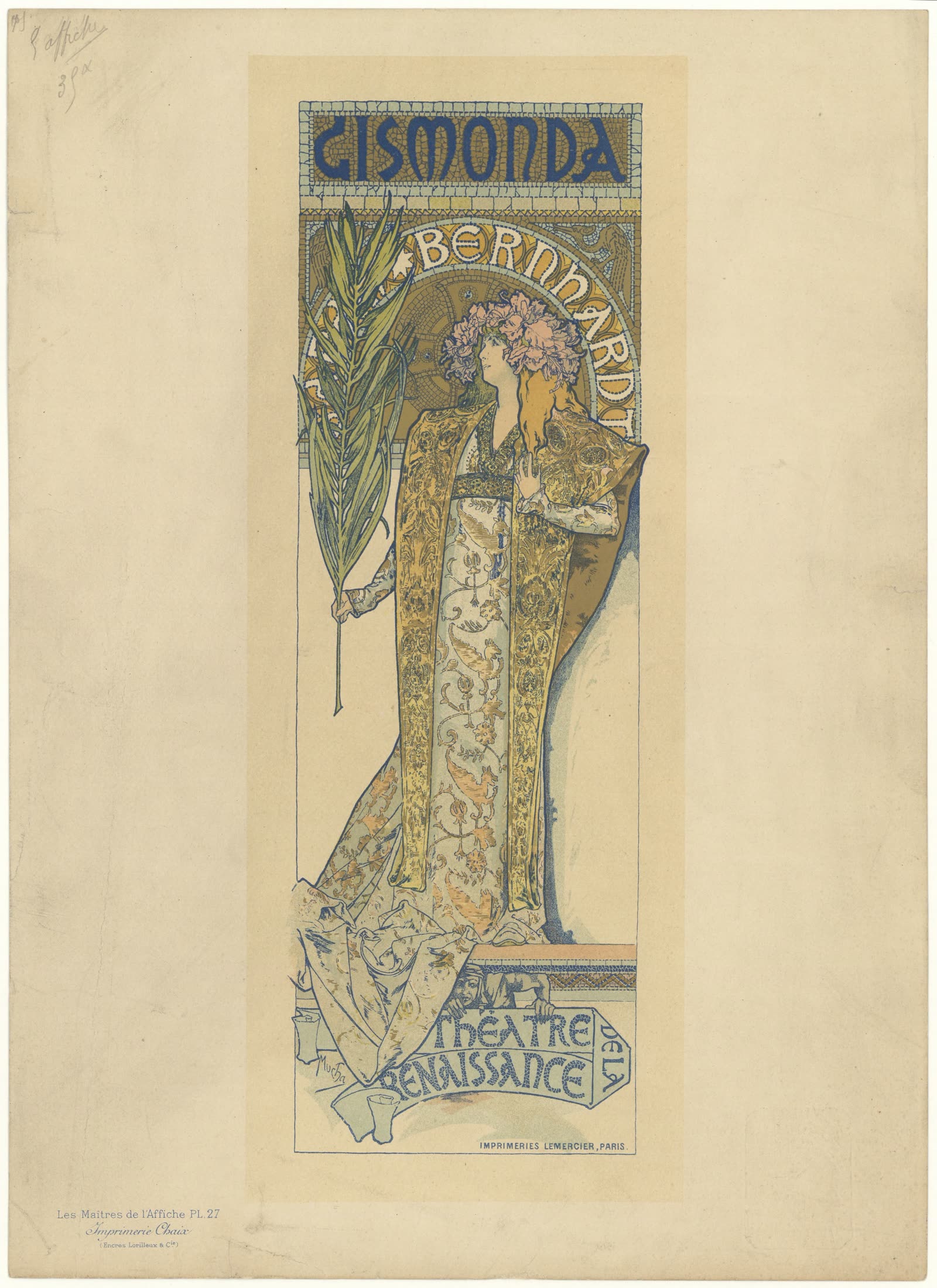
Art Nouveau is often reduced to a decorative reflex: lilies, curls, women with streaming hair, a little Parisian elegance at the edge of modern life. That reading is too small.[1][2][3] The movement's real achievement was infrastructural. Between the 1880s and the First World War, it taught line to do more than ornament an object. Line began to organize posters, furniture, ironwork, jewelry, interiors, and even the thresholds through which a city moved each day.[1][2][4] In that sense, Art Nouveau was not just a style you looked at. It was a style that tried to redesign the conditions of looking and passing through space.
The image at the top, Mucha's Gismonda, matters for exactly that reason. It is a poster, but it does not behave like a disposable announcement. It behaves like a vertical environment: figure, halo, lettering, and border fuse into one continuous decorative field.[3][5]
1) The name came from a shop, but the ambition was larger
Museum summaries agree on the broad timeline. The Met places Art Nouveau from the 1880s until the First World War, with strongest force in applied arts, graphic work, and illustration.[1] The V&A adds that the movement emerged internationally under different names, with Brussels, Paris, and Munich among its key centers.[2] The label itself stuck through Siegfried Bing's Paris gallery Maison de L'Art Nouveau, yet the movement never belonged to one showroom or one nation.[1][2]
That matters because Art Nouveau was not a house style in the narrow sense. It was a coordinated refusal of tired historicism.[2] Instead of borrowing finished forms from older periods and pasting them onto new objects, artists and designers tried to make structure and decoration grow together. The V&A's international overview describes exactly that combination: natural forms, fluid line, asymmetry, and the integration of structure with ornament.[2]
So the movement's core wager was not "nature is beautiful." Its wager was that modern design could become continuous across media. A vase, a poster border, a balcony rail, and a shop interior might all belong to one visual grammar without collapsing into mere repetition.[1][2][3]
2) Posters taught the movement how to move
If Art Nouveau wanted public life rather than private connoisseurship, it needed a delivery system. The poster supplied one. Reproductive print gave the style speed, scale, and urban repetition.[1][2] This is why Gismonda remains such a useful image for the movement. The Mucha Museum's biography states that Mucha's first Sarah Bernhardt poster for Gismonda was an immediate sensational success and led to a six-year contract with the actress.[5] The V&A's essay on the whiplash line pushes the point into public behavior: collectors prized the poster so quickly that many examples were stripped from the streets.[3]
That detail is more than a colorful anecdote. It shows a structural change in where style lived. A poster hung in public before it entered a collection; it became fashionable precisely because it first worked as urban interruption. Art Nouveau therefore reached audiences not only through museums or elite rooms, but through repeated street encounters, periodicals, and printed surfaces that could be circulated faster than architectural commissions.[1][3][5]
The result was a new visual tempo. Instead of a single painting asking for one fixed encounter, the movement learned to operate through serial contact. You saw it on a wall, then in a magazine, then in a storefront, then at home in a decorative object whose curves rhymed with the poster you had already half-remembered.[1][2]
3) The famous whiplash was a structural tool
Art Nouveau's most recognizable motif, the whiplash curve, is easy to mock because it can look excessive in reproduction. The V&A's account is useful precisely because it restores force to the line. The whiplash was not just prettiness. It was an ornamental S-curve derived from botanical and natural studies, and it became a sign of freedom from older restraints.[3] The Met makes a similar point from another angle, tracing sinuous line back in part to botanical study and even deep-sea illustration.[1]
What matters is where that line appeared. The V&A follows it across architectural ironwork, decorative borders, textiles, glass, painting, jewelry, and American craft.[3] Once that spread becomes visible, the movement stops looking like a poster trend and starts reading as a systems project. The line is asked to do at least three jobs at once:
- attract the eye,
- connect structure and surface,
- make inert material feel as if it has internal growth.
That third task is the key one. Art Nouveau objects often seem alive not because they copy plants literally, but because their contours appear to have grown instead of being assembled. This is why the movement keeps feeling modern even when individual motifs age. It treated design as energetic continuity.[1][2][3]
4) Paris Metro entrances turned style into everyday infrastructure
The step from poster to city became unmistakable when the movement entered transit architecture. The Musee d'Orsay's 2024 presentation on Hector Guimard and the genesis of the Metro states the sequence plainly: after an unsuccessful competition in 1899, the Compagnie generale du Metropolitain asked Guimard to design station entrances, and he responded with deeply original accesses marked by organic silhouettes.[4] The same page notes that these entrances have become constitutive of Paris's image, as recognizable as Haussmann facades or the Eiffel Tower.[4]
This is the movement's strongest urban argument. Guimard's entrances did not sit inside a salon waiting to be chosen by a collector. They framed ordinary descent into the transport network. Commuters passed through a piece of Art Nouveau whether or not they intended to have an art experience that day. In one stroke, line became civic interface.[4]
That helps explain why French variants of the style could even be nicknamed Le Style Metro.[2] The phrase is not trivial. It captures the moment when decorative modernity stopped being confined to luxury goods and started shaping public thresholds, mobility, and city identity. Art Nouveau had moved from object to route.[2][4]
5) What the movement changed
By the time the 1900 Paris Exposition Universelle amplified Art Nouveau to an international audience, the movement had already shown its underlying model: style could scale across print, object, architecture, and circulation.[2] That model did not last unchanged. Later modernisms would harden geometry, simplify surfaces, or break more aggressively with ornament.[1][2] Yet Art Nouveau had already altered the design imagination.
Its deepest legacy is not the flower or the curl by itself. It is the claim that a modern visual language can migrate without losing identity. One line can begin as a poster border, continue as jewelry, reappear as ironwork, and end by shaping how people enter a train station.[1][3][4]
If you want to read the movement clearly now, begin with one question: where is the line only decorating, and where is it quietly organizing how a body moves, pauses, and looks? Art Nouveau still sharpens at that point of transition. It mattered when style stopped sitting inside the frame and began to script the city around it.[1][2][4]
Sources
- The Metropolitan Museum of Art, Art Nouveau (timeline overview, international spread, Bing's gallery, and the movement's graphic/applied-arts emphasis).
- Victoria and Albert Museum, Art Nouveau - an international style (movement overview, national variants, 1900 Paris Exposition, and the integration of structure with decoration).
- Victoria and Albert Museum, The Whiplash (the line's formal role, natural-world derivation, and the public impact of Mucha's Gismonda poster).
- Musee d'Orsay, Hector Guimard et la genese du Metropolitain (1899 commission context and why the Metro entrances became part of Paris's image).
- Mucha Museum, Biography (the immediate success of the first Sarah Bernhardt Gismonda poster and its career impact for Mucha).