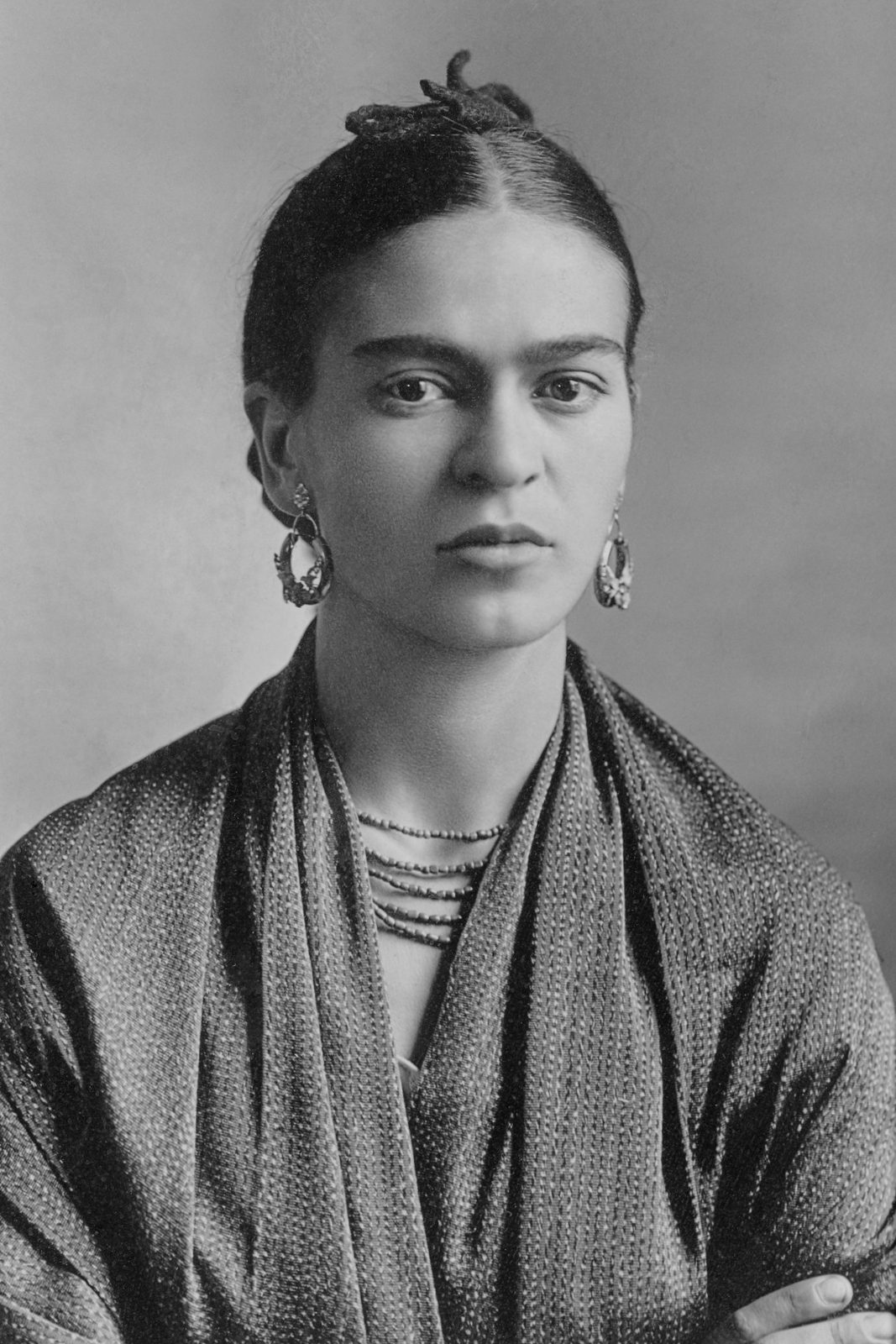
Frida Kahlo made fifty-five self-portraits out of 143 known works. She did not paint herself because no one else would sit for her. She painted herself because the self-portrait was the most precise instrument available for the kind of argument she needed to make — about pain, about the body as a site of historical and personal record, about what it means to be a Mexican woman looking back at a world that was deciding what to do with her.[1]
The circumstances of a studio
She was born Magdalena Carmen Frida Kahlo y Calderón in Coyoacán, a village then on the southern edge of Mexico City, in July 1907.[1] At six she contracted polio, which left her right leg slightly thinner than the left and produced a limp she would carry all her life. In September 1925, at eighteen, the bus she was riding was struck by a streetcar.[2] The collision fractured her spinal column in three places, her collarbone, two ribs, her right leg in eleven places, and her pelvis. An iron handrail punctured her body. She would spend more than thirty reconstruction surgeries across her life attempting to repair the damage, and she would live in almost continuous pain until her death at forty-seven.
Her mother had a special easel constructed so she could paint lying down. A mirror was fixed to the ceiling above the bed. The self-portrait, in these early years, was in part a practical solution: the subject was the one thing she had constant access to.[3] But it became something else. Looking at the Kahlo self-portraits in sequence, from the careful 1926 Self-Portrait in a Velvet Dress onward, what emerges is not narcissism but a sustained inquiry — each painting a different reading of the same instrument.
What the self-portraits do
The paintings share a set of formal strategies that only become visible when you notice how consistently Kahlo deploys them. The gaze is frontal and still. The face does not smile. The background is compressed — jungle growth, open sky, symbolic objects — rather than receding spatial depth.[1][3] These are not the psychological interiors of Rembrandt's self-portraits, where light models volume and the canvas creates an illusion of looking into a room. Kahlo's backgrounds press forward. The figure and the world around it are equally surfaced.
This flatness is deliberate and has a specific art-historical source. Kahlo drew heavily on the Mexican retablo tradition — small devotional paintings made on tin, typically commissioned by ordinary people to give thanks for miraculous intervention after illness or accident.[2] The retablo format places the depicted event in the upper portion and a brief explanatory text in the lower. It is not illusionist; it is declarative. Kahlo adapted this grammar to the self-portrait, using it to give her paintings the quality of testimony: this happened to this body. The text panel is often absent in her work, but the evidential logic of the retablo — the sense that a painting is a record and a petition simultaneously — runs through the whole sequence.
The iconography she layered onto this structure came from two directions: pre-Columbian Mexican culture and her own symbolic inventory. Monkeys appear repeatedly, both as symbols of lust in colonial iconography and as pets she kept at the Casa Azul. Hummingbirds carry luck in Mexican folk belief. Deer and the iconography of wounding — The Wounded Deer (1946) shows her face on a deer's body pierced by arrows — translate chronic physical pain into a vocabulary that the viewer can read without requiring biographical knowledge of the spinal surgeries.[3][4]
Tehuana dress and the question of identity
Kahlo's characteristic appearance — the elaborate Tehuana costumes, the braided hair adorned with ribbons and flowers, the pre-Columbian jewelry — is sometimes read as folk costume or feminist statement, and it was both, but it was also something more specifically political.[1] The Tehuantepec region of Oaxaca had a matrilineal social structure and a tradition of women's economic and cultural authority. By wearing Tehuana dress in Mexico City and later in New York and Paris, Kahlo was making a claim about which Mexico she belonged to and which Mexico she thought was worth taking seriously — not the European-assimilated urban culture of the political class, but an indigenous material and spiritual tradition that modernization had been systematically marginalizing.
Diego Rivera, whom she married in 1929 — and divorced in 1939, and remarried in 1940 — encouraged the Tehuana dress partly because he found it beautiful and partly because it aligned with his own political program of Mexican muralism and indigenismo.[2] But Kahlo's use of it was not derivative. It was the visual frame for her particular argument, and it became, in the later self-portraits especially, an instrument for examining the relationship between costume and identity: what you put on the body as a declaration, what the body requires independent of what you put on it.
The Two Fridas and the divorce year
The largest canvas Kahlo ever completed, The Two Fridas (1939), was painted in the year her first marriage to Rivera ended. Two versions of herself sit side by side: one in Tehuana dress with a heart that is whole, one in a European Victorian dress with a heart that is cut open and bleeding.[1][4] A thin vein connects them; the European Frida holds surgical clamps that have stanched but not stopped the flow. The painting has been read as autobiography — the Mexican self and the European self, the self loved and the self abandoned — and Kahlo herself said it emerged from loneliness. But it is also a painting about the problem of division: how a person can contain versions of themselves that do not connect cleanly, and what the cost of that division is made visible.
It was in this period that André Breton, the French Surrealist theorist who visited Mexico in 1938 and met Kahlo through Rivera, declared her work Surrealist. She rejected the designation with the sentence that has been quoted ever since: "I never painted dreams. I painted my own reality."[2] The distinction matters. Surrealism was organized around the unconscious, around disrupting the rational surface of bourgeois life from below. Kahlo's imagery was not eruptive from an unconscious she didn't control — it was a deliberate visual vocabulary she had built and deployed with precision. The strangeness of her paintings is earned strangeness, not a release valve.
The Broken Column
In 1944, following a spinal fusion surgery, Kahlo painted The Broken Column.[3] She is depicted in a medical corset, her torso open to reveal a crumbling Ionic column in place of her spine, her body pierced from shoulder to pelvis with nails of the kind used in pre-Columbian ritual sacrifice imagery. She stands in a cracked, arid landscape. She is crying, though the expression on her face is not one of appeal — it has the same stillness as all the self-portraits, the same refusal to ask the viewer for anything in particular.
This is the painting that most clearly establishes what Kahlo was doing with pain as a subject. Pain in her work is not dramatized for effect or aestheticized into martyrdom. It is documented. The nails are specific and numerous. The corset is real — she wore orthopedic corsets for most of her adult life, and several decorated ones survive in the Casa Azul. The broken column is anatomically located. The painting is not asking you to feel what she felt; it is asking you to see what was there.
Recognition, the Casa Azul, and the later years
Her first solo exhibition in Mexico did not open until 1953, one year before her death — forty years old at the time of her first New York show at the Julien Levy Gallery in 1938, where her work drew serious attention and several sales.[1][4] The Louvre acquired one painting following her 1939 Paris exhibition; she was the first twentieth-century Mexican artist to enter the collection. But the larger international recognition came slowly and unevenly, shaped partly by Rivera's greater institutional prominence and partly by the difficulty of placing her work in existing categories.
She died on July 13, 1954, at the Casa Azul in Coyoacán — the blue-painted house where she was born, which is now the Museo Frida Kahlo.[4] The cause of death was officially listed as pulmonary embolism; some accounts suggest a deliberate overdose. Her diary entry from the final days reads: "I joyfully await the exit — and I hope never to return." She was forty-seven.
The posthumous Kahlo is complicated. The face has become an icon, reproducible on bags and phone cases and gallery posters in a way that sometimes obscures the work itself. The biography — the accident, the surgeries, the marriages, the politics — gets narrated so often that the paintings can begin to seem like illustrations of events rather than arguments in their own right. The corrective is to look at the paintings directly and notice how much formal intelligence is operating in them: the compression of space, the precision of the iconography, the quality of the gaze that never softens, never asks, never explains itself more than it has already decided to.
Sources
- Wikipedia, Frida Kahlo — biographical timeline, major works, and critical reception overview.
- The Museum of Modern Art, artist record: Frida Kahlo — collection holdings and contextual notes.
- Harry Ransom Center, University of Texas at Austin: Frida Kahlo: Art, Garden, Life — object notes on Self-Portrait with Thorn Necklace and Hummingbird and related works.
- Museo Frida Kahlo (Casa Azul), official site — collection context, biography, and Casa Azul history.