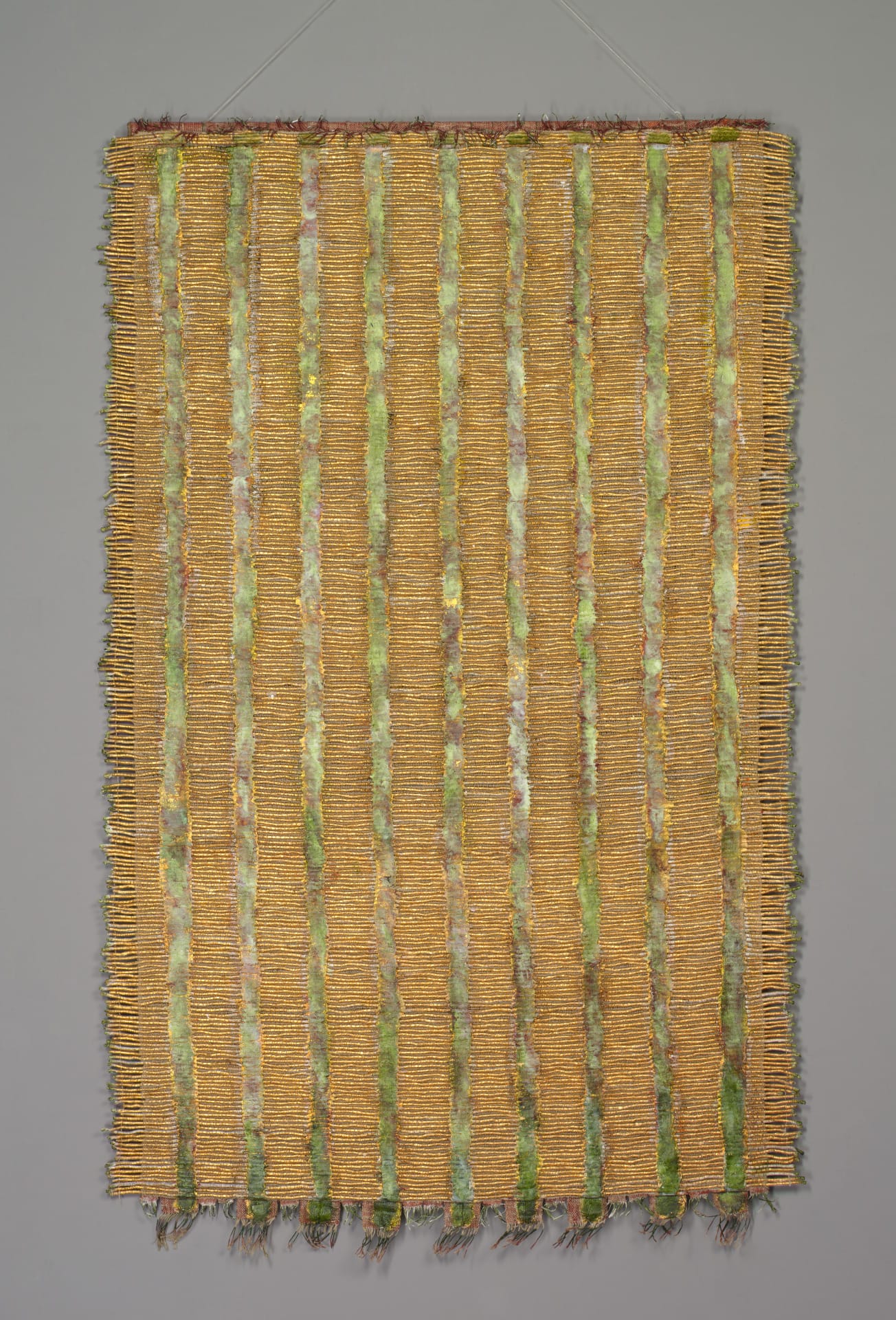
At first, Alquimia Verde LV looks like light organized into architecture. Fine gold ridges run horizontally, dozens of them stacked into tall vertical bands. Mottled channels of pale green, gray, and rust interrupt the shine. At the lower edge, short threads escape the rectangle. The work finishes by showing exactly what the gold could not abolish: this luminous wall is cloth.[2]
The Cleveland Museum of Art identifies the 1987 work as plain-woven cotton and linen with supplementary weft, gold leaf, gesso, and oxide pigments.[2] An earlier work in the same series makes the sequence even more explicit. The Art Institute of Chicago's record for Alquimia III reads almost like a set of stage directions: strips of linen and cotton; plain weave with exposed warps; applied gesso; gold leaf and pigment; sections joined by knotted, extended weft fringe. Made in 1983, that work is just over two meters tall and less than eighty centimeters wide.[1]
Those facts matter because Amaral's technique is not simply gilding on an unusual support. Every layer is made to negotiate with the next one. Weaving builds a flexible armature. Gesso gives that armature a more mineral skin. Pigment establishes intervals and depth. Gold leaf turns ambient light into a changing final color. Exposed joins keep the construction legible.
The result belongs to the Alquimia series, but the alchemy is not a fantasy of turning humble thread into noble metal. It is a more interesting conversion: Amaral makes metal behave like textile without allowing textile to impersonate a seamless metal sheet.
Image context: the cover is the Cleveland Museum of Art's photographic record of the actual 1987 work. Its ribbed gold bands, pigmented channels, woven edges, and short fringe make the series' layered construction visible in one view.[2]
The weave remains the armature
Plain weave is often described as the simplest interlacing: one set of threads passes over and under another. In Alquimia III, simplicity does not mean invisibility. The museum record specifies exposed warps and extended weft fringe, while the image shows the grid repeatedly opening between gilded areas.[1] The weave is therefore both support and drawing. Vertical and horizontal forces organize the work before any pigment or metal arrives, then reappear as dark intervals across the finished surface.
That distinction separates Amaral's object from a painting of woven texture. A painted grid can describe pressure, overlap, or a broken edge. Here those conditions are physical. The rectangles are held in relation because fibers cross, strips join, and knots take strain. The lower fringe is especially important. It is not a soft flourish added to a hard-looking field; it is the field's structure continuing past its image. Follow one loose element upward and the apparent wall resolves back into a system of crossings.
Amaral came to this problem through architecture as well as weaving. She studied architectural design in Bogotá before entering Marianne Strengell's weaving studio at Cranbrook Academy of Art in 1954–55. Fondation Cartier places her later work across the territories of painting, sculpture, installation, and architecture rather than inside a single medium.[4] Alquimia III earns that range materially. It has a facade, weight, joints, edges, and a relation to the wall, yet it can sag and respond in ways a built wall cannot.
Gesso makes softness carry weather
Gold leaf cannot perform this transformation alone. Gesso is the quiet hinge in the construction. Applied over the woven strips, it gives the fibrous surface enough body to accept pigment and leaf while preserving the ridges, breaks, and slight misalignments beneath them.[1] Instead of smoothing cloth into a neutral ground, Amaral uses coating to make its structure more pronounced. The surface begins to resemble plaster, adobe, or stone precisely because it never becomes perfectly flat.
An earlier work makes that move easier to see. Cal y Canto, made around 1979, is linen and gesso without gold. The Smithsonian describes earth-colored woven strips, irregular white coating, raw ends, and a five-inch depth that lets the object claim real space. Its title plays on an expression for something tightly closed, while the museum reads its gessoed, earth-toned construction in relation to masonry and Andean landscape.[3] Whether or not a viewer knows that verbal cue, the technique makes closure feel provisional: the piece looks barricaded, but its interlaced strips and uneven bottom remain vulnerable to separation.
Seen beside that work, Alquimia III does not represent a clean departure from fiber into luxury. Gesso had already allowed Amaral to test how a textile could acquire the visual density of a constructed surface. Gold intensifies the test. It adds a skin associated with permanence and value to an object whose joins and loose ends keep declaring mobility.
Gold arrives as fragments, not a finish
Gold leaf is often used to suppress ordinary light. A fully gilded plane can seem to emit a stable radiance instead of describing a particular hour or place. Amaral refuses that stability. In Alquimia III, leaf is distributed across small blocks. Some passages flare; others appear rubbed, darkened, or cooled by the pigment beneath and around them. The woven gaps prevent the separate pieces from fusing into one optical field.[1]
That brokenness is technical, but it also keeps the material's history unsettled. The Cleveland Museum of Art describes Alquimia Verde LV (1987) as cotton and linen in plain weave with supplementary weft, gold leaf, gesso, and oxide pigments. Its curatorial text holds two histories together: gold's revered place in pre-Columbian cultures and its exploitation under European colonization.[2] The work does not turn that conflict into an illustration. Instead, precious metal sits on a structure whose labor, fiber, and joints remain readable.
The caution matters. It would be too easy to call every golden surface spiritual, or to treat “pre-Columbian” as a single decorative source. Amaral's materials do not grant that shortcut. Gold can recall sacred objects, colonial extraction, church interiors, modernist abstraction, or simple reflected light; the weave prevents any one association from becoming a smooth master narrative. The surface is assembled from separate units, and its meanings stay similarly jointed.
Pigment controls how the leaf behaves
Calling these works “gold” can hide how much color does. The medium lists for Alquimia III and Alquimia Verde LV both pair metal leaf with pigment; the latter specifies oxide pigments.[1][2] Color sits beside, beneath, and across the reflective layer. It can cool an edge, break a glare, or make one gold passage appear deeper than its neighbor. What looks from afar like one luminous material is actually a sequence of optical disagreements.
This is why the photograph of Alquimia III should not be read as a fixed color sample. A camera records one lighting arrangement. In a room, a matte pigmented seam and a metallic square answer movement differently. The seam largely keeps its local color; the leaf changes as viewer, work, and light source shift. ICA Miami describes Amaral's later gold-leaf Estelas as surfaces that both refract and absorb light.[6] The same productive instability is already active here. Gold is not the color of the work so much as an instrument that makes viewing conditions visible.
The woven relief amplifies the effect. Because the leaf lies over a ridged, imperfect support, it cannot behave like metal foil stretched across a machine-flat panel. Tiny changes of angle produce small changes of brightness. The hand-built substrate breaks a grand glow into local events.
A series, not a recipe
Amaral did not use the Alquimia construction to lock herself into one signature silhouette. The Art Institute's Alquimia III is a tall vertical hanging from 1983. Cleveland's Alquimia Verde LV from 1987 is broader, incorporates supplementary weft, and lets green and oxide tones divide the gold. The Museum of Arts and Design's Alquimia #76 from 1989 turns to a wide horizontal format—forty-four by seventy-one inches—while retaining linen, gesso, gold leaf, and paint.[1][2][5]
Those differences clarify what the series actually repeats. It is not a motif but a problem: how can woven structure, coating, color, and metal remain individually perceptible while forming one object? Each work changes the answer by altering proportion, weave, intervals, or the balance between shine and pigment. “Alchemy” names a continuing experiment in material relations, not a secret effect applied at the end.
That experiment also explains why the category “tapestry” feels both correct and incomplete. These objects depend on textile knowledge, but they do not behave as flat pictures carried by cloth. Fondation Cartier describes Amaral's monumental abstractions as leaving the wall and crossing among painting, sculpture, installation, and architecture; ICA Miami likewise frames her language as sculptural and connects it to her architectural and textile training.[4][6] Alquimia III accomplishes that shift without giving up the evidence of how it was made. The wall-like presence comes from thread crossing thread; the golden authority rests on gesso; the surface changes with ordinary room light; the lower edge remains a set of knots.
Gold leaf obeys the weave, then, because Amaral never asks it to conquer the weave. She gives it a fibrous ground that can crease its light, divide its prestige, and expose its dependence. The most precious layer is also the most contingent. Under every flash of gold, the textile keeps hold of the work.
Sources
- Art Institute of Chicago, public collection record for Olga de Amaral, Alquimia III (Alchemy III) (1983) — image, dimensions, construction, provenance, and exhibition history.
- Cleveland Museum of Art, Alquimia Verde LV (1987) — weave structure, materials, dimensions, and the museum's account of gold's layered Colombian histories.
- Smithsonian American Art Museum, Cal y Canto (c. 1979) — object record, visual description, gesso-and-linen construction, architectural background, and landscape interpretation.
- Fondation Cartier pour l'art contemporain, “Olga de Amaral” — institutional biography covering her architecture and Cranbrook training, fiber-art context, and movement among textile, painting, sculpture, installation, and architecture.
- Museum of Arts and Design, Alquimia #76 (1989) — collection record documenting the series' horizontal format and its linen, gesso, gold-leaf, and paint construction.
- Institute of Contemporary Art, Miami, “Olga de Amaral” — exhibition account of Amaral's architectural textile language and the changing optical behavior of her gold-leaf works.