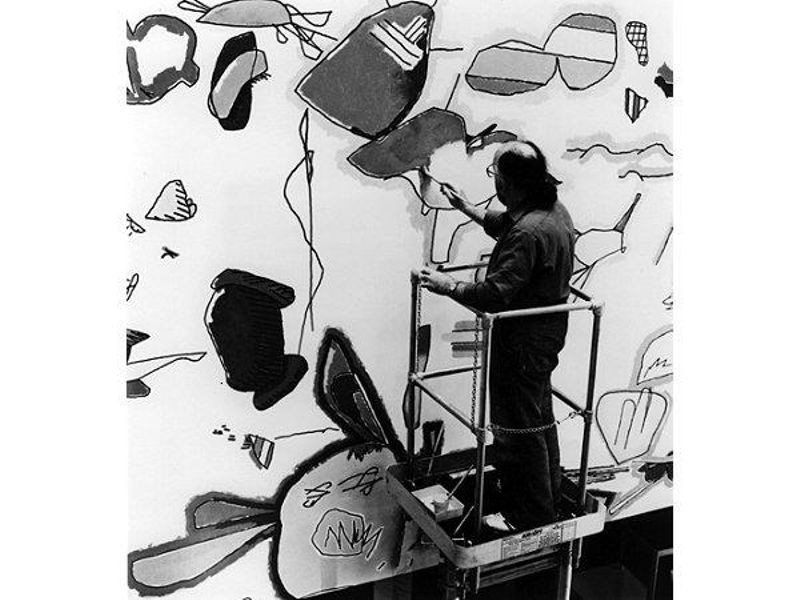
The most revealing image of AARON is not one of its finished pictures. It is an early-1980s photograph of Harold Cohen standing on a raised platform beside a wall-sized drawing at the Computer Museum in Boston. A field of machine-drawn forms spreads around him. Cohen is adding color by hand. The scene looks less like a computer replacing a painter than a painter discovering that his studio has acquired another pair of hands.[3]
That first impression is right, but incomplete. Cohen did not merely color what a machine independently imagined. He wrote the rules, revised the knowledge base, designed or built the devices that carried instructions into ink and paint, judged results, and decided what problem AARON should confront next. AARON, meanwhile, did something a passive tool could not: it made compositional decisions within those rules and produced images Cohen had not planned stroke by stroke. The work lived in that unsettled interval between control and surprise.
The Whitney Museum calls AARON the earliest artificial-intelligence program for artmaking and treats it as a collaboration Cohen pursued from the late 1960s until his death in 2016.[1] That long duration is the key. AARON was not a single invention that generated a recognizable house style forever after. It was a studio system with a biography—abstract, then figurative, then able to handle color, then abstract again—and each phase recorded a new answer to an old painter's question: what must an artist know in order to make a mark behave like an image?
Image context: the cover is a real archival photograph from the Computer History Museum, not an AARON output or a schematic. It belongs here because the article is about the whole working arrangement—artist, paper, programmed line, drawing machine, and hand-applied color—not only the pictures that arrangement produced.[3]
A painting problem disguised as a computer project
Cohen arrived at computing as an established painter, not as an engineer searching for an artistic demonstration. UC San Diego brought him to its Visual Arts Department in 1968; he later helped found and direct the university's Center for Research in Computing and the Arts.[4] What drew him toward software was a crisis inside painting. He wanted to know how artists turn knowledge into marks, how a cluster of lines begins to suggest a world, and how much of that process could be stated rather than performed by instinct.
Early mainframes made the inquiry awkward. Programs traveled through punched cards and returned their results later, a rhythm almost comically remote from the feedback of brush against canvas. Cohen learned programming, moved through different computers and languages, and by 1971 had presented an early painting system at a computing conference. He named AARON in the early 1970s; subsequent work at Stanford's Artificial Intelligence Laboratory pushed the project into a more durable form.[1][3]
The important distinction is that AARON was symbolic AI. It did not train on a warehouse of existing pictures or learn a style from examples. Cohen explicitly programmed knowledge and behavior: relations such as inside and outside, figure and ground, near and far; ways for a line to continue; procedures for placing forms without letting the drawing collapse into a tangle. Random variation kept results from repeating, but randomness operated inside a structure of artistic judgments.[2][5]
That makes AARON less like a slot machine for images than a very peculiar studio assistant whose education consisted entirely of Cohen's attempts to describe drawing. The V&A is explicit about the boundary: AARON could not independently acquire new techniques. Cohen had to alter it.[2] Its autonomy began after the rules were written, not before. Within a run, it could make choices and surprise its maker; between versions, its development still depended on him.
Rules had to become marks
Software alone did not solve Cohen's problem, because his subject was never only computation. A line had to arrive on paper with scale, drag, pressure, and an imperfect edge. Early AARON drawings were executed by a small floor-running robot called the Turtle, equipped with a pen. Later came flatbed plotters, robotic arms, and a large painting apparatus that could mix and apply color.[3][4] Each device changed the work because each translated the same abstract instruction into a different physical gesture.
The Turtle is especially revealing. It moved over sheets laid on the floor, turning code into a public performance. At the San Francisco Museum of Modern Art in 1979, it drew in the gallery while a roughly one-hundred-foot mural made by AARON and colored by Cohen extended the system's marks to architectural scale.[3] Viewers did not encounter a hidden calculation followed by a mysterious printout. They watched a machine negotiate real space.
The early drawings remained largely abstract: branching, enclosing, dividing, and repeating without naming particular objects. During the 1980s, Cohen expanded AARON's knowledge so it could construct plants, rocks, people, and plausible spatial relations. In his 1988 paper How to Draw Three People in a Botanical Garden, he framed the research not as a quest for photographic correctness but as an inquiry into the structures by which representations come to represent anything at all.[5]
That shift from evocative shapes to bodies and gardens did not simply add subjects to a menu. AARON needed rules for how limbs connect, how a person can stand or sit, which forms may overlap, and how objects occupy foreground and background. Representation became a test of whether tacit studio knowledge could survive being made explicit. Every awkward figure exposed a gap in Cohen's account; every convincing arrangement suggested that some part of drawing had been described well enough to operate without his hand.
Color changed the division of labor
For years, the cleanest division seemed to be that AARON drew and Cohen colored. The cover photograph preserves exactly that arrangement. Yet color was not an optional finish. It could join or separate forms, pull a figure forward, suppress a line, or change the emotional temperature of an entire composition. If AARON could not handle color, then a large part of painting still remained outside the model.
By 1995, Cohen had built a system that could both draw and paint. The Computer History Museum describes a large vacuum table, a robotic arm, brushes, and mixed pigments. A workstation generated images overnight; Cohen reviewed them and selected one for the apparatus to execute.[3] Automation had expanded, but selection had not disappeared. Nor had engineering: software, paper handling, brush choice, pigment, and mechanical reach all shaped what could become a finished work.
This is where simple arguments over whether Cohen or AARON was "the artist" begin to fail. Cohen compared the relationship to a Renaissance workshop, and the analogy is useful so long as it does not turn the software into a person.[3] AARON had operational independence without a human life, ambition, or capacity to rewrite its own aims. Cohen possessed those aims, but he did not specify each resulting image. Authorship was distributed across different kinds of agency: framing the problem, encoding knowledge, varying a composition, materializing it, selecting it, and sometimes coloring it.
The resulting works are not merely illustrations of a technical milestone. Their looping plants, improbable figures, and dense fields have a visual character produced by the system's constraints. Yet the most consequential artwork may be the changing boundary around those works. Cohen repeatedly moved a task—composition, figure construction, color choice—from his own embodied practice into code, then watched what that transfer revealed about the task.
A system with a biography
Most tools are judged by how faithfully they preserve an artist's intention. AARON was valuable when it complicated Cohen's. It could generate more drawings than he could have conceived individually, but productivity was not the deepest point. Its results gave him evidence about his own theories of image-making. The program was therefore both maker and testing instrument: it produced pictures while exposing the strength and weakness of the ideas behind them.
That is why the project's decades matter more than any claim that it anticipated today's text-to-image software. The comparison is historically useful, but the systems work differently. Contemporary generators typically infer patterns from large training datasets and accept natural-language prompts. AARON's knowledge was written and revised by one artist, its capabilities were narrow, and its limits were unusually visible.[1][2] It could not be asked for any imaginable style. It could only work inside the visual world Cohen had painstakingly made available to it.
Those limits made the collaboration legible. When AARON gained people, plants, or color, one could ask what new knowledge had entered the system and what Cohen had chosen to delegate. The machinery also kept computation physical: a robot crossed paper, a pen ran dry, a brush reached a boundary, a painter knelt on the floor. Intelligence never floated free of matter.
The archival photograph catches that truth better than a polished output can. Cohen is neither surrendering authorship nor performing a ceremonial last touch. He is working inside a circuit he built, responding to marks that returned from his own rules in an unforeseen arrangement. AARON made the algorithm part of the studio because it turned programming into an extended artistic medium—one capable of carrying a question for nearly half a century without settling it.
Sources
- Whitney Museum of American Art, "Harold Cohen: AARON" — exhibition overview on the software's origins, changing forms, drawing and painting machines, and Cohen's understanding of the project as collaboration.
- Victoria and Albert Museum, "Collection Selection Boxes — Artificial Intelligence" — institutional account of AARON as symbolic AI, its explicit rules and random variables, its inability to learn independently, and its progression from abstract line to figures and color.
- Chris Garcia, Computer History Museum, "Harold Cohen and AARON—A 40-Year Collaboration" (2016) — chronology of the computers, Turtle, SFMOMA presentation, painting system, selection process, and the circa 1982 archival photograph used for the cover.
- UC San Diego, "UC San Diego Pioneering Visual Artist Harold Cohen Passes" (May 12, 2016) — institutional biography covering Cohen's 1968 arrival, CRCA leadership, engineered drawing devices, and AARON's successive abstract, figurative, color, and later abstract phases.
- Harold Cohen, "How to Draw Three People in a Botanical Garden" (AAAI, 1988) — Cohen's primary-source explanation of AARON's representational knowledge and his inquiry into how visual structures represent.