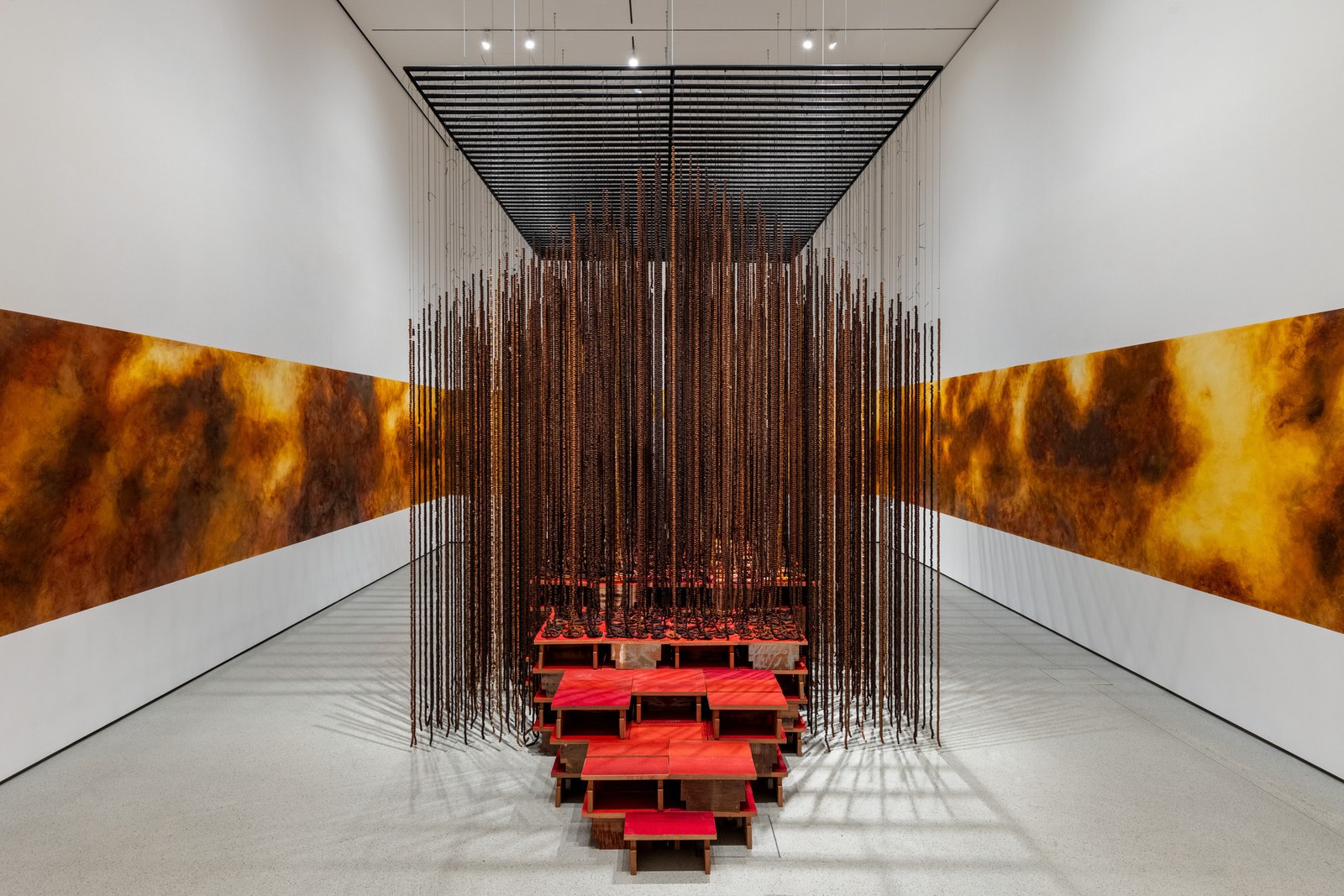
Image context: the cover is Jonathan Dorado's January 2024 photograph of Montien Boonma's actual installation at MoMA, built from herbs, spices, natural binders, cotton string, wood, and steel. It is neither generated imagery nor an explanatory graphic. Its limitation is useful: the photograph can preserve the hanging architecture, but it cannot carry the scent that makes the surrounding room part of the work.[1][8]
Before a visitor sees Montien Boonma's House of Hope, the work may already have crossed into the visitor's body. Its medicinal herbs and spices release an odor that travels beyond the suspended structure, through the gallery, and into the air being breathed. In MoMA's 2024 installation, that scent could announce the work before its red stools and dark bead curtains came into view.[1][2]
This is a quiet reversal of the usual museum contract. A conventional easel painting usually keeps its pigment on a support. A sculpture may occupy shared space, but a plinth or barrier still tells us where the object stops. Scent is less obedient. It disperses, weakens, mingles with ventilation and other bodies, and changes as the materials age. It cannot be contained by the edge of a frame or fully recovered by a photograph.
Olfactory art therefore does more than add one neglected sense to an otherwise unchanged artwork. It relocates the work. Some of it remains in herbs, bottles, diffusers, recipes, or porous sculpture; some of it exists only as a temporary relation among material, air, architecture, and a breathing visitor. Once scent becomes a medium, atmosphere is no longer background. It is where the art happens.
The work arrives before the object
House of Hope was developed in 1996–97 as Boonma was thinking through illness, healing, Buddhist practice, and the bodily knowledge carried by traditional Thai medicine. The installation forms a permeable house from 1,648 strands of dark herbal beads above 440 small red stools. For its 1997 New York presentation, the walls were covered with a mixture of herbs and rice starch while Boonma's assistant Apisit Nongbua arranged the medicinal beads, intensifying the room's aromatic warmth. MoMA's later reconstruction involved sourcing medicinal ingredients and fabricating roughly half a million pills for the hanging strands.[2][3]
Those quantities explain the work's density, not its meaning. From a distance, the beads resolve into an elementary outline: walls and pitched roof. Up close, the house loses solidity. Gaps admit the eye and body; individual pellets replace the apparently continuous surface; earthy odor ignores the outline altogether. Boonma referred to the descending beads as a “black rain,” an image that holds weight and relief together.[3]
The scent matters because it prevents the house from becoming merely a symbol that can be decoded at a glance. Herbs associated with healing do not promise that art can cure disease, and Boonma's work should not be flattened into a generalized wellness room. The aroma instead gives hope a material condition: fragile ingredients, repeated labor, bodily exposure, and an enclosure that remains open. Viewers do not stand outside an illustration of healing. They enter an atmosphere whose effects cannot be guaranteed.
A smell has no obedient edge
Smell begins with volatile chemicals in the air binding to sensory receptors high in the nasal cavity. Neuroscientist Rachel Herz emphasizes that this direct encounter with airborne molecules distinguishes olfaction from senses whose stimuli can be held at a more obvious distance.[4] For art, that elementary fact has radical spatial consequences.
First, an odor has an uncertain border. Its reach depends on concentration, airflow, temperature, humidity, nearby materials, and time. Second, it makes sequence unstable. A visitor may encounter the work in a corridor, then locate its source; another may enter when the scent has faded or after becoming accustomed to it. Third, it complicates the idea of detached looking. Breathing is not the same as touching an object by choice. The gallery's supposedly neutral air has become an active carrier.
None of this makes scent automatically more authentic than vision. A smell can be engineered, mislabeled, marketed, or culturally overread as easily as an image can. Nor does everyone receive it in the same way. Olfactory perception varies, associations are learned as well as bodily, and some visitors have limited smell or need to avoid scented environments.[4][7] The important shift is not from a false eye to a truthful nose. It is from the fiction of a self-contained object to a medium whose conditions and differences must be acknowledged.
The nose can map what the eye edits out
Sissel Tolaas treats smell not as an atmospheric garnish but as information. For Berlin, City Smell Research (2004), she gathered odors in different districts, reconstructed them with headspace and scent-simulation techniques, and placed them in bottles shaped to recall a city map and compass points. The work drew on an archive that MoMA described in 2011 as containing more than seven thousand scents.[5]
The size of that archive matters because it refuses perfume's narrow hierarchy. Tolaas has preserved sweat, rotten fish, dog feces, laundry, kebabs, and shoe-shop air alongside conventionally pleasant odors. A city rendered this way does not become a picturesque skyline or a clean set of zones. It becomes cooking, labor, waste, weather, commerce, bodies, and memory occupying the same map.[5]
The bottles give the project portable objects, but the object is not the final destination. Each container is an interface: opening it activates a place elsewhere, and the result appears inside a present body. Smell can make distance collapse without pretending that a chemical reconstruction is the district itself. Its precision is paradoxical. The source can be analyzed and simulated, yet the encounter remains dependent on whoever opens the bottle, where, and when.
Air can carry several dates at once
Anicka Yi expanded that spatial argument to the scale of Tate Modern's Turbine Hall in In Love With the World (2021). Biomorphic machines called “aerobes” floated through the former power-station space while scentscapes changed week by week. The odors were tied to different imagined periods in Bankside's environmental history rather than to one signature fragrance.[6]
The sequence moved through radically different atmospheric propositions. One scentscape combined marine and earthy notes for deep prehistory; another used vinegar, smoke, and animal urine to evoke Roman Bankside; a Machine Age mixture drew on fuel oil, burning coal, ozone, and pipe tobacco. Developed with smell researcher Pamela Dalton, the series made historical time something visitors shared through the air while the aerobes altered their programmed behavior above them.[7]
This is not a neutral time machine. No scent formula can recover the total air of a vanished era, and an odor list is already an interpretation. Yi's sharper move was to make that construction visible. The Turbine Hall did not smell “old”; it cycled through authored hypotheses about geology, industry, waste, labor, and habitation. Hsuan L. Hsu reads the work's later industrial scents through atmospheric inequality—questions about who receives clean air, who bears pollution, and how a shared atmosphere can distribute risk unevenly.[7]
The aerobes made the same proposition in another register. They appeared to inhabit the hall with visitors rather than perform for them like obedient machines. Scent linked those bodies without making them equivalent. Human, mechanical, architectural, and historical systems occupied one volume, but each sensed and moved through it differently. Air became both connective tissue and evidence of unequal exposure.
Conservation becomes calibration
Olfactory art makes a familiar museum problem impossible to hide: what exactly is being preserved when a work is installed again? The surviving components of House of Hope can be measured and cataloged, but the work's history shows that faithful dimensions are not enough. Its 1997 Tokyo structure felt too heavy to Boonma; in New York, the smaller room and aromatic wall treatment produced a warmer, more enveloping result. He worried about the cold cement floor, the relation between the suspended house and its room, and even photographs that made the installation look too fixed and perspectival.[3]
That history suggests a score rather than a frozen master copy. The score includes materials and counts, but also density, access, scent strength, temperature, and the relation between the suspended house and its room. Reinstallation becomes calibration: not license to improvise freely, and not a claim that every molecule can be restored, but a disciplined attempt to recover the work's operative relationships.
Scent sharpens the distinction between identity and sameness. Fresh herbs will not be chemically identical across harvests. Aromatic compounds fade. Ventilation changes diffusion. Visitors acclimate at different rates. Preserving such a work may therefore require recipes, supplier knowledge, fabrication records, environmental observation, and testimony from collaborators alongside the visible object.[2][3] The work survives through maintained constraints, not through the fantasy that time can be removed.
The photograph records its own failure
The image above is indispensable evidence. It establishes scale, geometry, color, suspension, and the precarious transition from red steps to dark hanging beads. It proves that House of Hope is not an invisible concept. Boonma built a substantial, materially exacting installation, and the photograph lets its form travel.[1]
But olfactory art teaches us to read that evidence without confusing it with the whole work. A screen cannot deliver herbal concentration, the moment scent first becomes noticeable, or the way another visitor's movement redirects a current of air. Even a perfect visual record leaves the medium's spatial behavior outside the frame.
That failure is not a defect to solve with a scratch-and-sniff substitute or a more lavish caption. It is a critical fact. Reproduction normally allows the museum and the reader to forget how much an artwork depends on presence. Scent makes the loss obvious. It asks us to imagine an artwork not as an object plus an optional atmosphere, but as a set of encounters that includes its room, its maintenance, its changing materials, and bodies that never perceive in exactly the same way.
The most consequential olfactory art does not simply make a gallery smell unusual. It makes the air legible. Boonma turns it into a fragile architecture of hope; Tolaas makes it a map of urban life that refuses deodorized order; Yi gives it a layered history of organisms, machines, fuel, and unequal breath. In each case, scent escapes the artwork's apparent container and reveals that the container was never as sealed as it looked.
Sources
- Museum of Modern Art, “Montien Boonma, House of Hope, 1996–97” — official object record, materials, dimensions, collection metadata, and source of the photographic reproduction used here.
- Sarah Cowan, “Smell: Montien Boonma's House of Hope,” Museum of Modern Art Magazine (October 7, 2024) — institutional account of the work's healing context, medicinal materials, scent, and refabrication.
- Chanon Kenji Praepipatmongkol, “Montien Boonma: The Shape of Hope,” post at MoMA (2024) — archival and collaborator-based study of the Tokyo and New York installations, bead count, aromatic mural, temperature, fabrication, and photographic limits.
- Rachel Herz, “Ten Minutes with Rachel Herz: On Smell,” Museum of Modern Art Magazine (January 17, 2024) — neuroscientist's explanation of airborne odorants, olfactory perception, memory, and smell in art.
- Museum of Modern Art, “Sissel Tolaas, Berlin, City Smell Research, 2004” — project record covering headspace methods, the scent archive, bottle-map design, and smell as urban information.
- Anicka Yi Studio, “In Love With The World at Tate Modern” (2021) — artist-studio project page on the aerobes and weekly scentscapes linked to Bankside's history.
- Hsuan L. Hsu, Olfactory Worldmaking. University of Minnesota Press, 2026 — scholarly analysis of Anicka Yi's scentscapes, embodied perception, atmospheric inequality, and olfaction's variable responses.
- Museum of Modern Art, “Installation view of the gallery ‘Montien Boonma's House of Hope’” — January 2024 image record and attribution to photographer Jonathan Dorado.