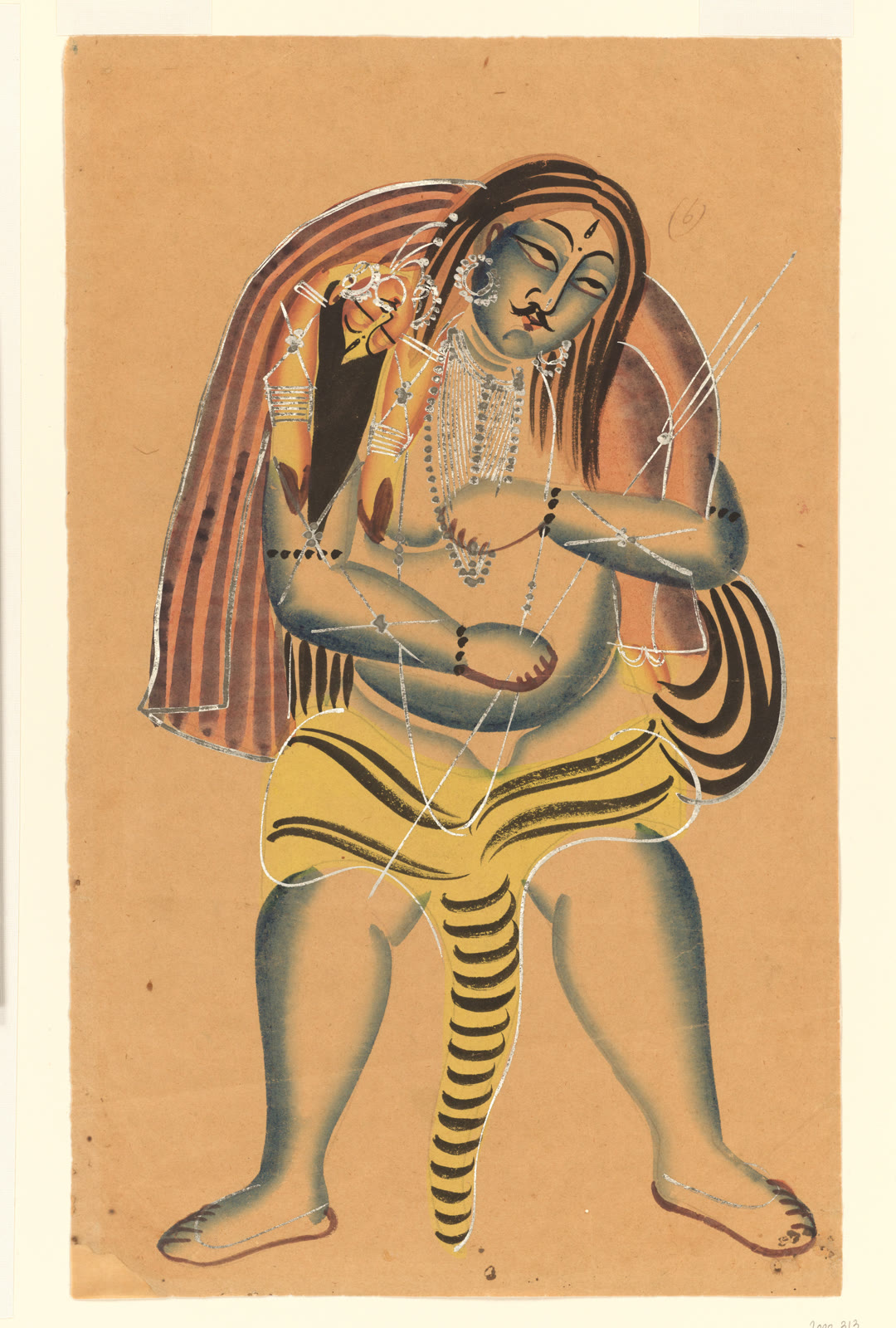
Image context: the cover is the Metropolitan Museum of Art's real photographic reproduction of an actual Kalighat painting, not a generated image or an analytical graphic. The work's exposed paper, broad color washes, dark contour, and metallic highlights preserve the material decisions that made a complex sacred story legible on a single market-ready sheet.[4]
The first surprise in a Kalighat painting is how little scenery it needs. A god, a fashionable couple, a cat with stolen food, or a figure caught in scandal occupies a nearly empty sheet. There is no landscape to enter and often no furniture to establish a room. A dark contour turns, swells, narrows, and closes around the body; a few washes give it weight; color and gesture do the rest.
That economy can look timeless when a sheet hangs alone in a museum. It was anything but. Kalighat painting developed in nineteenth-century Calcutta—now Kolkata—inside a rapidly changing colonial port, beside a major pilgrimage destination, and within a market shaped by travelers, mill-made paper, ready-made pigments, and cheaper printed pictures. Its famous blank ground was not an escape from modern life. It was one answer to modern life's speed.[1][2]
The painters, or patuas, did not merely simplify an older village tradition. They changed its unit of attention. Long painted scrolls designed to be unfurled while a story was sung became individual sheets that a passing customer could grasp at once, carry away, install at home, or treat as a record of the city. Kalighat's style was born from that conversion: narrative became pose, sequence became silhouette, and the bazaar turned brushwork into a form of circulation.
A pilgrimage market changed the size of the story
The Kalighat temple drew worshippers, local visitors, and foreign travelers by the early nineteenth century. As Calcutta expanded as an industrial harbor and imperial capital, artisans migrated toward its growing markets. Among them were patuas from Bengal whose customary work included narrative scrolls—some more than twenty feet long—used alongside sung performances at rural fairs and festivals.[1][2]
Around Kalighat, the audience behaved differently. Pilgrims wanted devotional images and souvenirs; tourists wanted portable evidence of where they had been; urban buyers brought other tastes and references. A scroll that disclosed its story scene by scene was poorly matched to a stall serving a mobile crowd. The single sheet concentrated the encounter. One or two figures, an uncluttered ground, and a compact action could be recognized before the buyer moved on.[1][2]
New materials helped make that concentration practical. Mill-made paper replaced cloth for many works. Imported ready-made color reduced some of the preparation required by older systems. Quick-drying water-based paints allowed a workshop to move from outline to wash to detail without turning every sheet into a long project.[1][2] These were not neutral substitutions. Paper encouraged a bounded, portable picture; speed rewarded decisive contours; the market made repeatable subjects useful.
The Met's Shiva Carries the Corpse of Sati keeps the sacred origin visible. The story is tied directly to Kalighat: the temple was understood as one of the places sanctified when parts of Sati's body fell to earth. On the sheet, however, a cosmic narrative is compressed into one interlocked mass. Shiva's legs plant the group; Sati's body arcs across his shoulders; black stripes and silver ornament keep two figures distinct without releasing them from the silhouette. The painting could carry a temple story because it did not attempt to illustrate every episode.[4]
Speed became a discipline, not a shortcut
Kalighat's quickness is easy to romanticize as the spontaneous touch of an anonymous folk painter. Surviving works point to something more organized. Pika Ghosh describes a division of labor in which a master often established the basic form in pencil and other members of a family workshop inked it. Repeated subjects and shared iconographic formulas then helped workshops serve broad demand without inventing every sheet in isolation.[2]
That workshop structure matters because the line was not a flourish added at the end. It was the picture's load-bearing element. A successful contour had to define a cheek, shoulder, wrist, drape, and change of direction with very little correction or background support. Inside it, graded washes could run from a darker edge toward a paler center, giving limbs and faces volume without building a fully modeled room. The result joined flat pattern to bodily weight: the sheet looks immediate because its decisions are so controlled.
The palette was equally worldly. Non-destructive Raman analysis of nineteenth-century Kalighat paintings on industrial paper identified chrome yellow, while the V&A's history notes that imported ready-made color helped workshops increase production.[1][3] The point is not that every workshop used one fixed recipe. It is that commercial materials moved into the repertoire. Kalighat painters absorbed them without surrendering the brush rhythm that made the pictures recognizable.
Nor should repeated designs be mistaken for failed originality. Repetition allowed workshops to meet demand, but a shared formula could still shift through pressure, color, spacing, and detail. Kalighat painting asks for a different model of authorship: not the unique image invented from nothing by a solitary named genius, but a visual language maintained by practiced hands, varied in production, and tested in public.
The gods learned the city's posture
Religious subjects remained central, yet the city entered even when a god occupied the page. Penn Museum's study notes deities wearing Victorian-style crowns, adopting metropolitan fashions, or appearing against theatrical curtains. Such details did not simply Westernize an older iconography. They made divinity and colonial modernity share the same body, sometimes elegantly and sometimes uneasily.[2]
The repertoire also widened. Kalighat workshops painted Hindu stories, Islamic subjects, proverbs, literary episodes, topical events, tradespeople, servants, courtesans, colonial rulers, and the emergent Bengali middle classes. The page became a quick social stage. A fashionable babu could look polished and ridiculous at once; a domestic encounter could turn manners into theater; a public scandal could become a sequence of images long before today's illustrated news cycle.[1][2]
Animals sharpened that satire by making vice instantly legible. Penn's nineteenth-century painting of a cat gripping a prawn casts the well-fed predator as a hypocritical ascetic: renunciation is announced while appetite remains visible in its mouth.[5] The joke works at a glance, but it is not visually crude. The cat's arched body, bright eye, spotted coat, and captured prawn turn moral contradiction into an elegant contour.
It would be too easy to celebrate every secular sheet as democratic social criticism. The surviving repertoire includes mockery and moral warning as well as devotion; satire could expose hypocrisy while still turning people into recognizable social types. Kalighat painting did not stand outside its audience's anxieties. The same economical figure could serve a sacred image, caricature, proverb, topical narrative, or literary episode depending on its subject and purchaser.[1][2]
Hand painting was already a mass medium
The usual account of Kalighat's decline sets handmade authenticity against mechanical reproduction. Cheaper printed pictures did help erode the market in the early twentieth century, and many patua families left the neighborhood or found other work.[1] But the opposition is misleading. Kalighat painting was already commercial, collaborative, formula-driven, and produced in numbers for a mixed mass audience. Lithography did not introduce repetition or the market; it intensified conditions the painted sheets had helped master.[1][2]
This is why the encounter with print should be read as both competition and continuity. The V&A collection holds watercolors, line drawings, and hand-colored lithographs within the same broad Kalighat history.[1] Their coexistence complicates any clean boundary between the handmade sheet and the mechanically multiplied picture. A hand-colored lithograph combines print and brush; a repeated painted subject delivers variation within a shared formula. Customers encountered recurring subjects in formats that differed in price, finish, and means of production.[1][2]
What print changed most decisively was scale and price. A workshop could coordinate several hands, but a press could multiply an image without repainting each sheet. Kalighat's bold silhouette and isolated figures were well suited to reproduction, yet the very legibility that helped the style flourish also made its market vulnerable to cheaper competitors. Its success contained one mechanism of its displacement.
The painted tradition did not simply vanish. The V&A traces continuing Kalighat practice among artists in West Bengal who address religious subjects, secular life, and current events.[1] That continuation should not be treated as a frozen survival from the nineteenth century. Adaptability was present from the start. A form built by migration, new materials, shifting customers, and media rivalry remains itself by changing what it can picture.
The museum slowed the sheet down—and changed its identity
Today's museum encounter reverses the bazaar's tempo. A single Kalighat sheet is isolated, protected, attributed to a period, and offered prolonged attention. That care makes its line, paper, pigments, and abrasion available to study. It can also hide the conditions that produced the object: the family workshop, repeated design, cheap sale, ritual use, tourist itinerary, and competing pictures nearby.
The route into collections was not innocent. Foreign travelers acquired the sheets as portable signs of an “exotic” place. Some collectors treated them as illustrations of Hindu belief or ethnographic documents rather than as records of a complicated colonial city. Artist names often went unrecorded even when they might have been recoverable. Later, modernist taste elevated the same sheets for sparse composition, vigorous line, and abbreviated volume.[2]
Each frame revealed something and discarded something. “Souvenir” preserved circulation but could trivialize skill. “Ethnographic object” preserved evidence but could flatten satire and individual variation. “Modern art” made formal invention visible but risked converting speed, teamwork, and commerce into timeless spontaneity. The most faithful reading keeps those identities in tension.
That tension is what makes Kalighat painting feel so modern now. Its sheets are devotional objects and commodities, workshop products and startling aesthetic events, local pictures and travelers across empires. They do not become important only after a museum recognizes their brushwork. The brushwork was already thinking through a new city: how to arrest a moving customer, how to make one gesture carry a story, how to turn shared formulas into vivid difference, and how to survive beside machines that could make pictures faster still.
Kalighat painting made the city fit on one sheet without pretending the city was simple. Its empty ground is full of pressure—from pilgrimage, labor, class, empire, appetite, and print. The figures remain bold because everything unnecessary was removed. What remains is not less history. It is history moving at the speed of a line.
Sources
- Victoria and Albert Museum, “Kalighat painting” (updated April 17, 2024) — institutional history of the genre's temple-market origins, shift from scroll to single sheet, materials, collection, decline, and contemporary practice.
- Pika Ghosh, “Kalighat Paintings from Nineteenth Century Calcutta in Maxwell Sommerville's ‘Ethnological East Indian Collection,’” Expedition Magazine 42, no. 3 (2000) — archived copy of a study of urban subjects, workshop production, tourism, collecting, and the sheets' changing status.
- Peter Vandenabeele, Jim Tate, and Luc Moens, “Non-destructive analysis of museum objects by fibre-optic Raman spectroscopy,” Analytical and Bioanalytical Chemistry 387 (2007) — open-access technical study identifying chrome yellow in nineteenth-century Kalighat paintings on industrial paper.
- Metropolitan Museum of Art, “Shiva Carries the Corpse of Sati, ca. 1865–75” — official object record, iconographic context, medium, dimensions, and source of the public-domain photographic reproduction used as the cover.
- Penn Museum, “Kalighat Painting, 29-225-8” — official object record for the nineteenth-century cat-and-prawn satire, including materials, dimensions, provenance, and interpretation.