
El Anatsui's bottle-top works are easy to praise for the wrong reason. They look miraculous from a distance: discarded aluminum becomes a shimmering field, hard units behave like fabric, and a wall begins to ripple as if it had learned weather.[1][2][3][4] But Tate's short film, El Anatsui - "When you unite things, their power keeps growing", is valuable because it pushes past the simple transformation story. The point is not merely that waste becomes beauty. The point is that material, labor, trade memory, and installation all remain visible inside the beauty.[1]
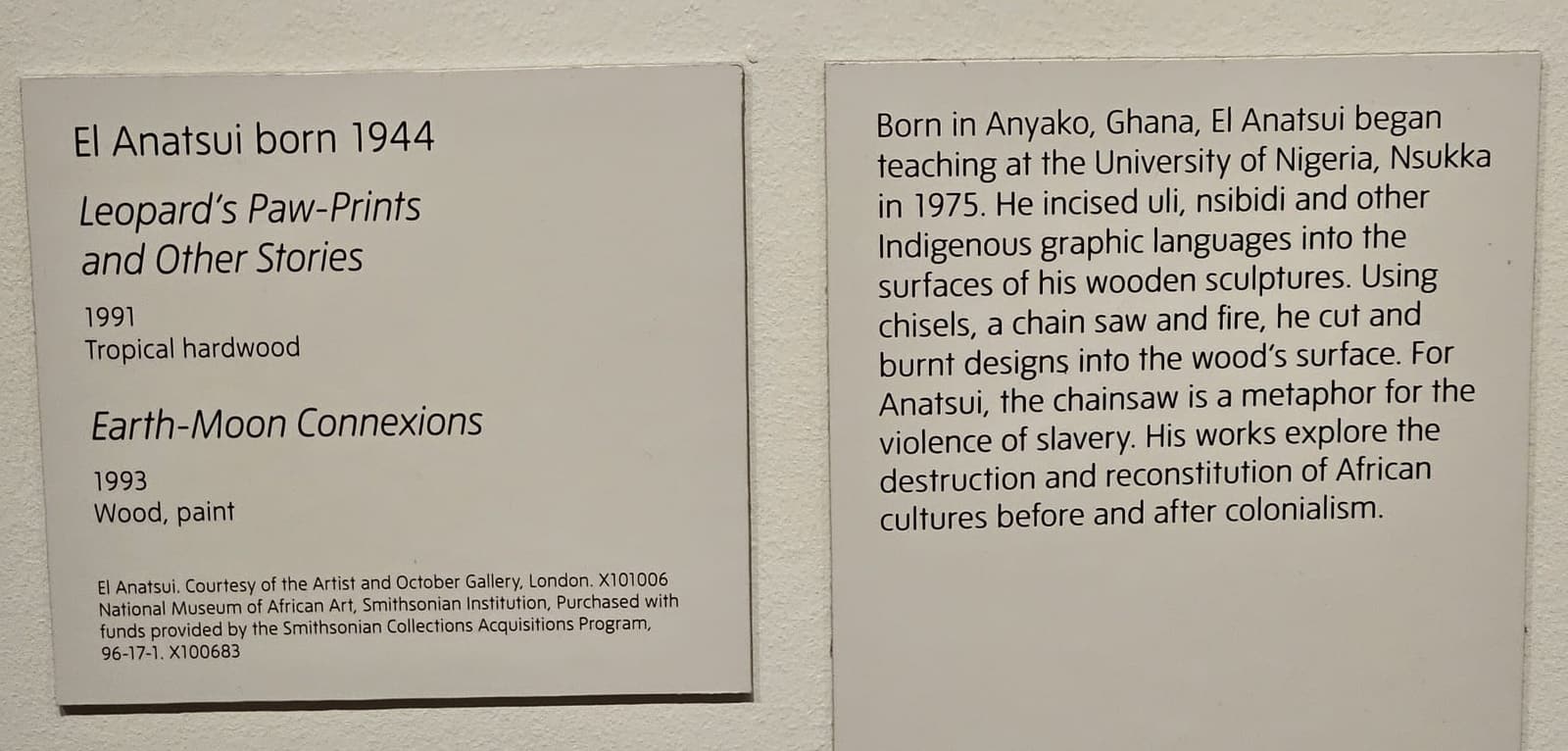
That distinction matters because Anatsui's work sits between several categories at once. Born in Anyako, Ghana, in 1944 and long based in Nsukka, Nigeria, he has worked across wood, ceramics, found objects, and metal hangings.[2][3][5] His best-known bottle-top sculptures begin from small consumer remnants linked to alcohol circulation, colonial trade routes, and everyday economies; they are then cut, folded, stitched with copper wire, and handed over to new conditions of display.[2][3][4] Tate's film makes that handoff legible. It lets the viewer see that the finished work is not a frozen monument, but a negotiated surface.
The strongest way to watch the video is to resist treating the gold, red, black, and silver surfaces as pure spectacle. Anatsui's art is spectacular, but the spectacle is built from units that still remember handling. The cap, seal, strip, stitch, fold, assistant's hand, curator's decision, and installer's wall all belong to the work's meaning. A reader who cannot play the video should still hold onto this: Anatsui makes sculpture less by conquering material than by making thousands of small material histories act together without losing their separateness.[1][2][4]
Image context: the lead image comes from a Wikimedia Commons photograph of El Anatsui's work installed in Tate Modern's 2025 exhibition Signs of Life: The Nsukka School, Nigerian Modernism. It is a real photographic view rather than a generated visual or diagram, and it fits this article because the installation view shows how Anatsui's stitched metal fields change scale when they meet architecture.[6]
Around the opening, the bottle top stops being a gimmick
The film begins by letting the material announce itself before theory arrives.[1] The camera stays close enough for the viewer to see folded edges, wire joins, branded fragments, and tiny variations of color. That is the correct distance at first. From across a hall, Anatsui's hangings can read as grand textile, landscape, curtain, or abstract painting. Up close, they become a field of handled pieces. The drama lies in the shift between those scales.
This is where the word "recycling" becomes too small. Recycling describes a material pathway, but Anatsui is doing something more exacting. The Hyundai/Tate account of Behind the Red Moon stresses that his 2023 Turbine Hall commission was made from thousands of metal bottle tops and fragments stitched into three expansive abstract compositions, each tied to movement, migration, trade, and the transatlantic slave trade.[2] Art21's artist library frames the same material turn as a break with sculpture's traditional adherence to fixed shape, while also tying the bottle-cap fields to colonial and postcolonial exchange in Africa.[4]
Tate's video makes those written claims visible.[1] The bottle top is not erased by the final image. It remains readable as a remnant of use, branding, trade, drinking, discard, collection, cutting, and stitching. That persistence is central to the work's force. If the caps disappeared completely into seamless illusion, the work would become decorative alchemy. Instead, Anatsui keeps the unit visible enough that beauty and history keep interrupting each other.
The film's middle section turns unity into a labor problem
The title line, "when you unite things, their power keeps growing," can sound simple until the film shows what unity costs.[1] Anatsui's hangings do not come from a single heroic gesture. They are assembled through repetitive, distributed labor. Dozens of assistants may participate in cutting, folding, sorting, linking, and expanding the metal sheets.[2] That studio fact matters because the works themselves are about relation. Each fragment gains force by joining a field, yet the field remains visibly made of fragments.
This is the difference between unity and sameness. A conventional monument often asks parts to disappear into one commanding form. Anatsui's hangings ask the parts to keep vibrating inside the whole. The viewer can read the work as one huge surface, then as clusters, then as individual caps, then as the seam logic binding one patch to another. Tate's film is especially useful because the camera can move through these scales more quickly than a still photograph can.[1] It shows the work breathing between collective image and local decision.
The "non-fixed form" is the key idea here.[2][4] Hyundai/Tate's press material explains that Anatsui's hangings fold for travel and appear differently each time they are installed.[2] Art21 helps name the larger art-historical consequence: these metal works challenge sculpture's fixed-shape expectation while still carrying the history of cast-off materials.[4] This means installation is not a neutral afterthought. Each hanging arrives with potential, and each display converts that potential into a particular drape, fold, sag, tension, and edge. The installer does not replace the artist, but installation becomes part of the authorship chain.
Around the discussion of scale, cloth becomes an argument about sculpture
The film's strongest art-historical lesson is that Anatsui does not simply make metal look soft.[1] He uses softness to challenge what viewers expect sculpture to be. Princeton's artist-in-residence profile describes his bottle-cap sculptures as three-dimensional works made from ordinary caps collected from junk depots, with effects of color, reflection, opacity, and choreography.[5] That language is useful because it refuses to leave the work in one category. The hangings are sculptural because they occupy space and depend on gravity. They are painterly because color, reflection, and field composition matter. They are textile-like because they fold, drape, and carry associations with cloth. They are architectural because a wall, hall, or facade changes how they behave.
This category pressure is not a formal trick. It is the work's politics of form. Anatsui's materials carry histories of exchange between Africa and Europe, including the alcohol trade and broader colonial circuits.[2][5] When those materials become a cloth-like field, the result is neither a simple condemnation nor a simple redemption. It is a surface where damage, survival, commerce, touch, and splendor are forced into the same visual event. Tate's film makes that complexity easier to grasp because motion keeps the work from settling into a single reading.[1]
That is also why the pieces can look luxurious without becoming innocent. The gold surfaces may initially recall royal textile, mosaic, or ceremonial hanging. Then the cap fragments reassert themselves. The viewer's eye keeps moving from wealth to waste, from abstraction to commodity trace, from beauty to the labor of assembly. Anatsui does not resolve that movement. He composes it.
The Turbine Hall frame shows why non-fixed form needs architecture
Although the Tate video is not only about Behind the Red Moon, the Turbine Hall commission sharpens the article's argument.[1][2][3] The 2023 installation was Anatsui's largest work to date, staged in three acts: The Red Moon, The World, and The Wall.[2] Hyundai/Tate describes a red moon and sail-like beginning, a middle act in which scattered human-like forms gather into a circular earth from a specific vantage point, and a final black metal cloth with waves and rocky peaks at its base.[2] The artist's own site similarly frames the commission as a journey through thousands of repurposed liquor bottle caps, staged in relation to human history and natural force.[3]
That matters because Anatsui's non-fixed method becomes most legible at architectural scale. A small object can be rearranged, but a Turbine Hall hanging makes rearrangement public. Viewers move beneath and around it. Light changes its metallic skin. Distance turns fragments into symbol; proximity returns them to their cut and stitched facts. The work is therefore not only installed in architecture. It tests architecture's ability to carry memory.
The film's lesson is quiet but demanding: Anatsui's power comes from refusing to choose between the fragment and the total image.[1] The cap remains a cap, yet the field becomes sea, wall, sail, robe, map, curtain, and wound. The work is unified, yet never sealed. It travels, folds, and changes shape; each installation asks the same material to become newly accountable to a room.[2][4]
That is why Tate's short video works as more than a studio visit. It teaches a viewing method. Start close enough to see the unit. Step back until the units become a field. Then move again, because the field is not fixed. Anatsui's art is strongest in that motion: between object and history, cloth and metal, individual hand and collective surface, one installation and the next.
Sources
- Tate, "El Anatsui - 'When you unite things, their power keeps growing' | Tate," YouTube video.
- Hyundai Motor and Tate, "Hyundai Motor and Tate Announce Opening of Hyundai Commission: El Anatsui: Behind the Red Moon" (October 9, 2023).
- El Anatsui Studio, "Hyundai Commission: El Anatsui: Behind the Red Moon" - exhibition page for the Tate Modern Turbine Hall commission.
- Art21, "El Anatsui" - artist library page on bottle-cap works, fixed shape, and colonial and postcolonial exchange.
- Princeton University Art Museum, "El Anatsui" - artist-in-residence profile on bottle-cap materials, reflection, opacity, and Nsukka.
- Wikimedia Commons, file page for "El Anatsui, Room 8, Signs of Life - The Nsukka School, Nigerian Modernism, Tate Modern, London 11.jpg".