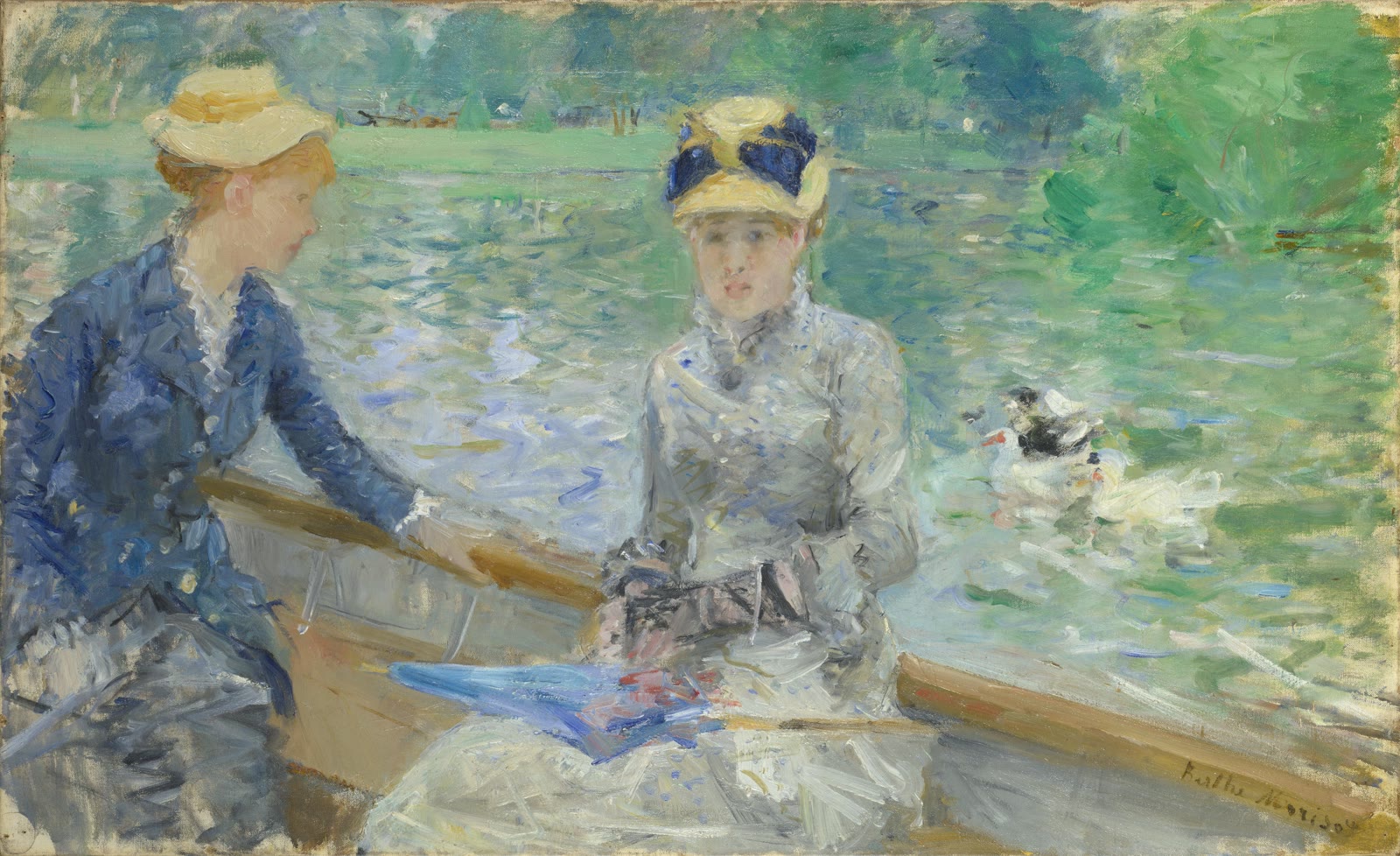
Berthe Morisot is still too often described as if she were an elegant side figure inside Impressionism: important, certainly, but somehow gentler and smaller than the men. That description misses what makes her durable. Morisot built a modern art of partial access. She worked in places that could be dismissed as private or feminine, then made those places structurally unstable, full of air, interruption, and social tension.[1][2][3] In her hands, a balcony, a nursery, a garden path, or a boat on a city lake becomes a machine for testing what can be seen clearly and what slips away.
That is why her famously loose surfaces should not be filed under charming incompletion. The speed in Morisot is an argument. She paints modern life as something caught in passing: a figure turning away, fabric shifting with wind, foliage breaking up a body, water refusing to sit still. The picture does not fail to close; it is organized around the fact that modern perception rarely closes at all.[1][3][6]
The career timeline matters because the method was deliberate
Several anchors clarify the scale of the achievement. Morisot was born in 1841, entered the Salon in the 1860s, and became a central participant in the Impressionist project rather than a peripheral associate.[1][3][6] She showed in seven of the eight Impressionist exhibitions, a record that makes clear how consistently she committed herself to the movement's independent public life.[1][6] That matters because it corrects an old habit of reading her through biography first and art second.
Biography still matters, but as working context. Morisot came from a cultivated bourgeois family, received training that was serious but constrained by what women could access, and built a career inside those limits without letting the limits define the work's ambition.[1][2] Instead of treating restricted social geography as a lesser field, she converted it into subject matter with formal bite.
Her modernity lives in thresholds
The best way to read Morisot is not as a painter of domestic retreat, but as a painter of thresholds.[2][3][5] Her spaces are constantly intermediate: women at windows, women in gardens, women with children, women in boats, figures poised between interior and exterior, attention and drift, sociability and solitude. These are not simply scenes of comfort. They are scenes in which modern life appears as a condition of being visible while never fully settled.
That threshold logic is especially important for nineteenth-century art history. Much canonical modernity was written through boulevard crowds, cafes, railway stations, and the public theater of the city. Morisot does something sharper. She shows that modernity also arrives through smaller calibrations: the management of leisure, the discipline of childcare, the tactility of dress, the pressure of looking at and being looked at in socially coded spaces.[1][2][6] Her pictures are full of softness on the surface and hard decisions underneath.
Summer's Day is leisure painted as instability
The cover image, Summer's Day (1879), is one of the clearest demonstrations.[4] The National Gallery identifies the scene as two women in a boat on the lake in the Bois de Boulogne, a site of Parisian leisure and display.[4] On paper that sounds relaxed. In the painting, it is anything but passive.
The women do not offer themselves to the viewer in a stable social portrait. Their black clothing lands heavily against water and greenery, but the handling around them keeps loosening the scene: reflections break apart, the boat edge slides, the foliage never hardens into a fixed frame.[4] Morisot gives leisure a nervous structure. The city is present as ritual and code, yet the image itself feels provisional, as if a gust of air could rearrange it in the next second.
That is a signature move in her work. Instead of making bourgeois femininity legible through polished finish, she paints it through fluctuation. The result is not vagueness. It is precision about instability.[3][4]
The Cradle proves that intimacy is also a formal problem
The same intelligence appears in The Cradle (1872), now in the Musee d'Orsay.[5] This is one of the works most likely to be sentimentalized because the subject is maternal attention. But the painting's force lies in its structure. The mother's gaze, the protective diagonal of the veil, and the quiet enclosure around the sleeping child create a field in which care is both tenderness and vigilance.[5]
That is the larger Morisot pattern. She does not choose intimate subjects because they are small in meaning. She chooses them because they allow pressure to build through relation: watcher and sleeper, sitter and air, dress and foliage, body and threshold. Her compositions keep asking how much of another person, or another moment, can ever be held in view before it shifts.[2][5]
Why Morisot reads more sharply now
Morisot matters in 2026 because she expands the map of what modern painting can be about. She makes room for a version of modernity that is not centered on industrial spectacle or masculine urban bravado.[1][2][6] Her art is built from fleeting intervals, social permissions, and sensory incompletion, yet it never feels weak. It feels exact about the instability it records.
If we read her only as the painter of women and children, we flatten her into subject matter. If we read her as a painter of thresholds, she comes back into focus as one of the movement's most rigorous engineers of looking. The unfinished edge, in Morisot, is where modern life enters the picture.[1][3][4]
Sources
- National Museum of Women in the Arts, "Berthe Morisot" artist profile.
- Musee d'Orsay, "Berthe Morisot (1841-1895)" exhibition presentation.
- The National Gallery, "Berthe Morisot" artist page.
- The National Gallery, Summer's Day object page.
- Musee d'Orsay, Le Berceau (The Cradle) object page.
- Encyclopaedia Britannica, "Berthe Morisot".