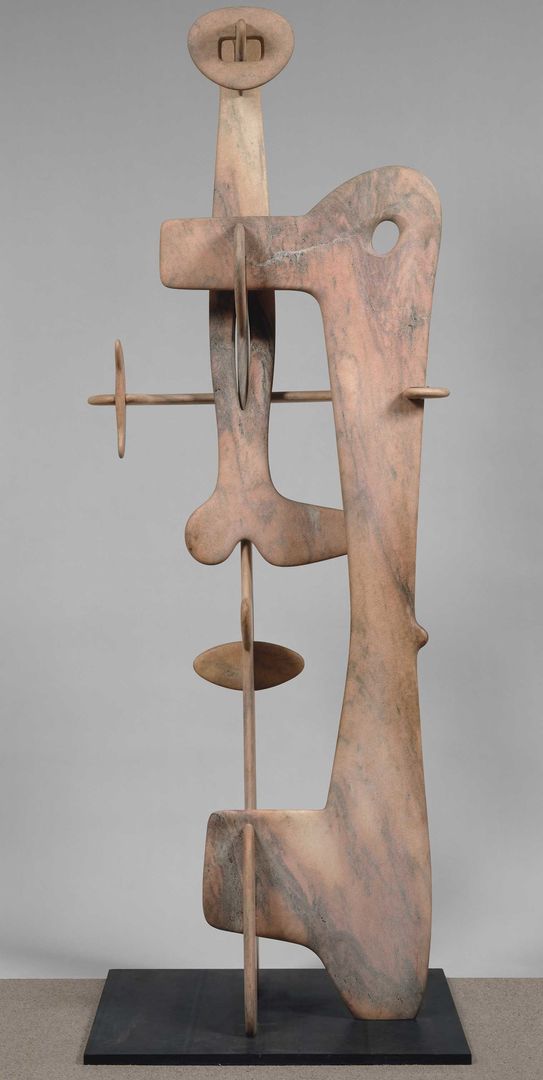
Look through the body. In Isamu Noguchi's Kouros, space remains visible where a chest or abdomen might close it off. Long pieces of pink marble rise beside one another; shorter shapes cross and interrupt them. We recognize something standing before we can confidently assign its parts to a person.
The sculpture is nearly three metres tall, yet its height does not produce the reassurance of a single, massive column. Your eye keeps returning to the connections. How does one piece meet the next? Where does its weight go? Noguchi's figure makes standing look like a relationship among parts.[1]
Completed in 1945, Kouros belongs to The Metropolitan Museum of Art. Its title invokes the standing male youths of Archaic Greek sculpture, and the museum identifies one of its own ancient statues as Noguchi's particular reference.[1] That association offers a way into the work. Begin with the familiar idea of a body upright in stone, then watch how much Noguchi can change while preserving the sense of someone there.
A body with room inside it
The photograph lets us see several kinds of edge at once. A broad, softly curved face of marble becomes a much narrower strip as its plane turns away. Thin edges give the stone a blade-like appearance, while the rounded contours suggest growth, joints, or bones. The sculpture moves between architectural assembly and bodily presence without settling completely into either.
At the top, a rounded shape offers the suggestion of a face, but its opening frames another upright piece. Farther down, a slender horizontal element extends to either side, crossing a long vertical opening. These small intersections interrupt the large slab on the right. The figure's bulk gathers unevenly, yet the thin projecting parts keep drawing our attention away from it.
This is why identifying a head, an arm, and two legs too quickly can make the work less interesting. An anatomical label ends a small uncertainty that Noguchi has made productive. Follow a contour instead. It rises, swells, narrows, and meets another piece. The eye can make that journey before deciding what organ or limb it resembles.
The openings matter as much as the outlines. They allow the background to enter the figure. In the reproduction, the pale field behind the sculpture is visible between its parts, so the body never entirely separates itself from its surroundings. Even at monumental scale, it leaves room for the world to pass through.
Against that openness, the ancient precedent becomes surprisingly specific. The Met's Attic kouros, dated about 590–580 BCE, advances its left leg while keeping its arms at its sides. It originally marked the grave of a young Athenian aristocrat. The museum also emphasizes the geometric patterning of its anatomy: this ancient body was already a carefully organized construction of forms, rather than an unmediated copy of flesh.[2]
Noguchi's departure therefore involves more than reducing realistic detail. He opens the figure's internal structure to view. Where the ancient youth presents a continuous bodily surface, the modern work asks us to make a whole from separated elements. Recognition becomes something we participate in.
Balance has material help
There is a tempting story about Kouros: that its marble pieces stand together entirely without fastenings. The Met's 2000 educator guide explicitly describes an assembly without pins or adhesives. Its current collection record, however, specifies eight interlocking pieces of pink Georgian marble, balanced and secured by two strategically placed pins. That is the account followed here.[1][5]
The difference matters because a close reading should survive contact with the object. The sculpture's delicacy does not depend on a claim that engineering has vanished. Nor does the older description establish when or why the two accounts diverged. Neither source, on its own, supplies that history.
What remains compelling is the visible negotiation of support. Some pieces rise; others cross them. Broad surfaces catch the light while narrow edges retreat. Looking at the junctions, we become aware that uprightness has been arranged. The sculpture can appear vulnerable without being an invitation to imagine an imminent collapse.
Knowing about the pins even sharpens that experience. A body can look self-possessed while relying on connections we do not immediately see. Here, assistance belongs to the construction of the figure. It need not spoil our encounter with it.
A figure that could begin again
Noguchi gave this assembly a future as well as a form. As Met archivist James Moske explains, the museum asked the artist for information when it acquired Kouros in 1953. Noguchi's reply allowed for the sculpture to be taken apart and rebuilt somewhere conditions became favorable. In 2020, conservators did dismantle and reassemble it for the museum's anniversary exhibition.[3]
That possibility changes the meaning of permanence. The work can remain itself through a carefully managed interruption of its standing form. Its identity resides partly in the relationships that can be restored among its pieces. Marble endures, but so does knowledge of how to put it together.
The historical setting gives this thought weight. In May 1942, Noguchi voluntarily entered the Poston incarceration camp in Arizona, hoping to contribute to life there. A New York resident, he had not been subject to the West Coast removal orders. He soon wanted to leave, but his stay lasted seven months. The Smithsonian's account makes the crucial distinction clear: choosing to enter did not leave him free to depart when he wished.[4]
It would be too simple to turn every opening in Kouros into an illustration of that experience. The sculpture supplies no fixed code linking a particular marble shape to a particular episode. In a 2022 Met essay, the Abang-guard collaborators and Louisa Lam suggest that its separate components may evoke wartime fragmentation, while their mutual support offers an image of resilience.[6] That is a persuasive interpretation, with room left for other readings.
Noguchi's documented provision for reassembly gives us something firmer to hold alongside it. This is a figure conceived with the possibility of another setting, another standing. The joints make that possibility tangible.
Return to the spaces inside the body. They first made the figure seem incomplete. After following its supports, they can feel generous: intervals that let separate pieces retain their shapes while becoming a presence together. Kouros stands tall, and lets us see how much standing asks of its parts.
Sources
- The Metropolitan Museum of Art, “Isamu Noguchi, Kouros” — current object record, date, dimensions, marble, eight components, two pins, and Greek reference.
- The Metropolitan Museum of Art, “Marble statue of a kouros (youth)” — Attic precedent, ca. 590–580 BCE, its pose, geometric anatomy, and funerary purpose.
- James Moske, “True to Form: 20th-Century Artist Statements from The Met Archives,” December 23, 2020 — photograph, Noguchi's 1953 statement, and the sculpture's reassembly in 2020.
- Howard Kaplan, “Gaman and the Story of Isamu Noguchi,” Smithsonian American Art Museum, June 22, 2010 — voluntary entry into Poston and the restrictions on leaving.
- Michael Norris, Greek Art: From Prehistoric to Classical, The Metropolitan Museum of Art, 2000, p. 203 — the older description of the construction, which differs from the current object record.
- Maureen Catbagan, Louisa Lam, and Jevijoe Vitug, “Asian American Modernism with Abang-guard,” The Metropolitan Museum of Art, June 9, 2022 — interpretation of Kouros through fragmentation, balance, and resilience.