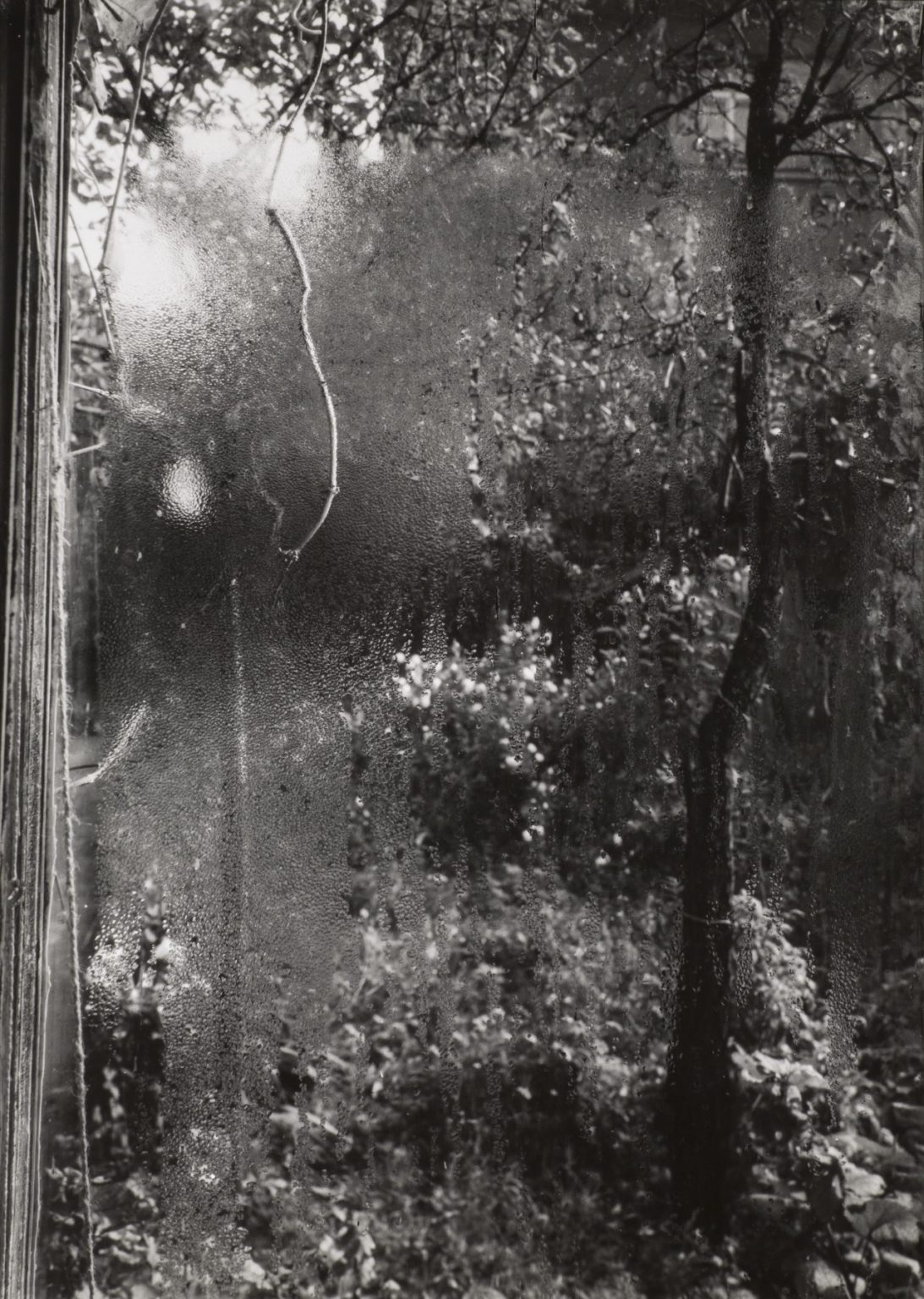
A window promises a view. Josef Sudek makes us hesitate at the glass. In the summer photograph from The Window of My Studio reproduced here, the garden remains close enough to invite recognition, yet difficult enough to keep that recognition unfinished. We know where we are looking without feeling that we have arrived.
The New Orleans Museum of Art identifies this gelatin silver print as The Window of My Studio, 1940–1954 (summer), accession 82.36.[1] That broad date should stay broad: it locates the work within Sudek's sustained exploration of the subject, without supplying a precise day or year for this exposure. The photograph asks for close attention; its catalogue information asks for a little restraint.
Where the eye gets caught
Start at the left edge, where the narrow window frame supplies a firm vertical. Beside it, a pale, slender stem hangs down against a field of tiny droplets. Its crooked outline is surprisingly legible. Across the pane, however, other forms dissolve into dark patches or break apart in clearer streaks. Sharpness arrives in fragments.
Above, leaves crowd the top edge. At the right, a dark trunk gives the garden a stronger upright. Between those anchors, the moisture makes an uneven curtain: finely stippled in one place, interrupted by larger beads and irregular channels in another. The glass has several textures, and each gives a different degree of access to what lies behind it.
Try following the hanging stem downward, then move across to the trunk. The eye crosses a region that is harder to name than either plant form. Something outside catches our attention; the intervening surface pulls it forward again. The composition makes that change of attention almost physical.
The effect is particularly striking because the photograph offers so little geographical information. A garden view can establish distances with a path, a wall, or a clear horizon. Sudek gives our eyes less certainty about how to travel. The space beyond the window feels present, but it is hard to occupy imaginatively. We cannot simply walk into this picture.
Read this way, the image makes recognition into an activity we can feel ourselves performing. A stem, a trunk, a leaf: each identification briefly steadies the view. Between them, light spreads through moisture without settling into an easily named object.
NOMA curator Russell Lord connects the window's surface with the surface of the photograph itself: both allow a viewer to attend to a material plane while perceiving a world beyond it.[1] That observation gives the image an unusually quiet self-awareness. Sudek can make a photograph about seeing without putting a camera, a photographer, or a mirror into the frame.
The room behind the view
The studio was a real working place in a Prague courtyard. Its institutional history records that Sudek began using it in June 1927 and lived there with his sister and assistant, Božena Sudková, until his move to another address in 1959. He continued using its darkroom afterward.[2] The possessive in My Studio has weight: this view belonged to a space of work and everyday habitation.
The same history says that the closure of his photography business during the early years of the Second World War helped change the studio from a workplace into a subject.[2] The window series began in 1940 and extended beyond the war. That chronology matters, but the summer image contains no visible event that lets us pin it to a particular political moment.
It is tempting to let the pane stand for withdrawal and the garden for freedom. Such a reading makes the arrangement too settled. Light still crosses the boundary. The exterior continues to change what can be seen from the interior. The photograph can feel sheltered and unsettled at once, with neither mood cancelling the other.
Nor should this window become a complete biography. The Jeu de Paume's account of its 2016 Sudek retrospective places his studio experiments alongside photographs made on walks through Prague, in its suburbs, and on excursions into the countryside.[3] Returning to one view belonged to a practice that also involved going out. The narrow field of this photograph is an artistic choice within that larger movement.
What returning makes possible
Repeated attention changes the status of an ordinary subject. On a first visit, a photographer might ask what makes this garden distinctive. Returning to the same window allows a different question: what has happened to the possibility of seeing it today?
Weather and vegetation can alter the view while the familiar location supplies continuity. The studio's history lists several overlapping projects, including The Window of My Studio, A Walk in My Garden, and Still Life on the Window of My Studio.[2] Those titles describe an artist finding different problems within a small physical territory. A room can offer enough material for years when the subject includes how things appear.
Sudek's attention also extended to the finished print. The International Center of Photography notes his preference for large-format contact prints and his experiments with pigment printing.[4] NOMA identifies the particular object reproduced here as gelatin silver.[1] These distinctions matter: a general account of his methods should not turn every print into the same process, or make the digital reproduction a substitute for its material surface.
On screen, we can still attend to the picture's refusal to resolve immediately. Let the garden come forward, then let the glass interrupt it. The second look does not necessarily deliver more objects to identify. It makes us more conscious of the looking itself. Sudek has taken a familiar view and left enough resistance in it to keep familiarity from becoming indifference.
Sources
- Russell Lord, “Object Lesson: The Window of My Studio by Josef Sudek,” New Orleans Museum of Art, May 27, 2020 — reproduced photograph, accession 82.36, medium, date range, and the relationship between window and photographic surface.
- Ateliér Josefa Sudka, “About atelier” — the Újezd studio's history, Božena Sudková, wartime changes, and the overlapping studio and garden series.
- Jeu de Paume, “The Intimate World of Josef Sudek,” exhibition held June 7–September 25, 2016 — studio experiments in the context of Sudek's broader work in Prague and the countryside.
- Meredith Fisher, “Josef Sudek,” International Center of Photography — collection biography drawn from Reflections in a Glass Eye (1999), p. 229; print quality, large-format contact prints, and pigment-printing experiments.