Amrita Sher-Gil is often introduced with the compression reserved for artists who died young: born in Budapest in 1913, trained in Paris, returned to India, dead in Lahore at twenty-eight, later treated as a foundational modernist for Indian art.[1][2] The summary is useful, but it can make her career sound like a bright line between Europe and India. The paintings are more complicated. They show an artist learning to use inherited modernist language while refusing to remain only its subject.
That is why the self-portraits matter so much. They are not side documents to a larger career. They are the workshop where Sher-Gil tested how a young woman of Hungarian and Sikh parentage, aristocratic background, Paris training, and colonial-world mobility could appear inside modern art without being consumed by its ready-made roles.[3][4] She does not simply paint herself as a confident artist. She paints the pressure of being looked at, classified, and desired, then turns that pressure into authorship.
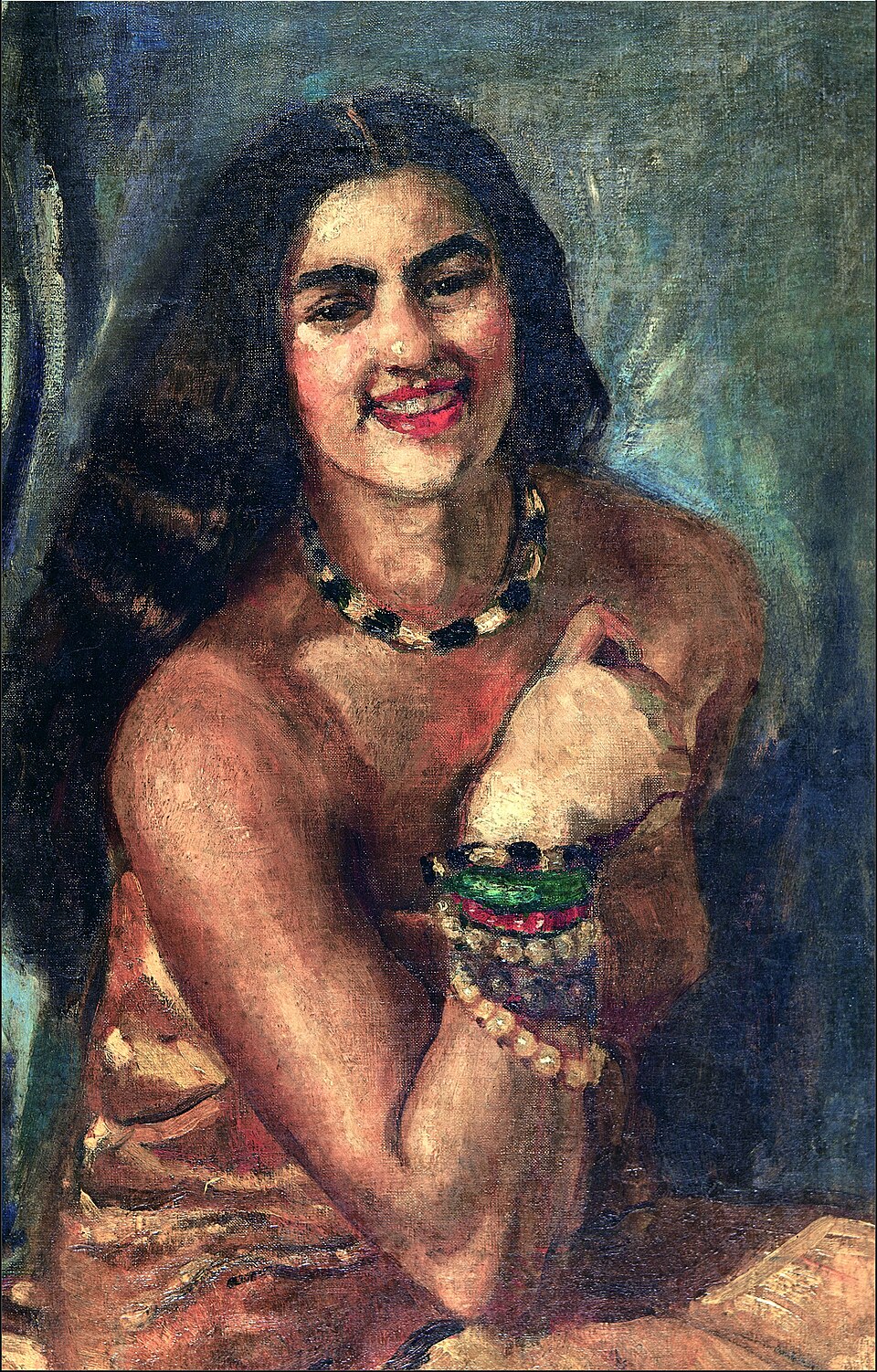
The 1930 self-portrait used here is bluntly direct. Sher-Gil faces the viewer in a dark dress, her body set against a warm red ground, the pose frontal enough to feel declarative without becoming theatrical.[6] The image has no studio clutter to prove labor and no anecdotal setting to soften the encounter. Its force comes from compression: face, dress, ground, gaze. She does not give the viewer much narrative to hold. Instead, she makes looking itself the subject.
A Painter, Not A Pose
Sher-Gil's Paris years gave her technical permission and a problem. The UCLA International Institute's account of Saloni Mathur's lecture stresses that Sher-Gil made much of her formal painting study in Paris during modernism's high moment, then had to work through the influence of Gauguin and Van Gogh rather than simply inherit it.[3] That training mattered. It gave her figure painting, oil handling, and access to the Post-Impressionist grammar that shaped much of her early work. But Paris also supplied a script for the non-European woman as object, muse, or exotic sign.
Her answer was not to step outside European modernism. She knew that language too well. Instead, she occupied it from an angle that made its assumptions visible. In the 1930 self-portrait, the red ground and simplified form do not imitate academic portraiture's social polish. They make the figure harder to place. Sher-Gil looks composed, but the picture is not simply self-assured. It is watchful.
This distinction matters because "confidence" can flatten her into an icon of premature genius. The stronger reading is that Sher-Gil understood self-fashioning as work. Kiran Nadar Museum of Art's account of her self-portraiture emphasizes her self-consciousness as both artist and modern woman, a double position that made the self-portrait more than autobiography.[5] She was shaping a viable artistic subject in paint: not muse, not student, not colonial specimen, but maker.
The Tahitian Detour
The sharpest test came in Self-Portrait as a Tahitian in 1934. Documenta 14 identifies the work as an oil painting made after her Paris training and stresses its relation to the Western colonial gaze.[4] UCLA's summary is even more explicit about the art-historical target: the painting overtly references Gauguin while asking how Paris, Tahiti, India, Hungary, and European modernist precedent could belong to one modernist map.[3]
Sher-Gil's move is risky because she does not simply reject the exoticizing frame. She stages herself inside it. UCLA's account of Mathur's close reading emphasizes that Sher-Gil's figure is not presented as a sexual object ready for consumption and that the small-room setting denies Gauguin's lush fantasy space.[3] That instability is the point. Sher-Gil makes the viewer feel the machinery of resemblance, projection, and possession.
The painting also complicates any easy celebration of reversal. Sher-Gil was not a powerless colonial subject looking back from below. She moved through elite and international spaces, and UCLA's report frames the work through her mixed cultural position between Europe and the subcontinent.[3] But the complication strengthens the painting rather than weakens it. Self-Portrait as a Tahitian does not offer purity. It offers self-conscious negotiation. Sher-Gil uses the very language that threatens to frame her and makes it answer to her own body.
Seen beside the 1930 self-portrait, the Tahitian image clarifies the earlier work. The frontal gaze was never just a young painter declaring "I am here." It was already an argument about who gets to decide what "here" means. Paris, India, Hungary, art school, aristocratic household, colonial modernity, and gender all crowd the frame even when the painting looks spare.
Returning Without Becoming Provincial
Sher-Gil's return to India at the end of 1934 is sometimes told as a conversion story: Europe falls away, India becomes the real subject. The better version is less clean. Britannica describes her as a pioneer of modernist painting in Indian art whose work often portrayed women and their struggles.[1] NGMA's centenary exhibition note similarly treats her short life as unusually rich and central enough to justify a major retrospective frame.[2] Those institutional summaries point toward importance, but the paintings show the mechanism.
In works such as Group of Three Girls and Bride's Toilet, Sher-Gil turns from theatrical self-presentation toward dense, quiet arrangements of women, fabric, posture, and suspended time.[5] Impart's object listings place both works in the National Gallery of Modern Art context and identify the basic subjects: three seated girls gazing downward, and women gathered around a bride.[5] The shift in subject is obvious. The deeper continuity is in the gaze.
The women in these later paintings are not offered as ethnographic evidence. They do not perform liveliness for an outside viewer. They often seem heavy with waiting, absorbed into interiors, ceremonies, or bodily proximity. That restraint is not passivity. It is Sher-Gil refusing the old demand that the non-European subject be legible as spectacle. The self-portrait's direct look becomes, in the later work, a more distributed refusal: figures who withhold, turn inward, or occupy the picture without explaining themselves.
Documenta 14's note on her later years is useful here because it names the range: rural domestic life, hillside landscapes, local ceremony, animals, and color shaped by encounters with Brueghel, Mughal and Pahari painting, and visits to Ajanta and Ellora.[4] The point is not that Sher-Gil replaced European sources with Indian ones. She built a style out of crossing, comparison, and friction. Her modernism does not become authentic by becoming isolated. It becomes stronger by deciding what to absorb and what to resist.
The Double Gaze
The phrase "double gaze" helps because Sher-Gil's achievement is not reducible to identity or technique alone. One gaze looks outward, studying the systems that made her visible: Paris academies, male modernists, colonial fantasies, Indian nationalist expectations, museum categories. The other gaze looks back from inside the painting, reorganizing those systems around an artist who refuses to be only evidence for them.
That is why the 1930 self-portrait still feels charged. It is not the most programmatic of her works, and it does not carry the explicit colonial quotation of Self-Portrait as a Tahitian. But it has the hard seed of the whole project. Sher-Gil puts herself before us without offering herself up. She uses portraiture as a site of control, not confession.
Her later reputation can sometimes turn her into a bridge between Europe and India, as though a bridge were a neutral structure. Sher-Gil is more interesting than that. She is a pressure point. Her paintings ask what happens when modernism's borrowed forms are handled by someone whom modernism also tried to turn into an image. The answer is not synthesis in the soft sense. It is a sharper authorship: the right to look trained, foreign, Indian, female, ambitious, and unresolved at the same time.
That unresolved quality is the reason Sher-Gil's short career remains large. She did not live long enough to settle into a late style, but she did make one durable claim. The painted self could be more than likeness. It could be a place where the artist studies the gaze coming toward her, then sends it back changed.[1][3][4]
Sources
- Encyclopaedia Britannica, "Amrita Sher-Gil" - biography covering her dates, Budapest birth, Lahore death, and importance to modernist Indian art.
- National Gallery of Modern Art, New Delhi, "Amrita Sher-Gil: The Passionate Quest" - exhibition note for the 2014 birth-centenary show.
- UCLA International Institute, "Behind Sher-Gil's 'Tahitian'" - report on Saloni Mathur's close reading of Self-Portrait as Tahitian, Gauguin, Van Gogh, and global modernism.
- documenta 14, "Amrita Sher-Gil" - exhibition artist page on Self-Portrait as a Tahitian, Red Clay Elephant, and Sher-Gil's later Indian subjects.
- Impart, "Amrita Sher-Gil" - artist page with object entries for works including Group of Three Girls, Hungarian Gypsy Girl, and Bride's Toilet.
- Wikimedia Commons, file page for Amrita Sher-Gil Self-portrait.jpg - image source page for the 1930 self-portrait used as this article's cover.