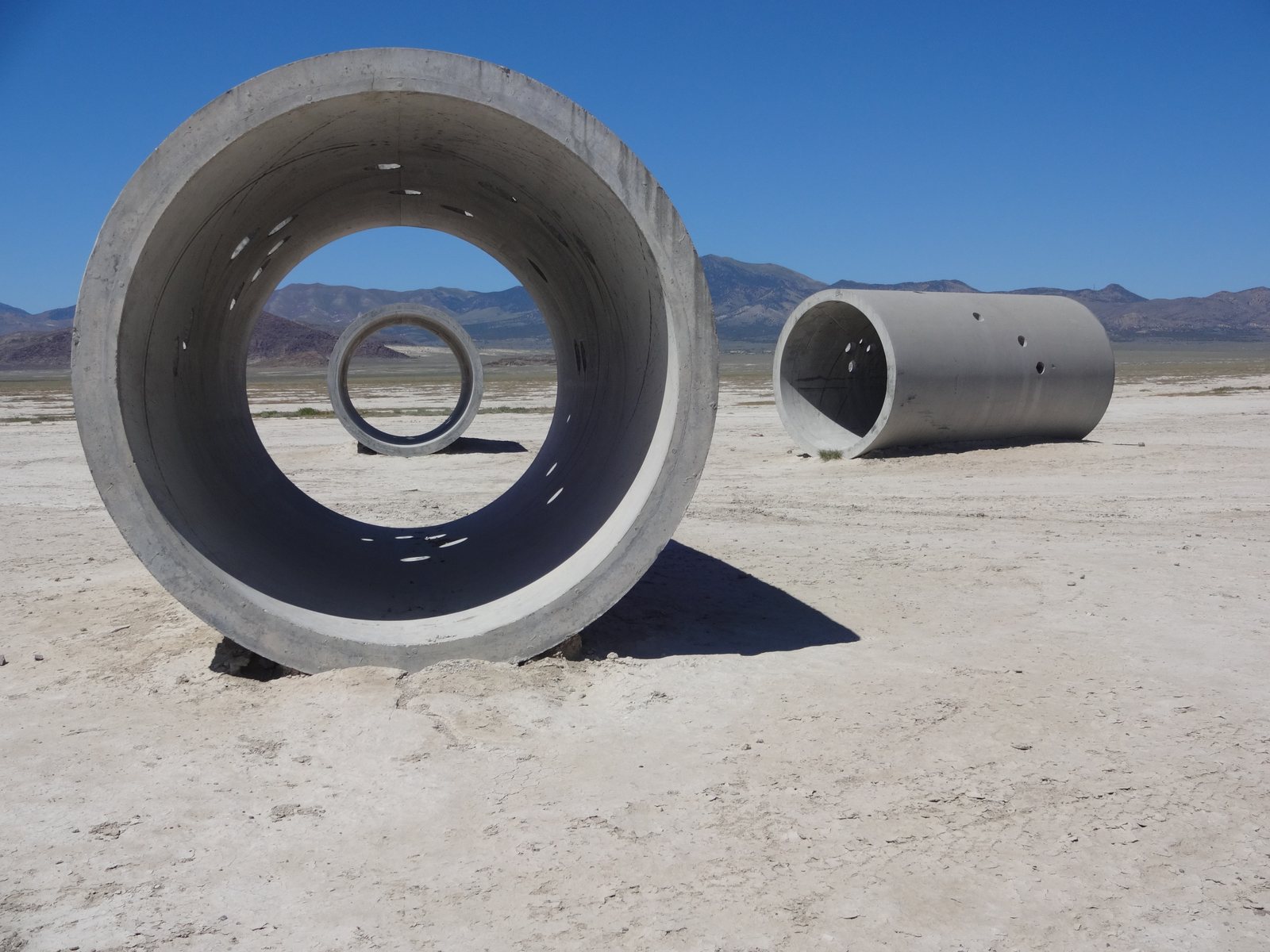
Nancy Holt's Sun Tunnels is easy to describe too quickly: four concrete cylinders in the Utah desert, aligned with the solstices, punctured by star patterns. That description is accurate, but it makes the work sound like a diagram that happened to be built outdoors. The force of the piece is stranger. Holt did not simply add astronomical meaning to a remote site. She made distance itself become part of vision.
The work was built between 1973 and 1976 in the Great Basin Desert near Lucin, Utah.[1][3] Holt arranged four concrete tunnels in an X configuration so that their axes frame the rising and setting sun at the summer and winter solstices.[1][3] Each cylinder is large enough to enter, and each is pierced with holes corresponding to constellations: Draco, Perseus, Columba, and Capricorn.[1][3] Those facts matter, but the artwork begins before the facts resolve. You approach through openness, heat, silence, and scale; then the cylinders give that openness a frame.
Image context: the cover photograph comes from Wikimedia Commons and shows the tunnels as real objects in an exposed landscape rather than as an aerial plan or explanatory graphic.[5] That choice is required by the article's argument. Holt's sculpture is not a clean symbol of cosmic order. It is a photographic, bodily, weather-exposed encounter with concrete, horizon, shadow, and sky.
The desert is not a backdrop
Holt purchased the land for Sun Tunnels in 1974, after searching the western desert for a place where open space could be experienced without the compression of city architecture.[1][2] That biographical fact matters because the work is not a portable sculpture later assigned to a dramatic site. Its form depends on a particular desert condition: long sightlines, sparse human interruption, and a horizon strong enough to make small changes in light feel structural.
This is where Sun Tunnels differs from a monument. A monument often concentrates attention on an object that claims permanence. Holt's work does almost the opposite. The tunnels are heavy, industrial, and plainly present, yet they exist to redirect attention outward. They make the sky and horizon more visible by admitting that the human eye needs help. The concrete does not dominate the desert. It teaches the viewer where to stand, where to look, and how slowly a frame can change the world it contains.
Dia's site page is useful because it treats the work as both sculpture and location, with practical visitor information sitting beside art-historical description.[3] That pairing is not incidental. Access, remoteness, seasonal light, road condition, and bodily orientation are not conveniences around the artwork. They are part of how the artwork functions. To see Sun Tunnels is to submit to a place that resists instant viewing.
The tunnel makes looking physical
The cylinders give the body a simple task: enter, crouch or stand, and look through. That task changes the desert from panorama to aperture. Outside the tunnels, the basin can feel almost too large to grasp. Inside one, the same landscape narrows into a round field of vision. The viewer becomes aware of edges: concrete rim, distant horizon, the line between light and shade, and the small delay between recognizing sky and feeling enclosed.
Holt's own writing about the work emphasizes this shift from vastness to human scale.[2] The tunnels do not shrink the desert in a sentimental way; they make its scale readable by giving the viewer a measuring device. A person can stand inside a concrete tube and feel the difference between bodily size and planetary motion. The sun is still remote, but it is no longer abstract. It enters the artwork as a timed event crossing an engineered frame.
That is why the solstice alignment is more than an astronomical trick. Around the solstices, the sun can be seen rising or setting through paired tunnels.[1][3] The effect matters because it joins precision to waiting. The alignment is calculated, but the encounter still depends on weather, date, time of day, and the viewer's willingness to be there. Holt makes cosmic order feel contingent, not automatic.
The star holes reverse the scale problem
The constellation holes create a second kind of seeing. During the day, sunlight enters through the holes and casts changing spots across the tunnel interiors.[1][3] At night, the same perforations connect the enclosed body back to the star field. In both cases, scale reverses itself. The sky is immense, but it appears as small openings in concrete. The tunnel is massive, but it becomes porous enough for light to draw inside it.
This reversal is one of Holt's strongest formal moves. The star patterns are not decorative cutouts. They are a way of making the viewer feel how systems of orientation are made. Constellations are already acts of framing: humans connect distant points of light into named figures so the sky becomes navigable. Holt translates that old habit into sculpture. The tunnel holes turn named stars into apertures, and those apertures turn sunlight into marks.
The result is not mystical in a vague sense. It is operational. Sun Tunnels stages a practical relation between perception and instrument. Concrete, compass direction, drilled holes, walking, and timing become the means by which a viewer can register celestial motion. Holt's art is often discussed alongside Land art, but this work is also a camera without film, an observatory without a dome, and a room whose ceiling is the sky.
Why the work still feels contemporary
In a culture trained to consume landscapes as images, Sun Tunnels is stubbornly inconvenient. It cannot be fully captured by one photograph, even though photographs of it can be beautiful.[5] A single image shows cylinders in desert space; it cannot reproduce the slow recalibration between approach, entry, shadow, alignment, and return to open air. That resistance is part of the artwork's intelligence.
Holt's wider practice helps explain this. The Holt/Smithson Foundation frames her work across photography, film, video, installation, public art, and site-specific sculpture, with perception and systems of locating as recurring concerns.[4] Sun Tunnels gathers those concerns into one severe object. It is photographic because it frames. It is cinematic because light changes over time. It is architectural because it gives the body a temporary room. It is astronomical because the room is aimed beyond itself.
The piece also asks for a different ethics of looking. The desert is not presented as empty space waiting for artistic occupation. It is the condition that makes the work possible and the force that keeps exceeding it. Wind, dust, heat, road distance, and darkness remain active. The artwork succeeds because it does not pretend to master those conditions. It gives them a visible structure and then lets them remain larger than the sculpture.
That is why Sun Tunnels still matters. It turns sight away from instant possession and toward alignment: between body and horizon, concrete and sky, human time and solar time, named constellations and lived weather. Holt built four tubes in the desert, but the real work is the disciplined change in attention they produce. You arrive with a landscape. You leave having learned that a frame can be a form of humility.
Sources
- Holt/Smithson Foundation, "Sun Tunnels" - official artwork page with date, site, materials, configuration, solstice alignment, and constellation details.
- Holt/Smithson Foundation, Nancy Holt, "Sun Tunnels" - artist writing on the work's desert site, scale, light, and framing logic.
- Dia Art Foundation, "Nancy Holt, Sun Tunnels" - visitor and site page for the Utah earthwork, including location, construction dates, alignment, and institutional stewardship.
- Holt/Smithson Foundation, "Biography: Nancy Holt" - artist biography and practice overview connecting photography, film, video, installation, public art, and site-specific sculpture.
- Wikimedia Commons, "File: Nancy Holt, Sun Tunnels, 1973-1976.jpg" - source page for the real photograph used as this article's cover image.
Editor’s Pick Review
This piece earns the editor’s pick because it treats Sun Tunnels as an experience of perception rather than a tidy Land art fact sheet. The article keeps the argument close to the work’s materials—concrete, desert distance, solstice alignment, drilled star apertures, shadow, heat, and bodily approach—so the reader understands why Holt’s sculpture cannot be reduced to an outdoor diagram. Its strongest move is the repeated return from art-historical description to the physical act of looking: the tunnels frame the horizon, make scale readable, and turn celestial timing into something a visitor has to wait inside.
It also passes the stricter visual standard for this round. The image is a real, topic-grounded photograph of the Utah work in open desert space, not an analytical chart or decorative abstraction, and the caption explains why that choice matters to the thesis. The Chinese version carries the same argument with a natural critical rhythm, stable terminology, and enough scene texture to preserve the essay’s visual intelligence without turning the prose into a literal translation.