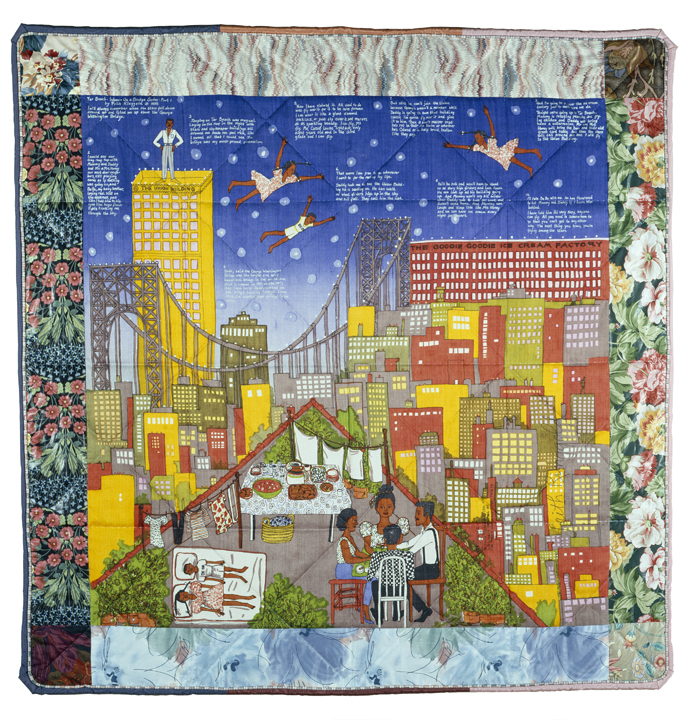
Faith Ringgold's Tar Beach 2 looks joyful before it looks strategic. A bright city rises behind a Harlem rooftop. Children fly through a blue night sky. A family gathers around food. The George Washington Bridge stretches across the center like a giant claim waiting to be crossed. Floral borders frame the scene, while blocks of handwritten text hover in the sky, turning the image into something closer to a speaking object than a silent picture.[1][2]
That first impression matters, but it is not enough. The work's real force comes from the way Ringgold refuses to separate fantasy from possession. Cassie Louise Lightfoot, the child narrator drawn from Ringgold's memories and alter ego, does not simply dream of flying for pleasure. PAFA's object record explains that Cassie can possess whatever she flies over, and in this image that means the George Washington Bridge.[1] Flight is therefore not escape from the city. It is a way of rewriting who gets to own, name, and move through it.
Image context: the cover is a museum photograph of the actual quilted work, not a diagram or a generated visual. That matters because Ringgold's argument lives in the join between image and object: painted-looking skyline, printed silk, pieced cotton, text, border, thread, and a square format that keeps rooftop, bridge, and sky in one held field.[1]
The roof is not background
The roof in Tar Beach 2 is easy to treat as a stage set, but it is the work's social engine. The Philadelphia Museum of Art describes the quilt as drawing on Ringgold's childhood memories of growing up in Harlem, enlivened by fantasy, with Cassie flying among the stars and becoming a heroic explorer.[2] The Guggenheim's 2025 press kit gives the urban detail a sharper historical temperature: before air conditioning was common, New York rooftops could become places where families sought relief outdoors, dining and resting above the heat of the apartment building.[3]
That makes the rooftop double. It is domestic space and public threshold at once. It belongs to the family, but it is exposed to the city. It is intimate enough for food, mattresses, and conversation, yet high enough to turn the skyline into a field of possibility. Ringgold places the family meal near the lower center, not as a sentimental pause from the fantasy but as the launch site for it.[1][2] The flying child is not cut loose from ordinary Black family life. She rises out of it.
This is why the quilt's warmth should not be mistaken for softness. The rooftop table, the sleeping children, the adults, the laundry-like fabric borders, and the surrounding buildings all insist that freedom begins in a specific material world. Cassie does not enter abstraction when she flies. She enters New York, with its bridge, buildings, labor, weather, and family memory still visible below her.[1][3]
The bridge is a machine for claiming space
The George Washington Bridge is the work's hardest object. It cuts through the center of the composition as infrastructure, icon, and obstacle. PAFA's description points directly to the bridge as the thing Cassie can possess by flying over it.[1] The Guggenheim's object record for the original 1988 Woman on a Bridge #1 of 5: Tar Beach fixes the scale of that claim: acrylic paint, canvas, printed fabric, ink, and thread, nearly human-height, now held as a major museum work rather than a private childhood memory.[4]
That is the crucial distinction. Cassie's flight is magical, but it is not vague magic. It has a legal and spatial imagination. To fly over the bridge is to reverse the normal relation between a child and a monumental structure. The bridge usually belongs to engineers, commuters, authorities, toll systems, and a city map drawn from above. In Ringgold's quilt, a girl claims it by movement, story, and vision.[1][4]
The scale makes the claim feel even bolder. Cassie is small against the bridge and skyline, but she is not diminished by that smallness. Ringgold repeats the flying body across the sky, so the child's movement becomes rhythmic rather than isolated. The viewer does not see one fragile exception. The viewer sees a body learning to occupy air. The city remains huge, yet the child's story has become large enough to organize it.
Text keeps the fantasy from floating away
One of Ringgold's strongest decisions is to write inside the picture. Text panels in the night sky prevent the image from becoming a mute dream scene. They make the work narrate itself. The Philadelphia Museum calls attention to Ringgold's combination of image and imagination, text and texture, as a contemporary spin on quilting and storytelling traditions.[2] The National Museum of Women in the Arts places that practice inside Ringgold's larger story-quilt method: paintings and text on quilted fabric that join autobiographical, historical, and imagined scenes about Black experience.[5]
The written voice matters because it gives Cassie authority over the terms of her fantasy. She is not only pictured flying. She tells the story that makes flight meaningful. That difference changes the viewer's position. We are not invited to look at a charming child from outside. We are made to encounter a narrator who names what the image is doing.
The quilt form intensifies that authority. Ringgold began making story quilts in the early 1980s, and the Smithsonian American Art Museum notes that she turned to the format after earlier work in painting, protest, performance, soft sculpture, and unstretched forms inspired partly by thangkas.[6] By 1983, according to SAAM, she was writing stories directly onto painted quilts.[6] Tar Beach 2 belongs to that larger breakthrough. It lets image, fabric, border, and voice share the work instead of assigning meaning to one privileged medium.
The border is part of the argument
The floral fabric border can look decorative if viewed too quickly. It is not. It keeps the city and sky from pretending to be a conventional easel painting. Ringgold produced Tar Beach 2 as a limited-edition silkscreen on silk with pieced printed cotton, according to PAFA's object record.[1] The Philadelphia Museum similarly identifies the work as a story quilt, tying image, imagination, text, and texture together.[2] The border therefore announces that the work's structure comes from cloth as much as from pictorial space.
That matters because Ringgold spent much of her career challenging inherited hierarchies about which media count as serious art. NMWA notes that she used story quilts partly as a way to work outside a Western canon dominated by white male standards, while SAAM describes her broader practice as a seven-decade effort to use art, life, and voice to advocate for social equity and intervene in dominant histories.[5][6] In Tar Beach 2, those commitments do not arrive as a lecture added to the image. They are built into the medium.
The quilt can be read, looked at, remembered, and imagined as something touched. Its square format holds the story, but its edges keep reminding the viewer of domestic labor, inherited craft, and collaborative knowledge. The city is not framed by neutral museum space. It is framed by fabric, by a medium associated with women, family, care, portability, and making-do. Ringgold turns that association into strength rather than apology.[3][5][6]
Why the flight still lands
The lasting power of Tar Beach 2 is that it lets freedom stay concrete. The child flies, but the roof remains. The bridge is claimed, but the family table remains. The story rises into the sky, but the words stay sewn into a made object. Ringgold does not ask viewers to choose between Black everyday life and imaginative sovereignty. She shows how one can generate the other.[1][2][3]
That is why the work still feels so alive. It is not only a bright image of uplift, nor only a political allegory in textile form. It is a carefully built system in which material, memory, fantasy, and claim reinforce each other. A Harlem rooftop becomes a launchpad. A bridge becomes a prize. A child becomes a narrator. A quilt becomes a city map drawn from below and above at the same time. In Ringgold's hands, flight is not disappearance. It is the moment a girl looks at the structure over her city and says, in effect: that can be mine too.
Sources
- Pennsylvania Academy of the Fine Arts, "Tar Beach 2" - object page with image source, date, medium, edition, dimensions, Cassie Lightfoot narrative, rooftop memory, and George Washington Bridge possession motif.
- Philadelphia Museum of Art, "Tar Beach 2 Quilt" - collection page describing Cassie Louise Lightfoot, Harlem childhood memory, flight, and Ringgold's combination of image, imagination, text, and texture.
- Guggenheim Museum, Collection in Focus: The Reach of Faith Ringgold press kit, 2025 - exhibition context for Woman on a Bridge #1 of 5: Tar Beach, rooftop life, flying Cassie, story-quilt tradition, and the work's modernist dialogue.
- Guggenheim Museum, "Faith Ringgold, Woman on a Bridge #1 of 5: Tar Beach" - official artwork page for the 1988 quilt, including title, medium, dimensions, credit line, and accession record.
- National Museum of Women in the Arts, "Faith Ringgold" - artist profile on Harlem childhood, political activism, story quilts, Black women artists' organizing, and the move beyond white male-dominated canon.
- Smithsonian American Art Museum, "Faith Ringgold" - artist biography covering Ringgold's painting, activism, thangka-inspired unstretched works, first quilt, story-quilt development, and art as historical record.