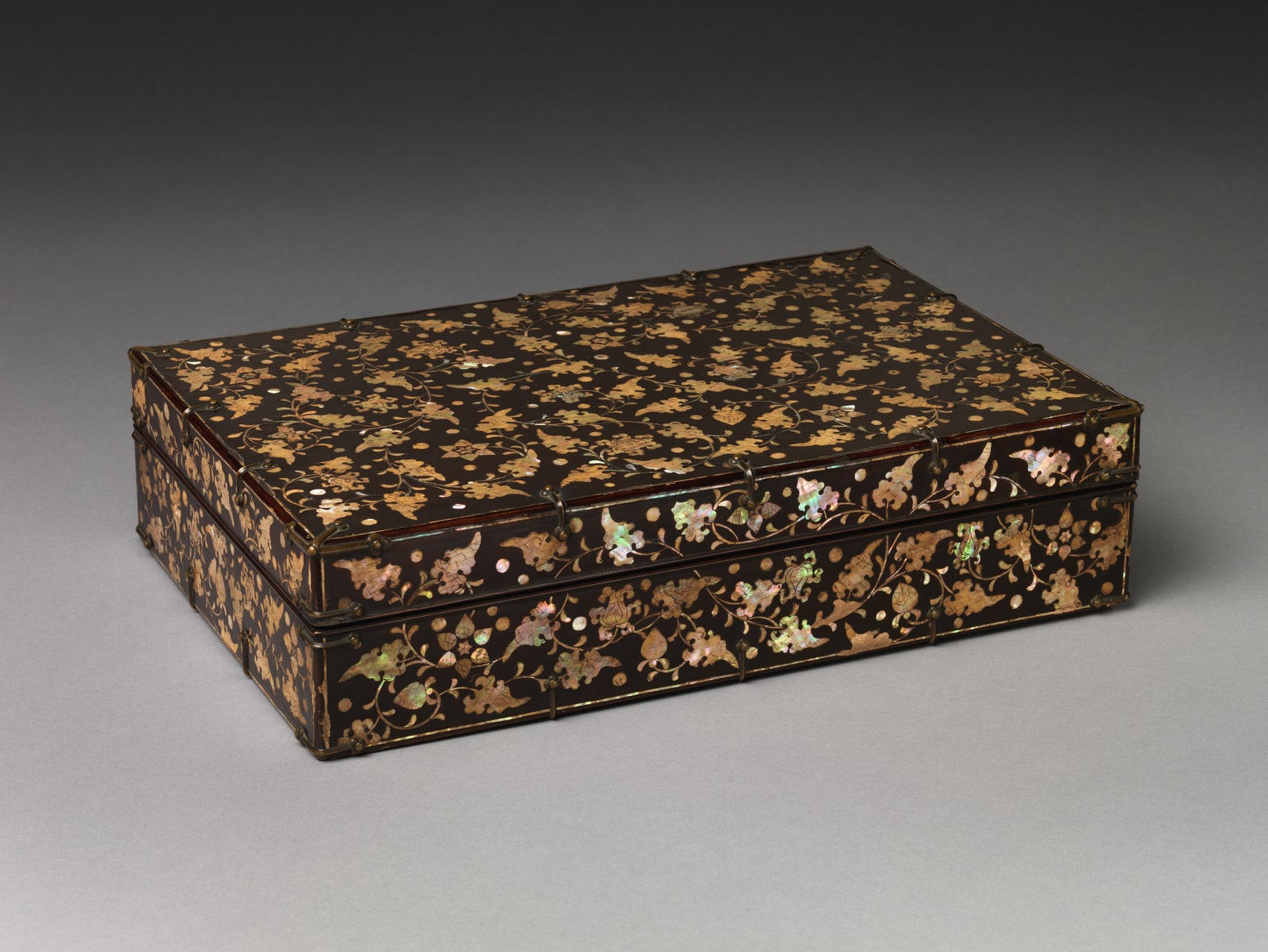
A vine travels across the lid, curls into a leaf, then sends the eye toward another flower. On this Korean stationery box in the Metropolitan Museum of Art, the pale decoration seems to have the fluency of a drawn line. Yet its medium is shell. Each change of direction belongs to a design assembled from pieces, held within a dark lacquer surface.[1]
The Met dates the box to the fifteenth or sixteenth century, during the Joseon dynasty. Boxes of this kind held paper and writing implements for scholarly men.[1] There is a pleasing reversal here: an object associated with brushwork wears a pattern made by cutting and joining. Understanding that work changes the pleasure of looking. The flowing vine begins to reveal its construction.
Building up to the shell
The Korean tradition of shell-inlaid lacquer is known as najeon chilgi. In the process described by the V&A, the maker cuts iridescent shell and glues it onto a lacquer ground. Thin coats of lacquer then cover the surface. Each must harden before the next is added, gradually bringing the surrounding lacquer up to the thickness of the shell. Between coats, lacquer covering the shell is scraped away to expose the design.[2]
The dark spaces have to be built up too. Shell and coating become parts of one surface through repeated applications and selective removal. Their relative heights help determine the finished effect.
The lacquer starts as tree sap, filtered and gently heated to reduce moisture. Applied in thin layers, it hardens under humid conditions and is polished for gloss.[2] Each fluent-looking pattern contains a sequence of pauses.
A line assembled by hand
Shell must also be prepared before it can behave like a line. The National Intangible Heritage Center's account of najeonjang, the craft of mother-of-pearl inlay, describes grinding shells to different thicknesses. Its presentation of artisan Song Bang-ung's work shows how long, narrow strips can be cut and arranged into continuous patterns. This method, kkeuneumjil, supports geometric designs as well as elements of landscape scenes.[3]
Think of the difference between following a line with a brush and laying out a line made of small, firm parts. In the latter, continuity is an achievement of placement. A turn has to be constructed. The maker decides where a piece ends and how the next one carries the eye onward.
The Met box offers a particularly rich exercise in that kind of looking. Follow one slender stem toward a broad leaf. The change of scale moves attention from connection to surface: first the route through the pattern, then the space occupied by the leaf. The dark intervals keep the crowded ornament readable. They let individual shapes emerge without breaking the larger rhythm.
Cracks that belong to the making
Some divisions within the shell were intentional. In its 2006 exhibition account, the Met explains that larger pieces on this stationery box were cracked before being set into the lacquer. It also identifies incised details within the flowers and leaves. A dark line can therefore record several different acts: joining, cracking or engraving.[4]
The museum suggests that the deliberate crackling may have drawn inspiration from crazed ceramic glazes, particularly celadon. That remains a proposed connection, rather than a demonstrated account of this maker's intention.[4] The useful certainty is more modest: these cracks were part of the making. Treating every broken-looking line as later damage would erase a decision about appearance.
The effect complicates the vine's elegance. At one distance, its shapes link into an expansive floral pattern. Closer attention finds interruptions inside those shapes. The ornament accommodates both readings; the pieces can remain visibly divided while the design feels continuous.
What a restored surface can conceal
Surviving lacquerware has also passed through other hands. During a V&A conservation collaboration in 2016, Korean specialist Yang Seok Joong demonstrated shell selection, pattern-making, sawing, engraving and attachment to museum conservators. Their work also revealed later Western varnishes on some Korean objects. Attempts to remove those coatings from a Joseon tiered box were abandoned because removal was damaging the decoration.[5]
This is a limit on any neat story of returning an object to its first appearance. Later layers may be difficult to separate safely. A conservator has to judge the particular surface in front of them, including the risks of making it look more complete or more original.
The Asian Art Museum faced a different problem with a group of Korean lacquered objects containing several inlay materials. Missing elements exposed lacquer ground or textile underneath and interrupted the designs. For losses in exceptionally thin ray skin, conservators made individually colored and textured paper replacements. These restored the patterns' legibility while remaining removable and distinguishable under ultraviolet examination.[6]
Those were repairs to other objects, not evidence of treatment on the Met stationery box. They nevertheless sharpen the question we bring to it. A fluent surface may preserve original assembly, deliberate fracture and later intervention in different combinations. Recognizing which is which requires material study as well as an attentive eye.
Return to the vine. Its pleasure survives this knowledge. The pattern still carries us from stem to leaf to flower, but the journey now includes the cuts, joins and patient changes of level that made it possible. Najeon gives a continuous design to materials that began in pieces.
Sources
- The Metropolitan Museum of Art, “Stationery box decorated with peony scrolls,” accession 2015.500.3.1a, b — current dating, materials, use and museum photograph.
- Victoria and Albert Museum, Lustrous Surfaces: Lacquer in Asia and Beyond, display guide, 2017, pp. 1–2 — lacquer preparation, humid hardening and the layered najeon chilgi process.
- National Intangible Heritage Center, “Najeonjang,” Google Arts & Culture — shell preparation and Song Bang-ung's strip-cutting and pattern-making techniques.
- The Metropolitan Museum of Art, Mother-of-Pearl: A Tradition in Asian Lacquer, 2006 photo gallery, “Stationery box with floral scrolls” — intentional cracking, incised details and a proposed connection with ceramic crazing.
- Dana Melchar, “Lustrous Surfaces collaborative conservation project,” V&A, May 4, 2017 — practical exchange with Korean specialists and the limits of removing later varnish.
- Asian Art Museum, “Filling the Gaps: Replacing Inlay on Korean Lacquered Objects” — exposed underlayers, paper replacements for lost ray-skin inlay and distinguishable, removable repairs.