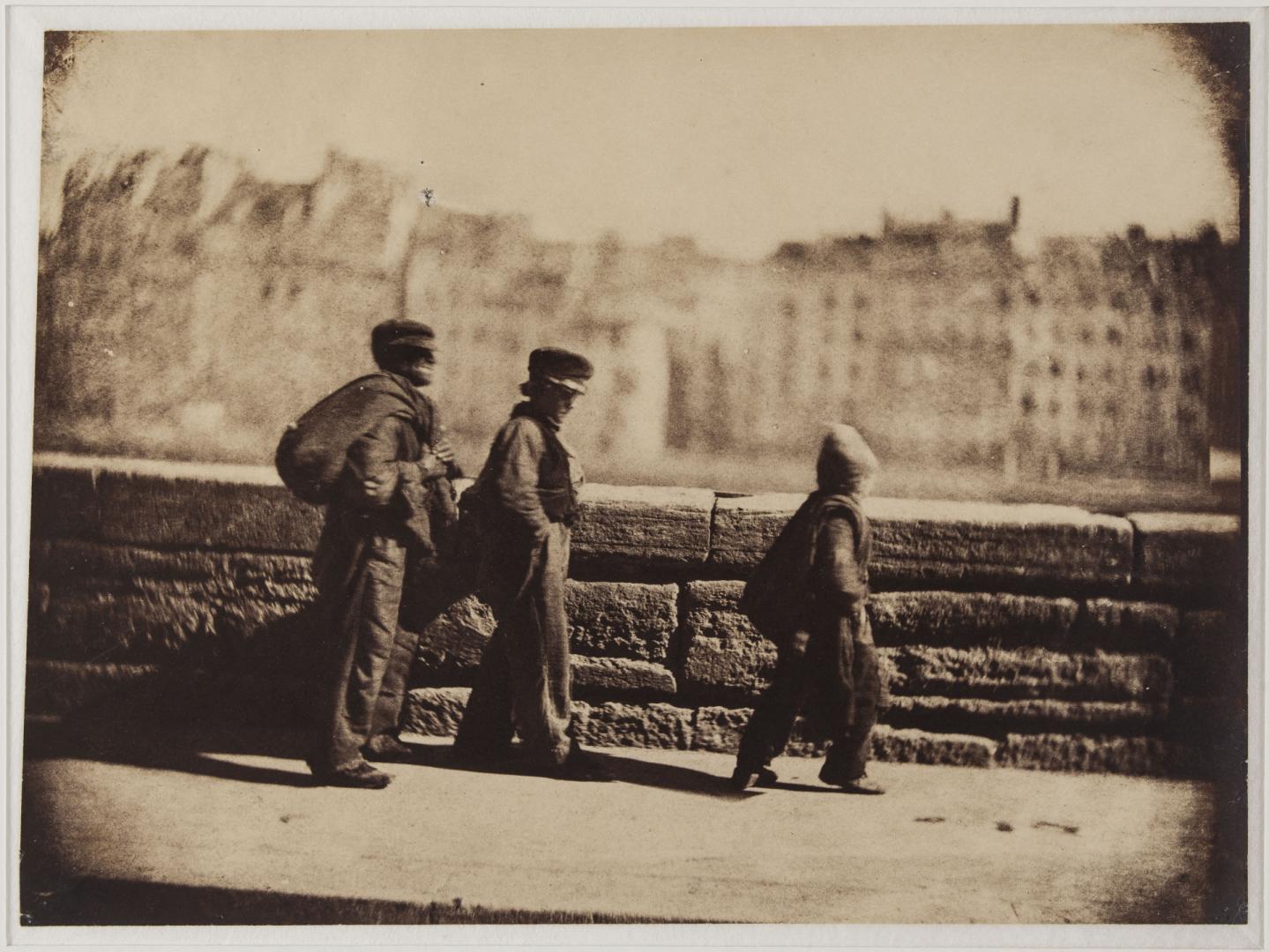
The smallest figure is already ahead. Two taller companions follow, their dark clothes gathering into a loose procession beside a stone wall. We read the group as a walk almost before we have examined the feet. The title, Chimney Sweeps Walking, seems merely to confirm something the photograph has already told us.
Yet that passing moment required people to hold a pose. Charles Nègre made the picture in the early 1850s; the Musée Carnavalet dates the print reproduced here to 1851–52. Its catalogue explicitly distinguishes the apparent spontaneity of the movement from the exposure that Nègre required of his models.[1] The pleasure of the photograph survives that knowledge. Look again, and the interesting question becomes how still bodies persuade us to imagine the next step.
A walk made from three bodies
The group does not form a neat row. The two taller figures occupy a tighter cluster, while the smaller one establishes a separate beat ahead. That uneven spacing gives the eye a direction. We move through the picture by noticing a body, a gap, another body; the rhythm feels less like an arranged portrait than people making their way along a pavement.
The wall gives their movement something to run against. Its long horizontal courses provide a steady measure behind the irregular shapes of coats, bags and legs. A figure's slight lean becomes easier to notice against that comparatively stable background. The setting supplies continuity; the people supply interruption.
There is no spectacular action here. Nobody needs to leap, run or wave. A modest difference between the placement of one leg and the other is enough to suggest an unfinished act. The camera shows a position, and the viewer supplies a sequence: the foot was behind, now it is here, soon it will be farther forward. That sequence belongs to our reading of the photograph. It is not a series of moments the photograph itself has recorded.
Knowing about the pose makes the effect more intimate. These people had to give the camera time. The image asks us to experience their arrangement as something we might have encountered while passing them. Its apparent casualness is an achievement shared between a photographic setup and the bodies that sustained it.
The city gives way
Beyond the wall, the buildings remain recognizable as a city without becoming an invitation to inspect every window. Their softness allows the foreground to command attention. We can understand where the group belongs while staying with the three figures.
Nègre had trained as a painter under Paul Delaroche, who encouraged students to use photographs as aids to painting. As Michelle Bird explains in the Fitzwilliam Museum's artist account, Nègre continued to exhibit paintings even as photography affected his choices of subject, light and composition.[2] The two practices overlapped. A painter's interest in arranging attention could remain active inside a photograph.
The Carnavalet record also attributes this picture's luminous effect to an optical device specially adapted to Nègre's lens.[1] It does not give enough detail to reconstruct the setup or assign an exact exposure time. We can nevertheless observe its pictorial consequence: the image does not distribute clarity evenly across everything in view.
That unevenness matters to the walk. A sharply insistent background might turn the figures into three details among many. Here, the softened distance lets us feel them passing in front of a larger world. The city supports the encounter without swallowing it.
What a pose can preserve
The Musée d'Orsay places Nègre's photographs of chimney sweeps, ragpickers and other working people within an older tradition of depicting everyday trades in painting, drawing and printmaking.[3] His subjects were part of urban life, but there was also an established artistic repertoire through which a viewer could recognize them.
That history complicates the ease of our first response. We can enjoy the group as a beautifully organized arrangement and still ask what the arrangement leaves out. Their clothing and burdens remain visible. Their names, destinations and responses to the photographer are not supplied by the picture. The title identifies a trade and an action; it does not give us three biographies.
I read the photograph's strongest tension here: the figures are specific enough to hold our attention, yet the pleasing rhythm can encourage us to treat them as a single motif. Looking closely means allowing both impressions to remain. We need not invent a story about their feelings to acknowledge the people whose bodies make the composition work.
Even the physical photograph deserves that specificity. The National Gallery of Canada holds a salted paper print of Chimney Sweeps Walking, dated December 1851.[4] The Carnavalet object illustrated here is catalogued as an albumen print, dated 1851–52.[1] Those are separate collection records for separate objects. The medium and date attached to one should not silently become the caption for the other.
Return to the smaller figure at the front. The next step still seems imminent, although no next step can arrive inside this frame. Learning that the scene was posed has changed what the image can prove about an unplanned encounter. It has also made visible another kind of event: people standing before a camera, sustaining the appearance of movement. The walk happens again each time we look.
Sources
- Paris Musées / Musée Carnavalet, “Les ramoneurs en marche, Paris,” PH21830—image source, albumen-print metadata, dating, posed movement and optical treatment.
- Michelle Bird, “Charles Nègre,” Fitzwilliam Museum, True to Nature—training with Delaroche and the continuing relationship between painting and photography.
- Musée d'Orsay, “Vers le reportage (1843–1933),” exhibition of 16 October 2007–6 January 2008—Nègre's photographs of working people and their relationship to earlier visual traditions.
- National Gallery of Canada, “Chimney Sweeps Walking,” accession 32485—record for its salted paper print, dated December 1851.