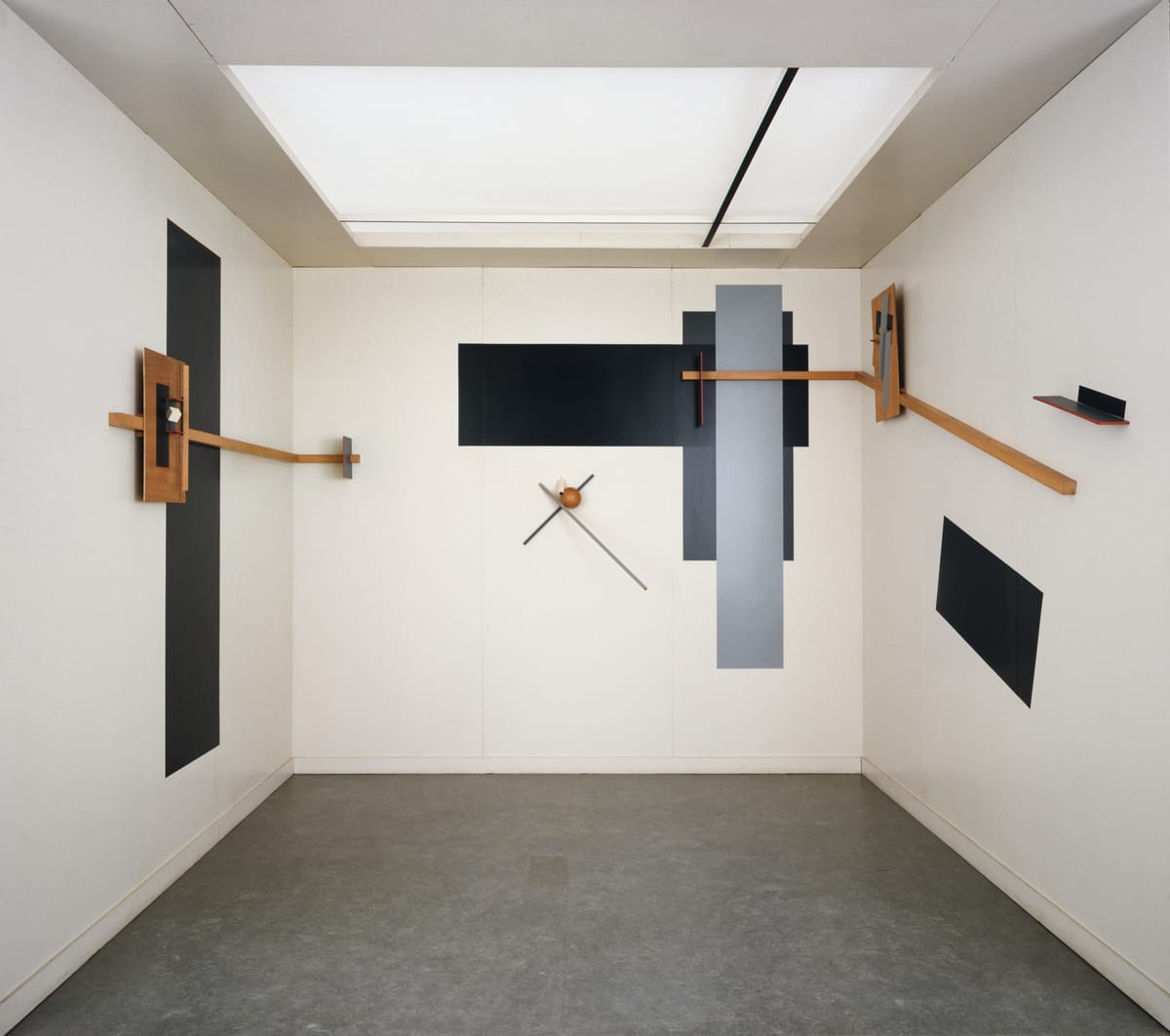
A line reaches the corner of a room and keeps going. In El Lissitzky's Proun Room, geometric fields and wooden reliefs spread across the walls; projecting elements give the eye reasons to leave the painted surface. The Van Abbemuseum's photograph shows its 1971 reconstruction of a space first made for a Berlin exhibition in 1923. Even in a photograph, the arrangement suggests that one position will never quite be enough.[1]
That invitation runs through Lissitzky's career. A book might need a searching thumb and a speaking voice. An exhibition might ask visitors to move a panel before they could see a painting. He kept designing the encounter along with the object. Following those encounters gives his apparently scattered activities—painting, typography, architecture and photography—a human scale: the distance between a work and the person trying to use it.
Born in 1890, Lissitzky studied architecture and engineering in Darmstadt before returning to Russia during the First World War. He illustrated Jewish subjects, including the Passover song Khad Gadya. In 1919, Marc Chagall invited him to teach at the art school in Vitebsk, where Kazimir Malevich's geometric abstraction helped redirect his work.[2] The maker of books and the student of buildings already shared a desk. His later experiments would keep bringing their different scales together.
Around 1919 he began making the works he called Prouns: compositions whose geometric forms suggest architecture while unsettling the ordinary rules of perspective.[2] They offer the mind somewhere to travel without providing a reliable floor. A form can seem to project toward the viewer, then belong to another spatial arrangement altogether. That instability matters more than any resemblance to a particular building.
The 1923 room made the invitation bodily. Its reliefs continued between walls, drawing attention across the corner and out into the space. The Van Abbemuseum describes the resulting movement of the gaze from surface to surface.[1] To follow the work, a visitor has to turn. Architecture becomes part of the time it takes to look.
During the same year, Lissitzky worked at a scale small enough to hold. For the Voice, published in Berlin, brought together thirteen poems by Vladimir Mayakovsky intended for reading aloud. The University of Illinois's library record identifies that performance purpose; a surviving first edition catalogued by Christie's shows how Lissitzky supported it. A thumb index helped readers find individual poems, while title pages combined differently sized type in red and black.[3][4]
The index is a wonderfully practical detail. Imagine preparing to recite: a title in a conventional contents list would send you hunting for a page number. Here the edge of the book helps your hand get there. The reader's movement becomes part of the design before a word is spoken. The typography then gives the eye its own changes of emphasis. In this reading of the book, hand, eye and voice cooperate; the page helps a poem leave the page.
Lissitzky enlarged that cooperation again in Hanover, creating the Abstract Cabinet for museum director Alexander Dorner in 1927. Strips along the walls changed their visual effect as visitors moved, while sliding panels allowed different works to appear. Designer Abbott Miller describes these devices in his account of exhibition design.[5][6] A viewer could no longer assume that the room was an unchanging background to the art.
The distinction from the Proun Room is useful. One made a composition large enough to enter; the other organized encounters with a collection. In both, a step to the side mattered. But the cabinet also offered choices about what to reveal. Looking acquired an order of operations, and visitors could discover how much the setting contributed to what they saw.
There is a catch in encountering these ideas through reconstructions. Curator Isabel Schulz documents how the older reconstruction of the Abstract Cabinet combined evidence from different moments in the original's history. It also lost one of the original entrances, altering the likely route through the room and its associated viewing directions. The original was destroyed under the Nazis in 1937; a new reconstruction replaced the older museum version in 2017.[6]
A missing doorway may sound like an architectural footnote. For an artist who composed with the visitor's movement, it changes the work. Schulz also describes visitors' uncertainty about what they were allowed to touch in the older reconstruction, even when parts were intended to move.[6] An invitation built into an object can be weakened by the habits of the institution around it. Knowing how to behave becomes part of knowing how to see.
Lissitzky's own working life was less frictionless than his precise forms might suggest. He continued photographic experiments while recovering from tuberculosis in Switzerland in 1924. Later, his activities included teaching, furniture and exhibition design, and layouts and photomontages for the propaganda magazine USSR in Construction.[7] His ability to direct attention had uses well beyond the gallery.
That political work places a limit on an appealing interpretation of his career. Giving people something to do does not, by itself, give them independence of judgment. A sequence can encourage exploration; it can also make a prescribed story more persuasive. Lissitzky's achievements ask us to keep both possibilities in view. Participation is a physical fact before it becomes a political promise.
Return to the line crossing the corner. The photograph holds the room still, but the work asks for a turn of the head and another position. Across Lissitzky's books and rooms, that small demand remains remarkably direct. The viewer has a body, and the artist has made something for it to do.
Sources
- Van Abbemuseum, “Prounenraum,” inventory 634 — collection photograph, materials, the 1923 installation and the museum's 1971 reconstruction.
- Museo Nacional Thyssen-Bornemisza, “El Lissitzky” — architectural education, Jewish book illustration, Vitebsk and the development of Proun.
- University of Illinois, Ricker Library, “For the Voice” — record of the 2000 edition, with the original 1923 publication and its purpose as poetry for reading aloud.
- Christie's, Vladimir Mayakovsky and El Lissitzky, “Dlia golosa,” lot 148, November 27, 2019 — a 1923 copy, its thumb index and red-and-black typography.
- Abbott Miller, “From object to observer,” Eye, no. 61, Autumn 2006 — Dorner's commission, changing wall effects and sliding display panels.
- Isabel Schulz, “Die Rekonstruktion von El Lissitzkys ‘Kabinett der Abstrakten’ auf dem Prüfstand,” demonstrationsraum — reconstruction history, circulation, visitor participation and the 2017 replacement; in German.
- J. Paul Getty Museum, “El Lazar Lissitzky” — biography, photographic work during illness and contributions to USSR in Construction.