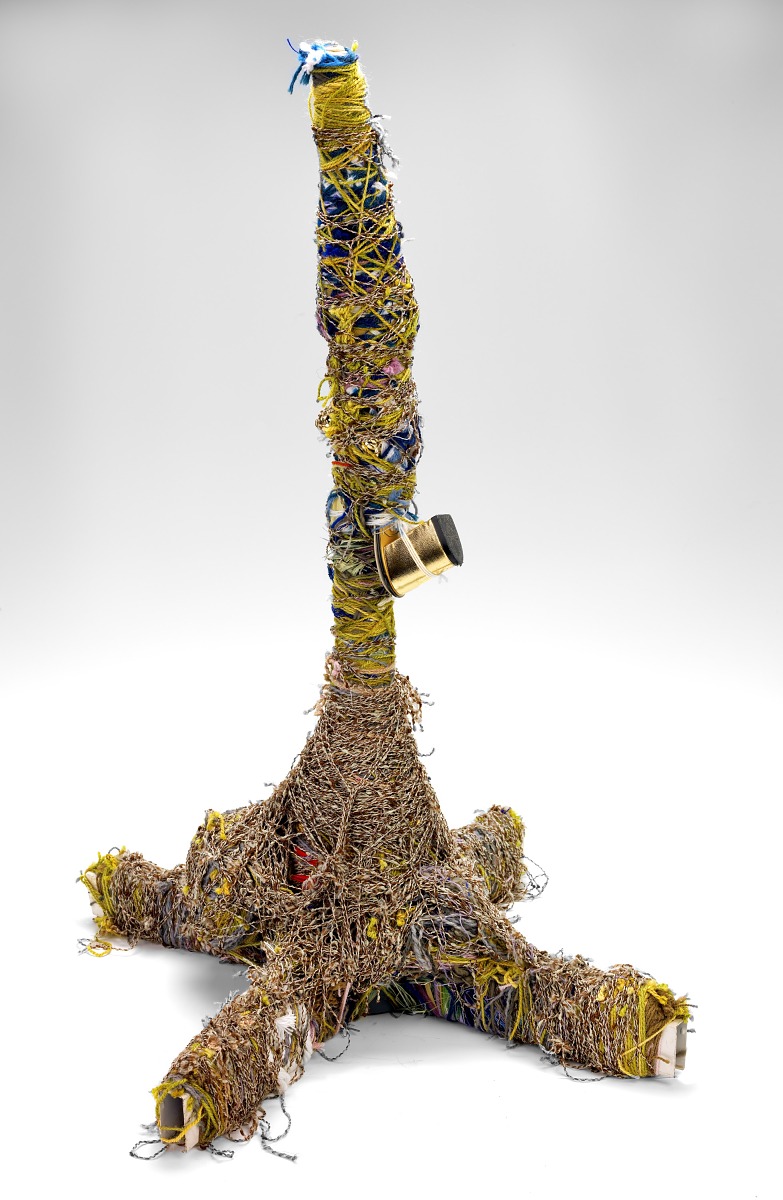
Judith Scott's Untitled at the Smithsonian American Art Museum looks, at first, like an object that has been hidden from us. A tall stem rises from a low, splayed base. Yellow, brown, blue, and stray multicolored fibers loop and cross the surface. A shoe section projects from one side like a small mechanical limb or a clue that has slipped out from inside the bundle. The sculpture does not disclose itself by opening. It discloses itself by showing how carefully it has been closed.[1]
That is the work's sharpest paradox. Scott's signature method was to take found objects and bind them inside layers of yarn, string, ribbon, fabric, and other fibers.[1][2] Museums often describe the hidden core because the fact is essential: there is something inside, and the viewer is not allowed to fully inventory it. But the sculpture is not a puzzle box whose value lies in guessing the contents. Its force comes from making concealment visible as labor, rhythm, pressure, and choice.
The Hidden Core Is Not The Whole Secret
The Smithsonian record identifies the work as mixed media, shoe section, and thread, about 33 7/8 inches high.[1] That plain inventory is useful because it keeps the sculpture from becoming vague. Scott is not making an ethereal fiber image. She is working with ordinary things: a shoe fragment, thread, found material, wrapping, tension, and accumulated decisions. The vertical body has to stand, the base has to spread, and the fibers have to hold an irregular structure together.
The visible shoe section changes the whole reading. If everything were fully covered, the sculpture might become a sealed relic. If everything were exposed, it might become an assemblage with textile decoration. The shoe breaks that balance. It gives the viewer one recognizable fragment, enough to confirm that the sculpture has a worldly interior, but not enough to explain the object away. We are given evidence, not access.
That distinction matters. The work is not saying that the inside is meaningless. It is saying that the inside cannot be exhausted by disclosure. Smithsonian's description of Scott's practice emphasizes found objects "nestled and enshrouded" within colored fibers, with the surface and the hidden interior held in tension.[1] The point is not secrecy for its own sake. The point is that the surface has become the place where the hidden interior acts on us.
Wrapping Turns Care Into Structure
Scott made art for the last seventeen years of her life at Creative Growth Art Center in Oakland, a studio founded to support artists with developmental disabilities.[3][4] That biography belongs in the frame, but it should not be used to soften the sculpture. The temptation is to turn the work into evidence of therapeutic expression and then stop looking. The better reading starts from the object itself. The wrapping is not generic accumulation. It is structure.
Look at the base first. It does not simply support the upright shaft; it sprawls in several directions, like roots, limbs, or stabilizers. The brown fiber mass is dense enough to feel earthen, yet loose enough that individual threads keep catching the eye. The vertical section then tightens and changes color. Yellow strands climb, cross, and bind over blue and darker passages. The wrapping does not smooth the object into a single skin. It produces different zones of pressure.
That pressure is why the sculpture feels bodily without becoming figurative. It has a stance. It leans slightly into imbalance. It has a base that touches the ground and a narrow upper form that seems both protected and vulnerable. Scott's work is often described through cocoons or nests, but this piece resists any one metaphor. It is too upright for a nest, too exposed for a cocoon, too awkward for a clean totem, and too materially specific to become a pure symbol.
The Brooklyn Museum's Judith Scott-Bound and Unbound exhibition page gives helpful scale to the practice: Scott often worked for weeks or months on single sculptures, enveloping found objects in yarn, thread, fabric, and other fibers to make fastidiously woven, wrapped, and bundled structures.[4] That duration is visible here. The object does not look quickly covered. It looks repeatedly reconsidered. Each layer answers the previous layer without erasing it.
Color Refuses Neutrality
The color is doing more than decoration. The yellow fibers have a sharp, almost electrical presence against the darker base and blue interior hints. They make the vertical section feel alert, even agitated. Brown and tan threads collect near the base, where they suggest weight and friction. Blue appears like something glimpsed through a net, a hidden color that keeps the surface from settling into one emotional register.
This is where a close reading has to resist a common mistake. Because Scott did not verbally explain her choices, it is tempting either to overinterpret every color as code or to underinterpret the work as pure instinct.[1][5] Both moves are weak. The sculpture does not need a decoded private dictionary in order to be read seriously. It gives enough formal evidence on the surface: contrast, density, projection, compression, and the repeated decision to bind without fully smoothing.
MoMA's page for Scott's 2002 Untitled makes a similar point about confidence and precision in texture and composition, even while noting that Scott did not verbally communicate her artistic choices.[5] That observation is important because it keeps agency in the object. Scott's silence does not make the sculpture mute. The work speaks through handling.
The Outsider Label Is Too Small
Scott's life story is inseparable from institutional exclusion. Born in 1943, she had Down syndrome, was deaf, and spent decades in an institutional setting before her twin sister Joyce helped bring her to Creative Growth.[3][4] That history should be stated plainly. It explains why Creative Growth mattered as access, not merely as a picturesque studio anecdote.
But the sculpture also tests the limits of the usual outsider-art frame. If "outsider" means the viewer is allowed to admire intensity while suspending formal judgment, the label becomes a trap. Scott's work deserves the opposite: more formal judgment, not less. This Untitled is a sophisticated object because it controls how much the viewer can know. It uses a found-object core, visible fiber labor, partial revelation, and bodily scale to make looking feel ethically charged.
The Smithsonian artist page is careful on this point, describing Scott's work as mixed-media sculpture that envelops found objects in dense layers of fiber and has been recognized for powerful self-expression and connection with others.[2] That last phrase is useful if it is kept concrete. The connection does not come from knowing what Scott meant in private. It comes from meeting an object that insists another person's interior life cannot be fully opened for our convenience.
Revelation Without Unwrapping
The most moving thing about the Smithsonian Untitled is that it denies the viewer the wrong kind of satisfaction. It does not unwrap. It does not let the shoe section become a key to everything else. It does not convert hiddenness into a mystery solved by museum text. Instead, it makes the condition of not knowing physically present.
That condition is not passive. The sculpture rises. It spreads. It catches color. It exposes one fragment and withholds the rest. It turns thread into surface, surface into pressure, and pressure into a kind of guarded presence. The hidden objects inside matter because they make the exterior accountable to depth. The exterior matters because it is the only form through which that depth can be encountered.
Scott made wrapping behave like revelation by refusing to treat revelation as exposure. In this work, to reveal something is not to strip it bare. It is to make the care, force, and boundary around it visible. That is why the sculpture stays with you. It knows that some interiors are real precisely because they cannot be completely possessed.[1][2][4][5]
Sources
- Smithsonian American Art Museum, "Judith Scott, Untitled" - object page for the ca. 1990-2005 sculpture used as the article image, with medium, dimensions, credit line, and artwork description.
- Smithsonian American Art Museum, "Judith Scott" - artist page describing Scott's mixed-media fiber sculptures and dense wrapping of found objects.
- Creative Growth Art Center, "Judith Scott" - artist biography and overview of Scott's wrapped sculptures, found-material armatures, and Creative Growth context.
- Brooklyn Museum, "Judith Scott-Bound and Unbound" - retrospective page on Scott's seventeen-year career, working method, Creative Growth, and bundled fiber structures.
- The Museum of Modern Art, "Judith Scott, Untitled, 2002" - collection page on Scott's found objects wrapped in yarn, twine, rope, and other fibers, with notes on texture, composition, and Creative Growth.