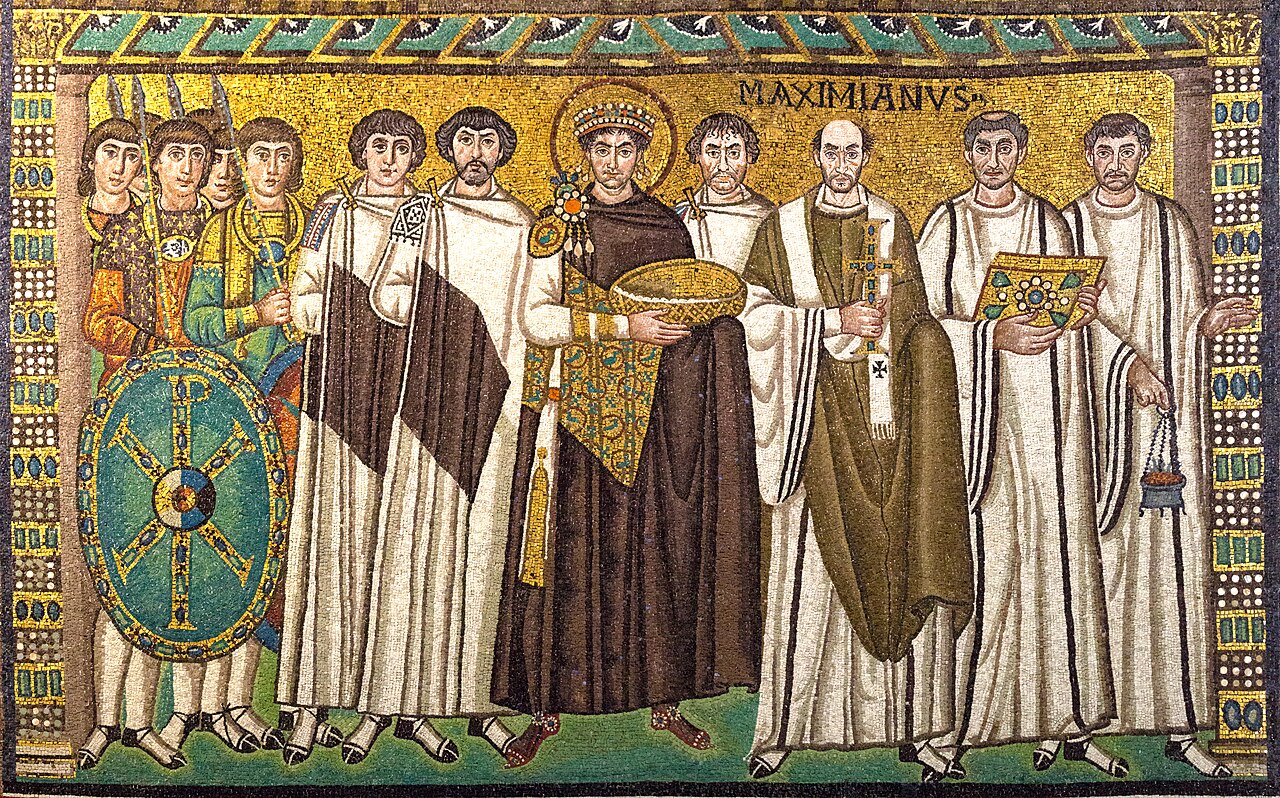
Image context: this post uses a real photograph of the San Vitale Justinian mosaic from Wikimedia Commons, not a generated Byzantine scene, a chart, or a decorative texture. The image is the evidence: a wall made of separate pieces that becomes legible only when matter, light, distance, and ceremony work together.[5]
Mosaic is easy to misunderstand because the finished image looks so authoritative. From the floor of San Vitale in Ravenna, the Emperor Justinian panel can seem almost inevitable: ruler in purple, haloed head, clergy and soldiers pressed into a gold field, the court arranged as if the wall itself has decided the order of the empire. But the authority of the image comes from an unstable technical bargain. Nothing here is painted smooth. The picture is assembled from small pieces, set by hand into mortar, and activated by light that never rests in one place.[1]
That is the medium's first lesson. Mosaic is not painting with harder material. It is a surface technology in which the smallest unit remains physically present even when the image resolves at a distance. The viewer must constantly move between two scales: a face, robe, shield, or halo as an image, and the tessera as a separate piece of glass, stone, or metal-backed brilliance. The art happens in the refusal to choose one scale over the other.
The wall is not a blank support
San Vitale makes that refusal especially clear because the church is not merely a container for pictures. Ravenna's official tourism site describes the city's UNESCO monuments as a fifth- and sixth-century mosaic heritage tied to early Christian and Byzantine buildings, imperial power, and dense artistic exchange.[2] That context matters for technique. A wall mosaic in a church does not behave like a framed canvas that could hang anywhere. It must answer architecture, procession, sightline, candlelight, daylight, ritual movement, and distance.
The Getty Conservation Institute's mosaic glossary helps strip the medium down to its physical grammar. A mosaic is not only the visible tesserae. It is also the bedding layer that receives them, the mortar between pieces, and the larger structure that lets the surface remain attached over time.[3] That hidden support matters aesthetically. The tessera can sparkle only because it is partly buried. The visible face depends on a concealed grip.
This is why mosaic has a different kind of patience from brushwork. A painter can drag a wet color across a surface and make the mark continuous. A mosaicist has to build continuity through interruption. Every edge is real. Every gap has to be accounted for. Skin, cloth, shadow, and halo are not blended into being; they are negotiated through placement.
Gold is not just yellow
Gold in Byzantine mosaic is often treated as a symbol first: divinity, empire, heaven, liturgical radiance. It is all of those things, but the symbolism only works because the material behaves so aggressively. The San Vitale panels place imperial figures inside a gold field, while related Byzantine tesserae in the Met's collection show how glass could carry gold and silver leaf at very small scale.[1][4] The gold field is therefore not flat background. It is a moving optical climate.
The Metropolitan Museum of Art's record for Byzantine mosaic tesserae gives the smallness of the system a useful scale. Its group of fifty pieces, dated broadly from the sixth to fifteenth century, includes glass with gold and silver leaf; the largest listed piece is only about 1.4 centimeters across.[4] That scale changes how we should read the San Vitale wall. The gold is not a wash of expensive color. It is a field of tiny decisions.
Those decisions make light part of the drawing. A slightly angled tessera catches one ray and rejects another. A glass piece can flash while nearby stone stays quiet. A gold-backed square can pull forward, then drop back as the viewer shifts position. The result is a surface that never becomes entirely still. This is why the Justinian panel can feel both rigid and alive. The bodies are frontal, ceremonial, almost locked in place. The wall around them keeps moving.
Distance completes the image
Mosaic depends on a disciplined misreading. Up close, the panel is all edges: cubes, slivers, seams, chips, color steps, and mortar lines. From farther away, the court gathers into a single scene. Justinian's purple, the bishop's white vestments, the guards' shields, and the gold ground become political theater. The image needs both distances. If seen only from far away, the work risks becoming a flat emblem. If seen only from inches away, it becomes material noise.
That two-distance structure is one reason mosaic is so powerful in ceremonial architecture. A visitor walking through San Vitale does not receive the image as a single stable view. The panel clarifies, breaks, flashes, and recomposes. Authority arrives as an experience in time, not just as iconography. The emperor's group does not merely stand in front of gold. It is continually being re-lit by the surface that surrounds it.
This also separates mosaic from the modern metaphor of "pixels." A pixel is meant to disappear into screen logic. A tessera does not disappear so obediently. It has thickness, front, side, weight, and an irregular relationship to the neighboring piece. It can be damaged, reset, cleaned, loosened, or read by a conservator as part of a physical condition history.[3] The unit is optical, but it is also archaeological.
The face is a construction of limits
Look at the faces in the Justinian panel and the technical problem becomes intimate. A human face asks for softness: cheek, brow, nose bridge, mouth, eyelid. Mosaic supplies small hard units. The art lies in making a rigid system behave as if it can breathe. That does not mean hiding the system. The best passages keep a slight tension between person and surface. Justinian's face is legible as a ruler's face, but it also remains a pattern of placed pieces answering the gold around it.
That tension suits the subject. The panel is not psychological portraiture in the later sense. It is a public image of rule, church, office, and presence. The hard units strengthen that claim. They make the figures less like passing individuals and more like bodies fixed into a durable order. At the same time, the glint of glass and metal prevents the order from becoming inert. The wall insists that power is staged through material maintenance.
This is where technique and politics meet without collapsing into one another. The mosaic does not communicate imperial authority simply because Justinian is centered and haloed. It communicates authority because the surface makes centrality luminous, durable, and difficult to separate from the church wall itself.[1][2]
Preservation keeps the medium honest
The survival of a mosaic can make it look timeless, but conservation language reminds us that the medium is vulnerable. Tesserae can detach; mortar can deteriorate; bedding layers can lose their grip; earlier interventions can become part of the problem.[3] The glittering surface is never free from maintenance. Its power depends on a fragile alliance between stone, glass, gold leaf, mortar, architecture, climate, and human care.
That fragility is not a side note. It is part of the medium's meaning. Mosaic makes images by giving up smoothness. It accepts seams, joints, reflected glare, distance, and physical labor as the price of radiance. The San Vitale panel still feels commanding because it does not hide that bargain. It turns smallness into scale, breakage into continuity, and light into a collaborator.
To look well at mosaic, then, is to let the image keep changing size. Step back and the emperor's court appears as ceremony. Step closer and the ceremony becomes glass, gold, stone, and mortar. Step aside and the light revises the wall again. The medium's intelligence is there: not in pretending that matter has vanished, but in making matter draw.
Sources
- Fashion History Timeline, "545-549 CE - Imperial Mosaics of the Basilica of San Vitale" - artwork analysis covering the c. 547 Justinian and Theodora panels, imperial clothing, court structure, and San Vitale context.
- Ravenna Turismo, "Unesco World Heritage monuments" - official Ravenna tourism page on the city's fifth- and sixth-century mosaic heritage, San Vitale, and UNESCO inscription language.
- Getty Conservation Institute and Israel Antiquities Authority, "Illustrated Glossary: Mosaics in Situ Project" - conservation vocabulary for tesserae, bedding, tessellatum, mortar, losses, detachment, and intervention conditions.
- The Metropolitan Museum of Art Collection API, object 708074, "Mosaic Tesserae" - object data for Byzantine tesserae made of glass with gold and silver leaf, with dimensions and material classification.
- Wikimedia Commons, "File:Sanvitale03.jpg" - source page for Roger Culos's 2015 photograph of the Emperor Justinian mosaic in the Basilica of San Vitale, Ravenna, used as the article image.