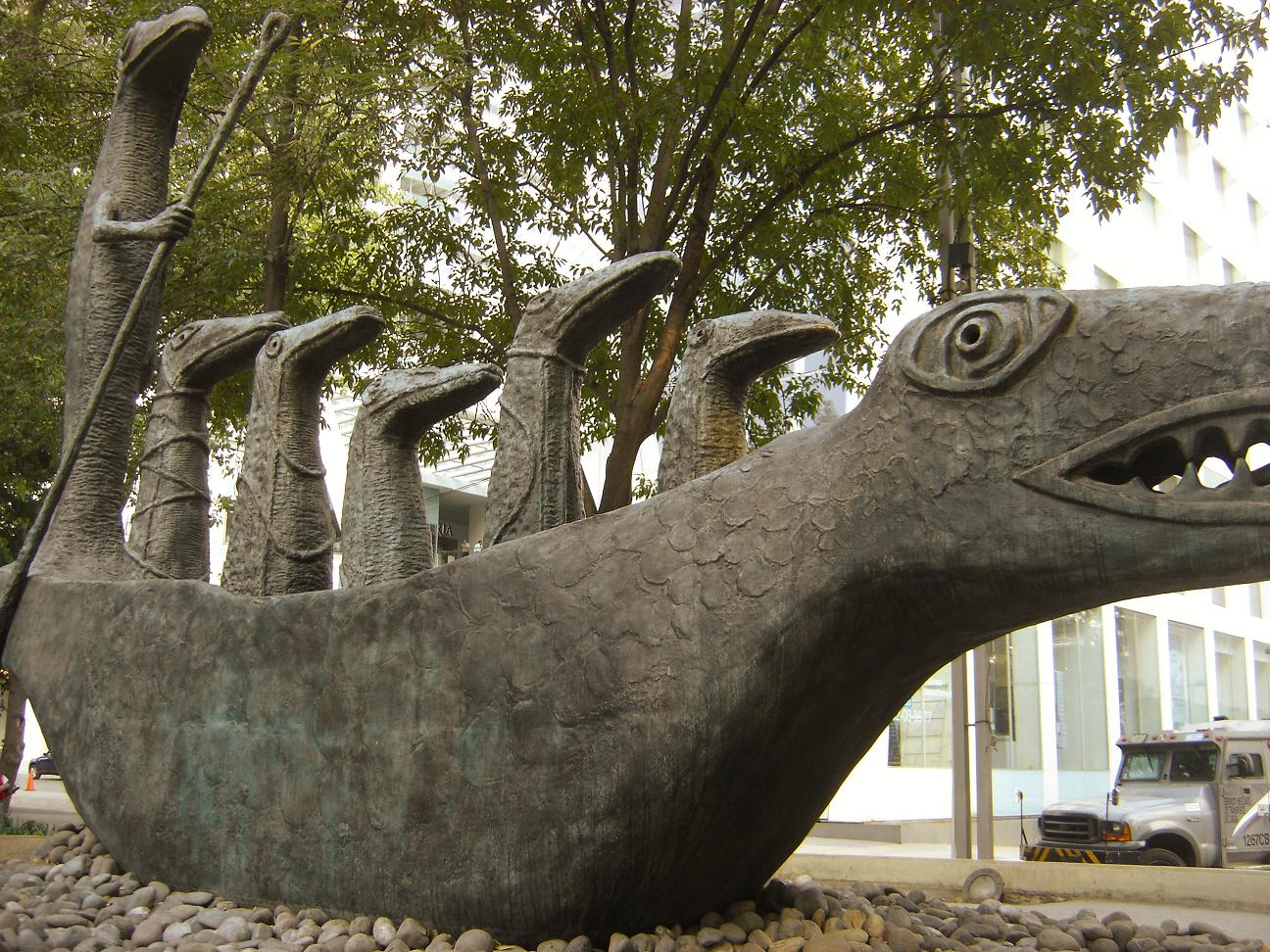
Image context: this post uses a real documentary photograph of Carrington's crocodile sculpture from Wikimedia Commons, not a generated Surrealist pastiche or a diagram. The sculpture belongs here because the essay follows Carrington's animal vocabulary from the early self-portrait to the public, late-career world of bronze bodies in the city.[5]
Leonora Carrington's animals are often described as dream creatures, but that makes them sound softer than they are. In her best work, the horse, hyena, minotaur, bird, crocodile, and human-animal hybrid are not decorative Surrealist props. They are escape devices. They mark the points where a person can slip out of family script, gender role, national identity, or the museum label that wants to make a woman artist legible by calling her someone's muse.
That is why Carrington still feels newly available in 2026, even though the biographical outline has long been known: born in England in 1917, pulled toward art against upper-class expectations, drawn into Surrealism, broken open by war and confinement, then remade through Mexico City, writing, painting, sculpture, and feminist politics.[2][6] The renewed attention matters only if it sharpens the way we look. Carrington was not important because she made Surrealism more whimsical. She was important because she made metamorphosis feel like a survival method.
The First Escape Is In The Room
The Met's Self-Portrait of about 1937-38 gives the argument in miniature. Carrington sits in white riding clothes with wild hair, one hand extended toward a prancing hyena, while a tailless rocking horse hovers behind her and a white horse runs into the green landscape beyond the window.[1] The painting is compact, almost theatrical, but it is not a closed stage. The horse outside has already crossed the threshold.
The Met reads the white horse as Carrington's symbolic surrogate, and that is useful as far as it goes.[1] But the animal is more active than a substitute portrait. It is the part of the self that refuses furniture. The rocking horse behind her is suspended and toy-like, a childhood object turned uncanny. The living horse beyond the curtain has motion, distance, and air. Between them sits Carrington, not as a passive sitter but as someone testing which creature can carry her out.
The hyena changes the room's temperature. It is too alert, too hungry-looking, too bodily to be charming. Its presence makes the self-portrait less about elegance than about alliance. Carrington does not tame the animal for the viewer. She reaches toward it as if a pact might be possible. The gesture matters because it reverses the expected hierarchy: the young woman in the chair is not threatened by animal wildness. She is using it to refuse the gentler cage of good breeding.
That refusal has biographical weight. NMWA notes that Carrington was born into an upper-class Irish-Catholic family in England, struggled against expected social conformity, enrolled in Amedee Ozenfant's London academy in 1936, met Max Ernst in 1937, and exhibited with Surrealists internationally.[2] Those facts can easily flatten into romance. The painting keeps them sharper. It shows the artist inventing a room where rebellion is not declared as slogan. It is distributed across hair, chair, window, horse, and hyena.
Surrealism Was A Door, Not A Home
Carrington's early Surrealist circle gave her permission to take dream logic seriously, but it also carried its own traps. NMWA states the blunt historical asymmetry: many critics dismissed women Surrealists, even while Carrington was making and exhibiting serious work.[2] The Met's audio transcript preserves the famous rejection of the muse label, where Carrington insists she was busy rebelling and learning to be an artist.[1] The point is not just that the old label was unfair. It was visually wrong.
Her art does not behave like the work of a muse. It behaves like the work of someone building exits from systems that keep assigning her a role. In that sense, the animal forms are not only personal symbols. They are structural tools. A horse lets the body change speed. A hyena lets desire look back without becoming pretty. A hybrid figure refuses the border between human and creature because that border has already been used to police who counts as rational, civilized, feminine, or sane.
MoMA's artist page is useful because it does not reduce Carrington to one legendary image. It places her across multiple works and terms, including Green Tea, And Then We Saw the Daughter of the Minotaur, Kitchen Clock, and Surrealism itself.[3] That range matters. Carrington's mature world is not one repeated dream. It is a working system of rooms, feasts, rituals, clocks, thresholds, and beings that have not agreed to keep one stable shape.
Mexico Made The Vocabulary Expand
World War II tore apart Carrington's European life. NMWA traces the sequence: Ernst was interned, Carrington fled to Spain, suffered extreme distress and institutionalization, married Mexican diplomat Renato Leduc to leave Europe, passed through New York, then traveled to Mexico, where she found a vital artistic community and remained in Mexico City for the rest of her life.[2]
The temptation is to read Mexico as rescue and stop there. Carrington's work is more demanding. Mexico did not simply offer safety; it gave her animal vocabulary more space to become social, ritual, and political. NMWA places her near Remedios Varo in a refugee-intellectual community, while Smithsonian's 2026 overview emphasizes that Carrington continued to explore nature, femininity, the occult, fiction, memoir, and Mexico's women's liberation movement.[2][6]
That breadth helps explain why the later animals feel less like private emblems and more like inhabitants of a parallel civic order. They are not hidden in the studio anymore. They gather, process, sit at tables, sail, appear as goddesses, clocks, masks, and messengers. The boundary creature becomes a citizen of Carrington's world.
The Musee du Luxembourg's 2026 exhibition page makes this point from another angle. The museum describes a show of 126 works, the first major exhibition in France devoted exclusively to Carrington, and frames her art through metamorphosis: human and animal, masculine and feminine, symbols answering one another.[4] That institutional language is important because it catches what the paintings and sculptures already know. Carrington's art is not about escaping identity into fantasy. It is about making identity mobile enough to survive.
The Crocodile Goes Public
The cover image, a Commons photograph of Carrington's crocodile sculpture, is useful because it shows what happens when that private grammar enters public space.[5] The work commonly known as Cocodrilo or How Doth the Little Crocodile turns an animal into a boat, a crew, a procession, and a joke with teeth. Several upright crocodile bodies ride inside the larger crocodile form, as if the creature has become both vessel and society.
It is funny, but not harmless. The mouths, eyes, scales, and oar-like gesture keep the sculpture alert. Carrington's crocodile is not a mascot. It is a mobile architecture of appetite. The smaller figures inside it appear carried and endangered at once, protected by the larger body but also absorbed into it. That ambiguity is exactly Carrington's territory. Her creatures offer passage, but passage is never neutral.
Placed after the early self-portrait, the crocodile sculpture changes the scale of Carrington's rebellion. In the 1937-38 painting, the animal exit is a window and a pact. In the bronze crocodile, the exit has become a public vehicle. The route is no longer only away from the family room, the lover's shadow, or the hospital. It is toward a shared myth that can sit in a city and let strangers meet it without needing the key to a private dream.
Why The Animals Still Work
The renewed Carrington moment in 2026 includes a film, museum exhibitions, and fresh attention to works made during her psychiatric confinement.[6] Those events are useful if they resist the old sensational arc: brilliant young woman, famous male artist, trauma, exile, rediscovery. Carrington's own images argue for a better sequence. First comes refusal. Then metamorphosis. Then a long practice of making creatures sturdy enough to carry memory without freezing it.
That is why her art should not be praised merely for being fantastical. Fantasy can be evasive. Carrington's is analytic. The animals reveal where the human story has become too narrow to tell the truth. They let a woman be furious without becoming a caricature, wounded without becoming a case history, mystical without becoming vague, and comic without becoming lightweight.
The horse, hyena, and crocodile are exits, but they are also tests. They ask whether the viewer can accept a world in which freedom may look ungainly, predatory, ritualized, or absurd before it looks noble. Carrington's answer is unsentimental. She does not offer liberation as a clean doorway. She gives us creatures with hooves, teeth, shadows, scales, and impossible passengers. Then she lets them move.
Sources
- The Metropolitan Museum of Art, "Leonora Carrington, Self-Portrait" - object record and audio transcript for the 1937-38 painting, including the hyena, rocking horse, white horse, and muse-label context.
- National Museum of Women in the Arts, "Leonora Carrington" - artist profile covering family background, Ozenfant training, Ernst, wartime flight, Mexico, Remedios Varo, exhibitions, and Samhain Skin.
- The Museum of Modern Art, "Leonora Carrington" - artist page listing Carrington's dates, associated terms, collection works, exhibitions, and Surrealist context.
- Musee du Luxembourg, "Leonora Carrington" - 2026 exhibition page describing the first major France exhibition devoted to Carrington, with 126 works and a metamorphosis-centered curatorial frame.
- Wikimedia Commons, "File:Leonora Carrington sculpture (2423346727).jpg" - source page for the real 2008 photograph of Carrington's crocodile sculpture used as the article image.
- Smithsonian Magazine, Michele Debczak, "No Mere Muse, This Influential Surrealist Artist and Feminist Gets Her Due in a New Biopic and Art Exhibitions" (May 28, 2026) - current overview of Carrington's renewed film and exhibition attention.