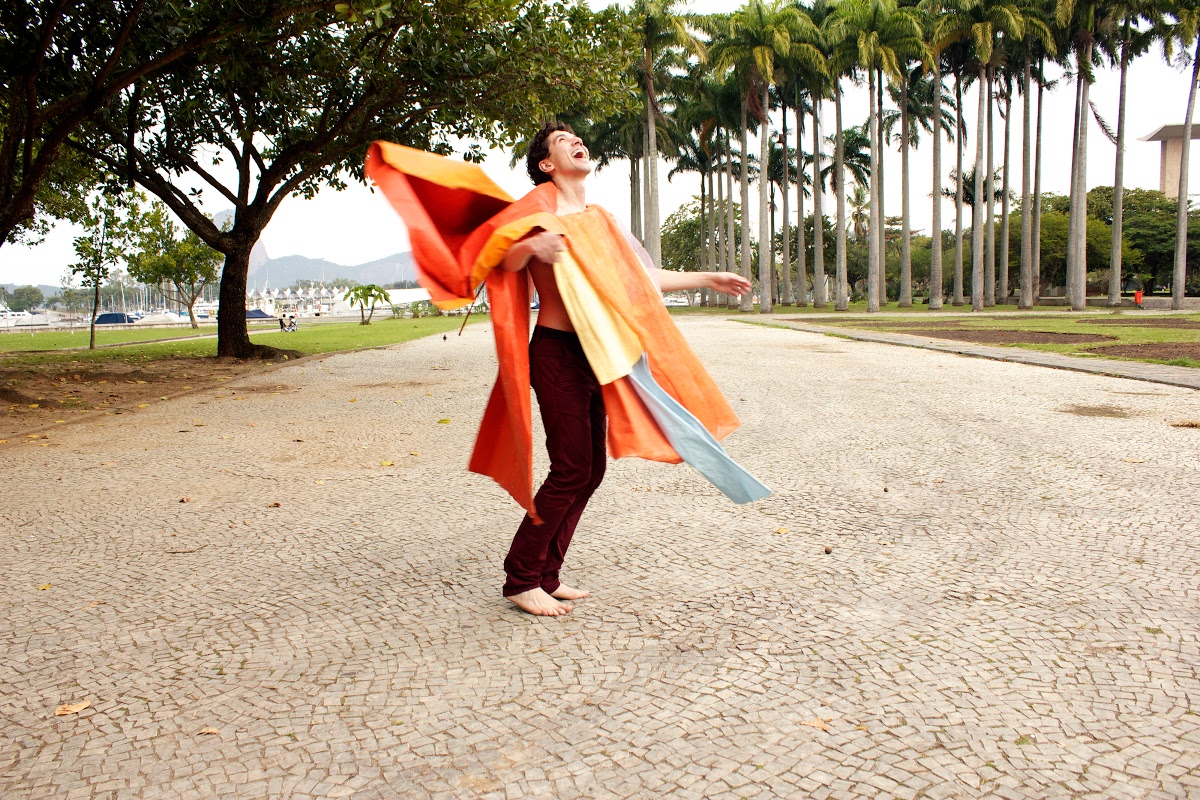
Image context: the cover is a photographic record of a Parangole being worn, not a diagram, poster, or generated reconstruction. That matters because this essay's central claim is physical: Oiticica did not merely design colored objects. He designed situations in which color had to be carried, unfolded, interrupted, and made public by a moving body.[1][6]
Helio Oiticica's Parangoles are often introduced as capes, banners, or wearable sculptures. All of those labels are accurate, and all of them are a little too still. A Parangole does not become convincing while hanging like evidence after an event. It becomes convincing when fabric slips off a shoulder, when a dancer turns too quickly for the camera, when orange or red cloth catches the air, when a museum visitor has to decide whether looking is enough.
That is why the Parangoles remain one of modern art's clearest tests of participation. They do not ask the viewer to supply a polite interpretation from a safe distance. They ask the viewer to become a participant, or at least to understand why refusal matters. Projeto Helio Oiticica describes them as capes, bands, and flags made from fabric and plastic, sometimes carrying political or poetic phrases; when someone wears, runs, or dances with one, that person stops being only a spectator and becomes part of the artwork.[1] The definition is plain. The consequences are not.
Color Leaves The Wall
Oiticica reached the Parangoles after a serious engagement with geometric abstraction, Concrete art, and Neo-Concrete questions about perception, embodiment, and the limits of a purely rational visual language.[3] That background matters because the capes are not a retreat from form into sociability. They are form under new conditions. Color, proportion, sequence, and surface still count, but they are no longer secured by stretcher bars, frames, or gallery walls.
Google Arts & Culture's record for Parangole P4 Cape 1, from MAM Rio's collection, gives the material facts with useful bluntness: acrylic on canvas, fabric, nylon, rope, and plastic; a work measuring 93 by 160 by 10 centimeters and dated 1964-1986.[6] That inventory pulls the work away from the fantasy of pure color. Oiticica's color is carried by rough material. It has weight, smell, edges, folds, and contingency.
In that sense, the Parangole is a painting after painting has lost its patience with being only looked at. A red or orange area is no longer a fixed plane. It becomes a flare across the back. A strip of blue is not an accent; it is a line made by a step, a turn, a pause, or a stumble. The work does not abandon composition. It relocates composition into time.
Samba Is Not Decoration
The decisive pressure came from Oiticica's contact with Mangueira, the Rio de Janeiro samba school and favela community that changed how he thought about the body, popular culture, rhythm, and the street.[1][2] MAM Rio is explicit that Oiticica began frequenting Estacao Primeira de Mangueira in 1964, and that this contact deepened his thinking about aesthetic experience beyond the fine arts by incorporating the body, music, choreography, rhythm, and vernacular popular elements.[2]
That sentence is easy to flatten into influence. It should be read more sharply. Samba did not supply local color for an avant-garde object. It supplied a different model of how an artwork could exist. In a samba context, movement is not an afterthought added to a finished visual object. Movement is the way pattern, social relation, sound, skill, and public appearance become real together.
The Parangole therefore changes the ethics of viewing. A museum can own or display an object. It cannot fully own the situation that makes the object work. The cape asks for a body trained, willing, exposed, and socially located. It asks for rhythm and a surrounding public. It asks for a threshold between art space and street space that is never neutral.
This is why the famous 1965 episode at Rio's Museum of Modern Art remains central rather than anecdotal. MAM Rio's artist biography recounts that Oiticica presented the Parangoles at Opiniao 65 with sambistas and musicians from Mangueira in a festive procession; when they were prevented from entering, the "work-party" happened outside the museum.[3] The episode did not simply create scandal. It clarified the artwork. The Parangole was designed to cross a boundary, and the institution showed where the boundary actually was.
Anti-Art With An Exact Form
MAM Rio says Oiticica considered the Parangoles "antiworks of art," while Projeto HO frames them as situations that dissolve borders between visual art, music, dance, body, artist, audience, and artwork.[1][2] The term can sound like a rejection of art, but in practice it is more exact than that. The Parangole rejects the habits that make art passive, private, and class-filtered. It does not reject formal intelligence. It gives formal intelligence a harder assignment: survive contact with the participant.
That assignment is visible in the materials. The capes, bands, and flags are made from fabrics and plastics, and sometimes carry political or poetic phrases.[1][2] These are not neutral supports. They create friction. They slow a body down or exaggerate its reach. They make the wearer aware of surfaces brushing skin and air. They turn the viewer's attention from the isolated object to the whole circuit: maker, wearer, observer, material, street, rhythm, and institution.
The political phrases matter for the same reason. MAM Rio's page names works such as P15 Parangole Cape 11 - Incorporo a revolta, and Projeto HO notes that political or poetic language could be built into the series.[1][2] The sentence is not a caption pasted onto a garment. It is carried by a structure that already depends on precarious material and public activation. Language becomes a working condition: the art lives through exposure, difficulty, improvisation, and collective movement.
A Public Body, Not A Universal One
Participation is often described in democratic language, as if inviting the viewer into the work automatically levels the room. Oiticica's Parangoles are more demanding. They show that participation can reveal inequality as much as dissolve it. Who is invited to wear the cape? Who is allowed into the museum while wearing it? Who gets photographed? Who becomes the artist, the participant, the collaborator, the outsider, or the problem?
MAM Rio's artist biography is useful here because it keeps sequence and setting visible: Oiticica trained inside MAM Rio's avant-garde circles, joined Grupo Frente, signed the Neo-Concrete manifesto, then entered the world of Mangueira and treated the body as the motor of the work.[3] Tate's performance case study likewise places the capes beside Mangueira Hill, samba music, and the need for participants to move or dance while wearing them.[5] That difference of contexts does not invalidate the work, but it prevents the easy reading. The Parangole is not pure liberation dispensed by an artist. It is a risky social form built inside unequal conditions. Its strength lies partly in refusing to hide those conditions.
Projeto HO's description says that through samba, dance, and the street, Oiticica broke down divisions between visual art, music, and dance, and also between artist, spectator, artwork, and body.[1] The better word may be "destabilized." The divisions do not vanish cleanly. They become contested. The spectator can become participant, but only by entering a situation where public movement is charged by class, race, place, and institutional permission.
That is why a Parangole still feels current. Many contemporary artworks ask for participation, but too many treat the viewer's body as an interface: press this, walk there, trigger the sensor, post the image. Oiticica's capes ask for more than interface behavior. Tate's account of Oiticica and Tropicália is useful because it places the Parangoles beside a wider challenge to traditional boundaries of art and spectator experience.[4] The capes ask whether participation changes the participant's relation to public space and to other bodies. They ask whether color can stop being a possession and become an event.
The Work Happens Between
The Google Arts & Culture/MAM Rio image used here shows a person wearing Parangole P4 Cape 1, an acrylic-on-canvas, fabric, nylon, rope, and plastic work associated with MAM Rio's collection.[6] The scene is bright and almost casual: palms, pavement, bare feet, fabric catching the air. It is tempting to read the photograph as joyous proof. But the better reading is less settled. The image shows how much has to go right for the work to exist at all: someone must agree to wear it, space must open around the body, and the cloth must be allowed to move.
The Parangole is therefore not a solved form. It is a proposal that has to be remade each time it appears. As a museum object, it can be conserved, documented, reconstructed, and studied. As an artwork, it still asks to be activated. The gap between those two conditions is not a failure. It is the point. Oiticica made a work that exposes the difference between possession and experience.
That may be the most durable lesson of the Parangoles. Color is not only what we see. Color can be what a body risks in public, what an institution admits or excludes, what a community carries into motion, and what a viewer understands only after recognizing that looking from outside is part of the problem. The cape does not hang still because the argument does not hang still. It keeps asking who gets to move, who gets to be seen moving, and what happens when art stops behaving like a thing and starts behaving like a public body.
Sources
- Projeto Helio Oiticica, "Parangoles" - official project page describing the capes, bands, flags, body activation, samba, street context, and the dissolution of boundaries between artwork, artist, spectator, and body.
- Museu de Arte Moderna do Rio de Janeiro, "Parangoles, 1964-1979" - MAM Rio collection page on Mangueira, dance, anti-art, materials, and related photographs.
- Museu de Arte Moderna do Rio de Janeiro, "Helio Oiticica" - MAM Rio artist biography covering Concrete and Neo-Concrete formation, Mangueira, Opiniao 65, Tropicália, and later career.
- Tate, "The story of Helio Oiticica and the Tropicalia movement" - museum overview linking the Parangoles, participatory art, and Tropicália's wider cultural context.
- Tate Research Publication, "Helio Oiticica 1937-1980 Parangoles 2007" - performance case study on Tate's 2007 Parangoles activation, Mangueira context, samba, and participatory movement.
- Google Arts & Culture and MAM Rio, "Parangole P4 Cape 1 - Helio Oiticica" - source page for the cover photograph and object details including date, dimensions, collection, and materials.