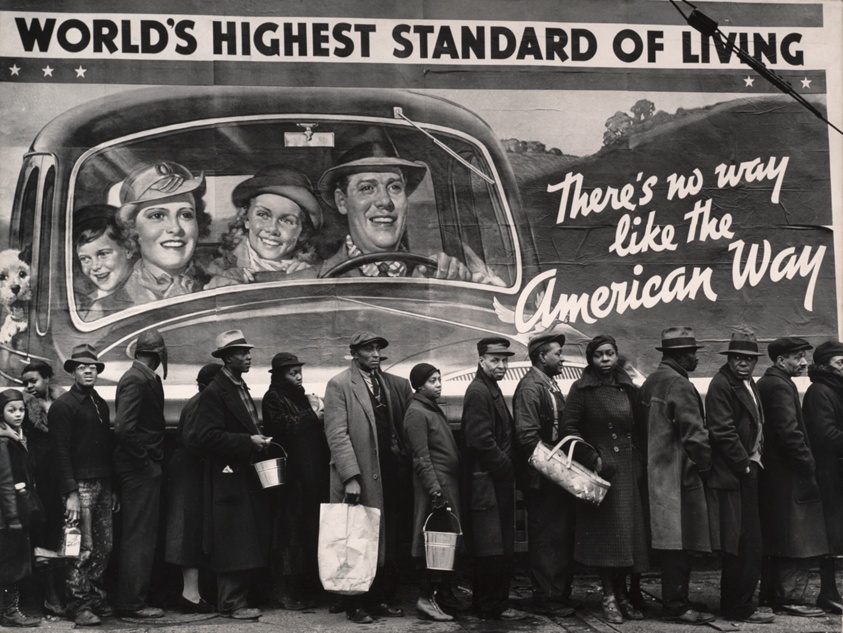
Margaret Bourke-White's World's Highest Standard of Living is often remembered for its irony, but irony alone is too small a word for what the photograph does. The image is not simply a visual joke about a slogan contradicted by poverty. It is a tight work of photographic ordering: a billboard, a queue, a disaster, and a racial hierarchy are all held in one public plane. The picture's power comes from the fact that nothing has to be explained away. The advertisement says one thing; the people beneath it prove another.[1][2][3]
The Art Institute of Chicago identifies the work as a gelatin silver print, made in 1937 and printed later.[1] The date matters because the photograph belongs to a specific emergency, not just to a generalized Depression mood. The Art Institute's essay notes that the image was taken in Louisville after the Ohio River flooding, while the National Weather Service's Louisville account describes the 1937 flood as a regional disaster whose crest at Louisville still stands far above later high-water marks.[2][4] Bourke-White was working as a photojournalist, but the result has lasted because she did more than record damage. She found a structure in which disaster exposed the machinery of public self-congratulation.
The billboard is a second picture
The most important thing in the photograph is that the billboard is not background. It is a picture inside the picture. Across the top of Bourke-White's frame, a smiling white family rides in an open car under a headline declaring the world's highest standard of living.[1][3] Their space is smooth, forward-moving, and apparently effortless. They are not waiting for anything. They do not need to carry baskets or stand shoulder to shoulder in the cold. The ad gives them motion, private comfort, and a future.
Below them, the real line moves horizontally in a much harder way. The people are packed close enough that the image can be read almost as a frieze. Bodies overlap; hats, coats, bags, baskets, and turned faces make a compressed band of need. The Whitney Museum's collection entry describes the image as showing African Americans lined up outside a flood relief agency, with the billboard above them forming the central contrast.[3] That contrast is not subtle, but Bourke-White's photograph avoids becoming blunt because the two zones are so cleanly joined. The billboard does not float above the scene as a later caption might. It is already there, part of the street, part of the same economy of looking.
This is why the photograph should be read as a work of composition as much as a document. The top half sells national confidence; the bottom half records local dependence. The billboard family has a car, leisure, and racial privilege. The people below have a line. Bourke-White's frame makes those two visual systems occupy the same civic surface, and the result is more severe than editorial commentary. The camera lets the advertisement incriminate itself.
The line turns waiting into evidence
The queue is not anonymous filler beneath the sign. It is the photograph's ethical center. Bourke-White places the relief line across the foreground so that viewers cannot skip from slogan to abstraction. The disaster has faces and postures. Some people look forward, some away, some downward; the line has the restless stillness of people who must keep waiting because there is no better option. The image does not ask viewers to imagine suffering in grand theatrical terms. It asks them to read waiting as a social fact.
That matters because flood photographs often turn catastrophe into spectacle: water in streets, rooftops isolated, bridges broken, crowds reduced to scale markers. Bourke-White does something different. She photographs the after-condition of disaster, the moment when emergency becomes administration. Relief is present, but it is visible as a queue. Need has been organized into a line, and the line is organized beneath a billboard that celebrates abundance.[2][3][4]
The racial structure of the image is equally direct. The billboard's white family stands for the advertised national norm, while the people below are identified by the Whitney as African Americans waiting at a flood relief agency.[3] Bourke-White does not need to add an explicit argument about exclusion because the frame has already built one. The American promise is not merely absent from the lower register; it is displayed above it as if it belonged somewhere else.
Bourke-White's industrial eye turns against the slogan
Bourke-White was unusually prepared to make this kind of image. Britannica describes her early career in architectural and industrial photography, her work for Fortune, and her role as one of Life magazine's first staff photographers.[5] That background is not incidental. Her best-known industrial pictures often admire scale, steel, production, and modern power. In World's Highest Standard of Living, the same clarity of structure remains, but the confidence has changed direction.
The photograph is full of modern systems: advertising, automobiles, mass media, emergency relief, urban infrastructure, and flood management. None of them appears as a neutral background. The billboard is a machine for manufacturing desire. The relief line is a machine for rationing help. The camera is a machine for placing those systems in relation. Bourke-White's discipline is what prevents the scene from dissolving into sentiment. She does not blur the contradiction. She makes it legible.
This is one reason the image has had such a long afterlife. The Art Institute essay stresses that the photograph is often mistaken for an unemployment line, even though it was made after the Ohio River flood.[2] The mistake is revealing. Viewers recognize the structure of Depression-era hardship even when they misname the event. The picture travels because the local disaster has been organized into a broader visual grammar: public promise above, public need below.
The photograph's force is found, then framed
The hardest question in reading the image is whether its power comes from chance or from design. The answer is both, but not evenly. Bourke-White could not invent that billboard, that slogan, or that line from nothing. The street provided them. Yet the photograph's meaning depends on the decision to place them with such ruthless clarity. A weaker frame might have used the billboard as context. Bourke-White uses it as an upper register, almost like the top panel of a diptych.
That structure changes how the viewer moves through the image. First comes the promise: the big words, the smiling family, the car, the fantasy of motion. Then comes the interruption: real people who are not moving freely but waiting in public for relief. Finally comes the recognition that the two zones are not separate. They are part of the same American street. The photograph hurts because it refuses the viewer the comfort of treating propaganda and hardship as unrelated things.
The National Weather Service account of the flood helps keep that reading grounded. Louisville's 1937 flood was not a small local inconvenience but an extreme Ohio River event whose scale still defines regional memory.[4] Bourke-White's image compresses that disaster into one street-level contradiction. Water itself is not the main visible subject; the social arrangement after the water is. By lowering the disaster into the act of waiting, she makes catastrophe less spectacular and more political.
That is why World's Highest Standard of Living remains sharper than many images built around obvious irony. It is not content to say that America failed to match its advertisement. It shows a society in which the advertisement and the failure stand in the same public space, each making the other more legible. The billboard does not merely mock the line. The line tells the truth about the billboard.
Sources
- The Art Institute of Chicago, "World's Highest Standard of Living" - official object page for Margaret Bourke-White's gelatin silver print, with title, date, medium, dimensions, image record, and collection metadata.
- The Art Institute of Chicago, "World's Highest Standard of Living" - museum essay on the photograph's Louisville flood context, later misreadings, and place in Bourke-White's career.
- Whitney Museum of American Art, "Margaret Bourke-White, The Louisville Flood" - collection entry describing the flood-relief line, billboard, and the image's contrast between American propaganda and economic hardship.
- National Weather Service Louisville, "The Great Flood of 1937" - official weather-history page on the Ohio River flood and Louisville's record flood crest.
- Encyclopaedia Britannica, "Margaret Bourke-White" - biography covering Bourke-White's industrial photography, work for Fortune, and role at Life magazine.