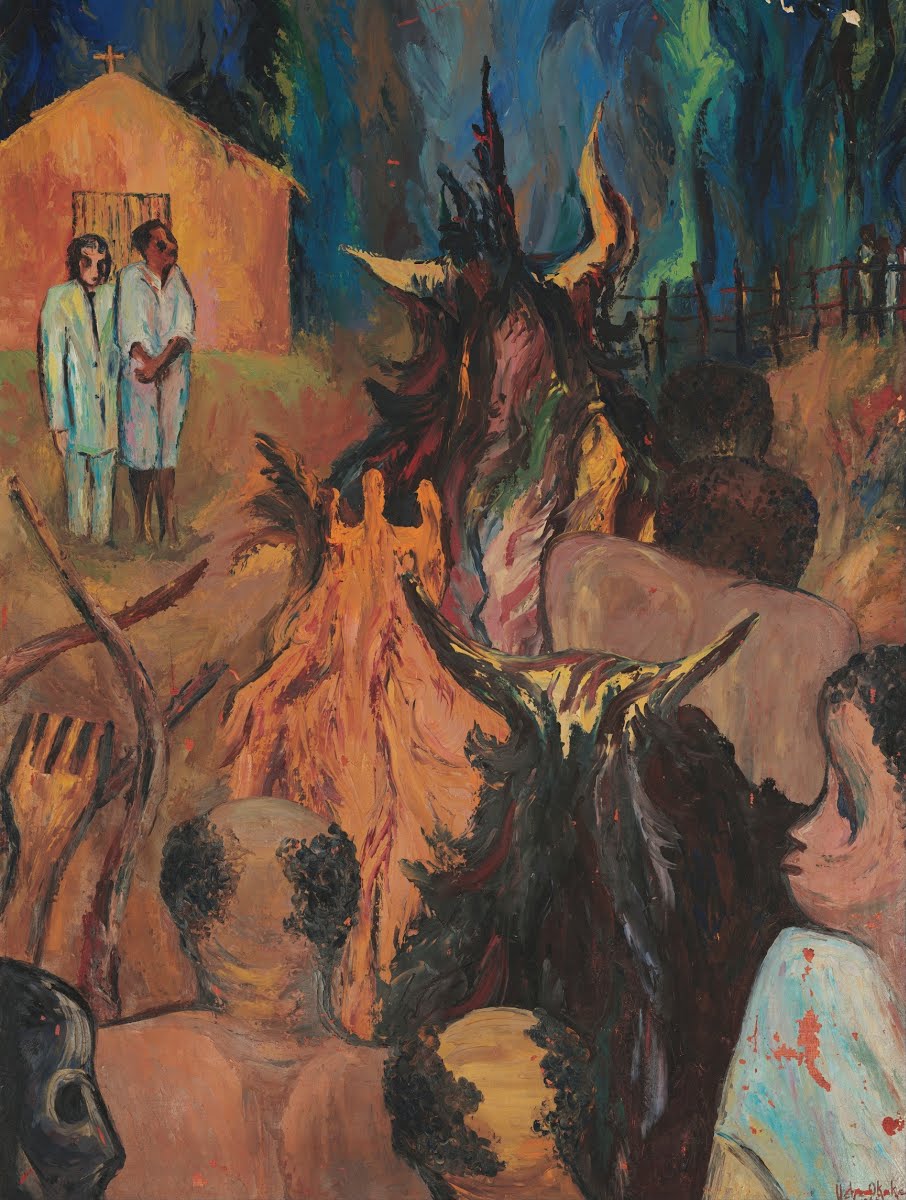
Image context: Uche Okeke made The Conflict (After Achebe) in 1965, several years after the Zaria Art Society's student experiment had ended. The painting takes a confrontation from Chinua Achebe's Things Fall Apart as its subject and renders it in oil on board. It is an afterimage of the movement rather than a group emblem: literary narrative, Igbo ancestral presence, European-format easel painting, and Okeke's own line all meet without dissolving into a neutral blend.[1]
Natural Synthesis sounds, at first, like the name of a style. It invites the eye to hunt for a common recipe: so much European modernism, so much inherited Nigerian form, stirred until a national aesthetic appears. The Zaria Art Society did something more difficult. Its members shared a method for deciding where artistic authority could come from, then produced work that often looked nothing alike.
That distinction is the movement's live wire. Formed by students at the Nigerian College of Arts, Science and Technology in 1958, on the approach to Nigerian independence, the society objected to an art education that treated British academic conventions as the curriculum and African arts as material outside it.[2][3] Yet its answer was not purity, retreat, or the replacement of one approved vocabulary with another. Natural Synthesis made selection itself an artistic responsibility. A painter could retain oil, perspective, printmaking, or compositional lessons acquired at college while choosing an intellectual and visual starting point that the college had failed to recognize.
The rebellion was collective. Its results belonged to different hands.
The argument began in a classroom—but not with a blank slate
The standard heroic version is clean: European teachers imposed a Eurocentric syllabus; Nigerian students rejected it; a decolonized modernism began. The institutional record is messier, and more interesting.
NCAST's art program was modeled on the British educational system, and Tate's exhibition history says its courses largely disregarded African art and cultural traditions. The Art Society's students met beyond that official structure, discussed their research, and made non-course work that they did not present to lecturers who discouraged independent exhibitions.[2][5] These parallel sessions effectively created a second curriculum: research a tradition, test what it could do in present-tense art, bring the result back for argument.
But Clara Etso Ugbodaga-Ngu, a Nigerian painter and pioneering woman lecturer in the department, complicates any picture of the school's faculty as mere scenery in a story of student revolt. She taught life drawing, imaginative composition, and painting. In 1959 she invited Ben Enwonwu to speak on contemporary Nigerian art and Timothy Adebanjo Fasuyi to lecture on traditional Nigerian art as part of an effort to widen and nationalize the department's offerings. MoMA's account also stresses that not every future society member rejected the imported curriculum in the same way; what united them was resistance to the exclusion of African references from serious art making.[4]
That complication matters. Natural Synthesis did not spring from cultural isolation, and it did not ask artists to forget what a college had taught them. It emerged inside a contested school already being changed by lecturers, students, visiting artists, nationalist politics, and arguments about what counted as knowledge. Decolonization here was not an eraser. It was a struggle over the syllabus, the studio, and the right to choose one's precedents.
“Synthesis” named a freedom, not a ratio
In October 1960—the month Nigeria became independent—Okeke wrote the society's Natural Synthesis manifesto. He linked the prospect of a new society to the making of a new culture and called on young artists to grow with the new nation.[2] The timing gave studio decisions constitutional weight: what should an independent artist inherit, and who was entitled to answer?
The word synthesis can make the solution sound frictionless. It was not an instruction to place a recognizably African motif inside a recognizably European composition. Nor did it assume a sealed African past on one side and a fully modern West on the other. Nigeria's artistic inheritances already included different regional, religious, courtly, domestic, performative, and commercial systems. European academic painting, meanwhile, could be both a colonial institution and a usable technology.
The method was selective. Okeke's formulation sought value in local practices and in forms arriving from elsewhere rather than granting either source automatic authority.[5] The crucial action was not mixing but judging: deciding what to study, what to carry forward, what to alter, and what to refuse. Chika Okeke-Agulu places the Art Society within wider networks of nationalist and Pan-African thought, literary publishing, exhibitions, and cultural exchange across Nigerian cities. In that account, Zaria matters not because it invented one Nigerian look, but because its artists made decolonization operative at the level of form.[3]
This is why Natural Synthesis could hold a group together without making its paintings interchangeable. A doctrine about the legitimacy of sources does not determine a palette. A research practice does not dictate a line.
Even the doctrine's status inside the group is not completely settled. In a 2025 interview, Demas Nwoko remembered “Natural Synthesis” as Okeke's phrase and presentation rather than a program the society formally debated and adopted. That late recollection sits uneasily beside the October 1960 text and the movement histories that treat it as the group's manifesto.[2][8] It does not make the shared project imaginary. It warns against turning a loose, argumentative student society into a bloc whose members merely executed one leader's rule—and helps explain why their work exceeds the label attached to it.
One method opened several visual languages
Uche Okeke's route ran through uli, an Igbo art of linear body and wall painting historically practiced predominantly by women. A work made near the end of the Zaria experiment shows that research becoming form: in Ana Mmuo (Land of the Dead) (1961), sinuous uli-derived lines generate abstracted funeral masquerades. That year, Okeke exhibited it at Ibadan's new Mbari gallery beside Demas Nwoko's Folly, a wide political allegory in which two caged birds fight under the colors of the Nigerian flag.[7] One method had already produced unlike spaces, subjects, and kinds of mark.
In The Conflict (After Achebe) (1965), the literary source is local and modern: Achebe's novel stages the collision between an egwugwu assembly and a Christian church in colonial-era Umuofia. Okeke did not illustrate “tradition” in the abstract. He moved a specific modern African novel and its account of ancestral and colonial authority into the durable, portable format of oil on board.[1]
Yusuf Grillo made different choices. The Yemisi Shyllon Museum's movement survey connects his work to Lagos life, an interest in mathematics, and sharply organized planes. The same survey describes Bruce Onobrakpeya looking toward Urhobo, Benin, and northern Nigerian stories and landscapes, then developing his own Ibiebe signs in a practice grounded in printmaking and experiment.[5] Nor did “local” always mean “from the artist's own ethnic background”: a Phillips Collection exhibition label traces Onobrakpeya's A Fulani Milkwoman through Fulani dress and Hausa architecture, while Simon Okeke's A Face may respond to objects excavated at Igbo-Ukwu.[7]
These are not regional ingredients applied to one modernist template. Okeke's elastic line, Grillo's faceted geometry, and Onobrakpeya's materially inventive prints organize vision differently. Their sources also cross categories that a colonial museum or syllabus might have kept apart: women's ephemeral painting, city architecture, folklore, masquerade, mathematics, Christian narrative, modern African literature, and technologies of reproduction.
The group therefore turned cultural plurality into formal plurality. “Nigerian” named the political horizon of independence, not a demand that every member perform the nation through the same signs. Natural Synthesis worked precisely because it left the artist with a problem rather than handing over a solution.
The source traditions were arts, not a warehouse of motifs
There is still a danger in celebrating synthesis too smoothly. When a modern painter transfers an inherited design into a signed, collectable work, the source does not arrive unchanged.
Pitt Rivers Museum's history of uli describes designs painted by Igbo women on bodies and clay walls for occasions including weddings, title ceremonies, and funerals. Body painting faded in roughly a week; wall painting washed away with the rains. That impermanence was not a technical failure but part of the art's social life. Colonial officers and missionaries tried to make permanent records through paper drawings, descriptions, and photographs, while Christianization and the move from clay to cement buildings helped diminish the settings in which the practice flourished.[6]
To move uli into ink, linocut, or oil therefore changes more than support. A temporary event becomes a transportable object. Work associated principally with women enters an art world whose named modernist protagonists were often men. A form renewed for a ceremony or wall becomes available to museums, markets, textbooks, and national narratives.
Okeke's relation to uli was intimate—his mother practiced it—and his later teaching helped make its visual intelligence legible to new generations.[1][2] Even so, “influence” should not turn the women who developed and sustained the practice into an anonymous preface to his achievement. A careful account keeps both transformations in view: Natural Synthesis resisted a curriculum that discounted uli, and its modern-art afterlife altered uli's duration, authorship, use, and audience.
That tension does not invalidate synthesis. It reveals what synthesis costs and creates. The strongest work does not merely display a borrowed sign; it makes the change of context perceptible.
A short-lived society produced a long institutional afterlife
The Art Society formed in 1958 and ceased collective activity as its students graduated and scattered in the early 1960s; the Yemisi Shyllon Museum's concise chronology gives its span as 1958–62.[2][5] Its method traveled because its artists built other places for it to operate.
Several members moved to Ibadan and helped establish the Mbari Artists and Writers Club in 1961 with publisher Ulli Beier. The club combined gallery, theatre, library, café, publishing house, and the orbit of the journal Black Orpheus, joining visual art to a larger African and international literary culture.[2][7] This was not a simple continuation of the Zaria meetings, but it preserved their conviction that modern art needed institutions of conversation as much as individual studios.
After the Nigerian Civil War, Okeke took charge of the fine-art department at the University of Nigeria, Nsukka. From the early 1970s, he encouraged students to research local environments and Indigenous systems including uli and nsibidi, not to revive them unchanged but to make them act on contemporary social and formal problems. The approach shaped the multigenerational Nsukka School.[2]
Here the movement's deepest reversal becomes visible. At Zaria, students had created an unofficial course beside a curriculum that marginalized African art. At Nsukka, research into those arts entered the curriculum itself. The counter-classroom became pedagogy.
Institutional success can harden an exploratory method into a label, however. “Natural Synthesis” is easy museum shorthand for any work that visibly joins African and European forms. Used that way, the term loses the argument that made it urgent: artists claimed the authority to research, discriminate among sources, and build different futures from them. The legacy is not a finished hybrid style. It is a repeatable question about who decides what an artist may know.
Look for the decisions, not the blend
When viewing work associated with the Zaria Art Society, the useful question is not “Which part is African and which part is Western?” That sorting exercise rebuilds the binary the artists were trying to outgrow. Look instead for decisions.
What prior art is being treated as knowledge rather than decoration? Which of its properties—line, rhythm, spatial order, narrative, material procedure, public function—has the artist selected? What changes when it enters oil paint, print, architecture, or a named studio practice? And what present problem makes the encounter necessary?
In The Conflict (After Achebe), no single ingredient completes the answer. The board and oil matter. So do Achebe's modern novel, the ancestral authority of the egwugwu, the violent contact with the church, and the painter's decision to crowd those forces into one encounter. The painting does not reconcile them. It gives their pressure a form.[1]
That is the clearest way to see the Zaria Art Society as a movement. Its coherence lies one level beneath appearance. The members agreed that inherited Nigerian arts could generate modern thought and that foreign techniques could be chosen without accepting foreign cultural hierarchy. Then they proved the point by refusing to look alike.
Natural Synthesis made one rebellion visible in different hands. The difference was not a failure to arrive at a national style. It was the freedom the method was built to produce.
Sources
- Yemisi Shyllon Museum of Art, Pan-Atlantic University, “Uche Okeke, The Conflict (After Achebe)” — official object record for the cover image, with date, medium, dimensions, artist background, and the painting's literary subject.
- Tate Modern, “Nigerian Modernism: Exhibition Guide” — curatorial account of NCAST, the 1958 Art Society, Okeke's October 1960 manifesto, the Mbari Club, and Natural Synthesis's later development at Nsukka.
- Chika Okeke-Agulu, Postcolonial Modernism: Art and Decolonization in Twentieth-Century Nigeria. Duke University Press, 2015 — study of the Art Society within the artistic, intellectual, and political networks of Nigeria's independence decade.
- Sule Ameh James, “Clara Etso Ugbodaga-Ngu's Many Roles in Nigeria's Modernist Art Scene.” post at MoMA (July 26, 2023) — research on NCAST's faculty, curricular change, and the varied positions of the students who formed the Art Society.
- Yemisi Shyllon Museum of Art, Pan-Atlantic University, “How the Zaria Art Society Rebelled” — institutional movement survey covering the society's dates, independent meetings, membership, and the distinct practices of Okeke, Grillo, and Onobrakpeya.
- Pitt Rivers Museum, “Uli Designs” — archival and cultural account of Igbo women's body and wall painting, its uses, intentional impermanence, colonial documentation, and movement into contemporary media.
- The Phillips Collection, African Modernism in America, 1947–67 digital press kit and exhibition labels — object-level research on Folly, Ana Mmuo, A Face, A Fulani Milkwoman, and the Mbari Club's publishing and exhibition network.
- Matthew Ochei, “Independence did not make Nigeria free — renowned architect Nwoko,” PUNCH (December 28, 2025) — primary oral account in which Demas Nwoko disputes the later treatment of Natural Synthesis as a formally adopted group doctrine.