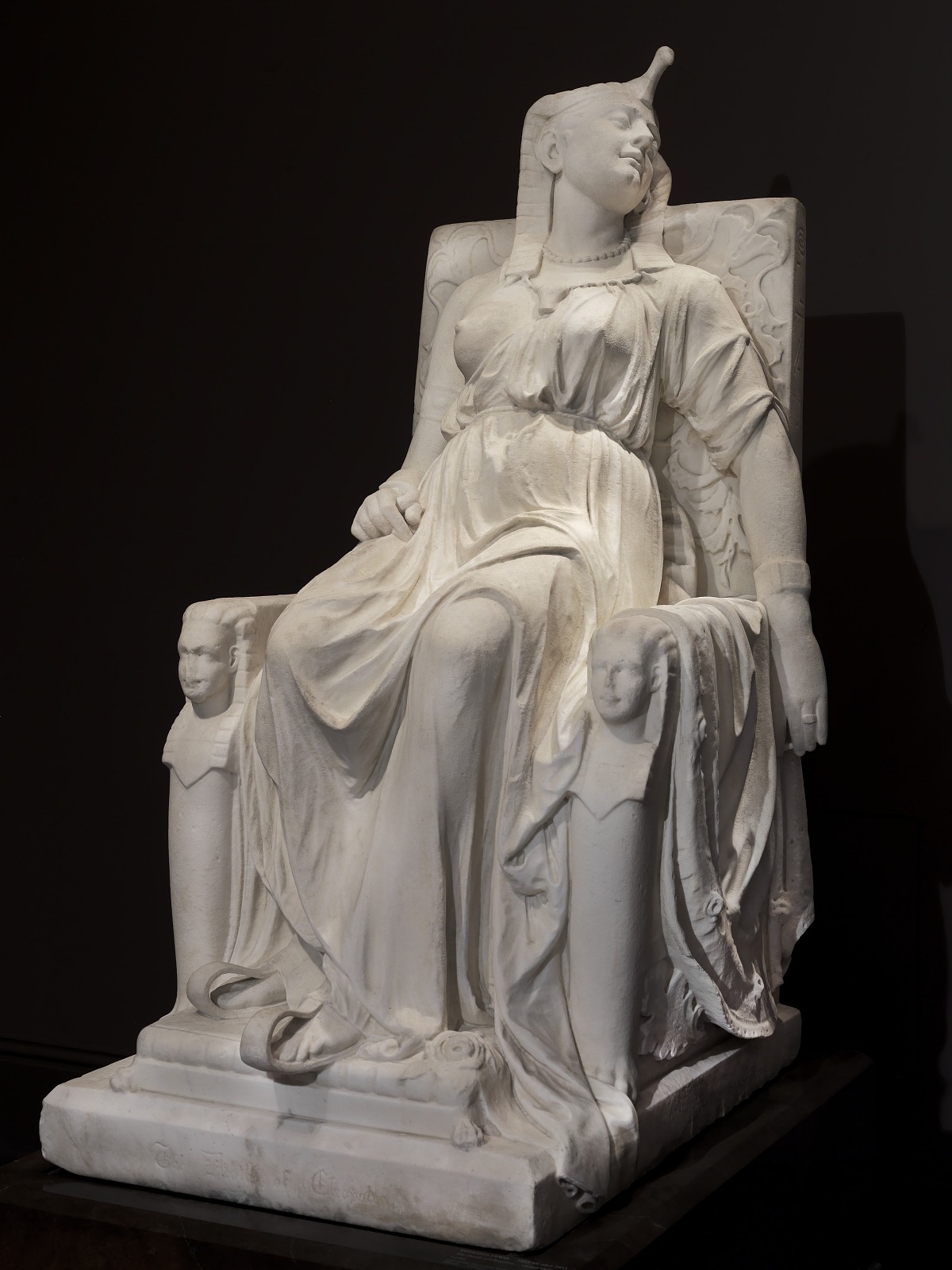
Edmonia Lewis's The Death of Cleopatra does something marble was often asked not to do in nineteenth-century sculpture: it lets death stay heavy. Cleopatra is not shown at the romantic instant before the asp, not lifted into a clean allegory of doomed beauty, and not arranged as a tidy lesson in imperial ruin. She is already dead. Her head tilts back, her mouth slackens, one arm drops, and the throne that should make her royal also fixes her in place. The result is a sculpture that keeps grandeur and bodily finality in the same room.
That tension is the work's engine. The Smithsonian American Art Museum identifies the sculpture as a marble work carved in 1876, more than five feet high, with Cleopatra seated in royal attire after the alleged fatal snake bite.[1] The museum's description also notes why the piece startled viewers: Lewis did not follow the softer convention of showing Cleopatra merely contemplating suicide. She showed the body after death, realistically enough that contemporary critics could call it repellent even as the work won attention at the Centennial Exhibition in Philadelphia.[1]
The Throne Does Not Rescue The Body
The sculpture's first trick is compositional. Cleopatra sits enthroned, which normally promises command, ceremony, and frontal authority. Yet her body interrupts that script. The lifted chest, fallen arm, slack head, and closed stillness make the throne feel less like a seat of power than a frame around aftermath. Lewis does not strip Cleopatra of majesty. She makes majesty unable to cancel physical consequence.
That is why the work is stronger than a simple "fallen queen" image. The Smithsonian points to identical sphinx heads on the throne and to meaningless hieroglyphics on its side, details that place the sculpture inside a nineteenth-century appetite for Egyptianizing signs as much as inside ancient history.[1] Those signs matter, but they are not where the work's seriousness finally lands. The sculpture's real pressure sits in the contrast between coded exotic splendor and the blunt fact of a body that can no longer perform queenliness.
Lewis knew how dangerous that contrast could be. Her career had been repeatedly read through identity before it was read through form. The Smithsonian biography describes her as the first sculptor of African American and Native American, specifically Mississauga, descent to achieve international recognition, and notes that she worked in marble partly because she feared others would doubt the originality of work finished by hired carvers.[2] In that context, The Death of Cleopatra becomes more than a daring subject. It is a claim of technical and interpretive authority in a medium whose prestige was never neutral.
Realism Becomes A Formal Argument
The word "realistic" can sound as if Lewis merely added unpleasant detail. That underrates the sculpture. Its realism is strategic. Cleopatra's death is not gore; it is weight, posture, and aftermath. Lewis uses marble polish and Neoclassical format to make the viewer expect idealization, then holds the viewer at the moment idealization fails. The queen is still carved with discipline. The surface still belongs to the tradition of refined marble sculpture. But the image will not let refinement erase mortality.
This choice becomes sharper when set beside Lewis's broader career. The National Park Service notes that Lewis moved from Oberlin to Boston, found support among abolitionist circles, made portraits of antislavery figures, and then joined expatriate sculptors in Rome, where her studio became a fashionable stop for visitors including Frederick Douglass.[3] Rome gave her access to the marble language of international sculpture. She did not use that language passively. In The Death of Cleopatra, she takes the prestigious apparatus of classical subject, throne, drapery, and carved stone, then uses it to show a female ruler at the moment when power has become inert.
That is what keeps the work from becoming only biography. Lewis's life matters, but the sculpture does not need to be defended only as a breakthrough by a Black and Indigenous woman artist. Its formal intelligence is visible. It knows how to stage a conflict between expectation and evidence. The viewer wants the throne to mean command, the white marble to mean purity, the antique subject to mean distance, and the famous queen to mean theatrical allure. Lewis keeps giving each expectation a counterweight: collapse, death, proximity, aftermath.
The Afterlife Makes The Sculpture Stranger
The sculpture's object history almost sounds too improbable, but it clarifies the work rather than distracting from it. SAAM records that after its acclaimed 1876 debut, The Death of Cleopatra was presumed lost for nearly a century, appearing at a Chicago saloon, marking a horse's grave at a suburban racetrack, and eventually reappearing in a salvage yard in the 1980s before entering the museum's collection.[1] That afterlife turns the sculpture into a second kind of survival story.
There is an irony here that should not be smoothed over. A work that refused to make a dead queen decorative was itself treated, for long stretches, as an oddity, marker, or leftover object. The violence is institutional and material rather than dramatic: misplacement, outdoor exposure, damaged surface, changed context, belated recovery. Yet that history also makes the sculpture's stubbornness more visible. It survived being misunderstood as an object just as it survives being oversimplified as an image.
The Peabody Essex Museum's 2026 retrospective framing is useful because it places Lewis's achievement at full scale rather than as a footnote. PEM describes Edmonia Lewis: Said in Stone as the first museum exhibition of its kind to gather the range of Lewis's art, emphasizing vivid naturalistic stone sculpture, abolitionist and social reform subjects, Indigenous identity, and religious and mythological figures.[4] That broader view helps restore The Death of Cleopatra to a career of deliberate choices. Lewis was not accidentally dramatic. She repeatedly used known subjects to test what marble could carry.
Why This Cleopatra Still Resists Easy Looking
Many historical sculptures ask to be admired from a respectful distance. This one makes distance unstable. The antique queen belongs to a far past, but the dead body's awkwardness is immediate. The marble is refined, but the subject resists refinement. The artist worked inside a Neoclassical vocabulary, but she does not let that vocabulary tidy the scene into uplift.
That resistance is why recent renewed attention to Lewis should not stop at celebration. The Smithsonian's educational materials connect Lewis to The Death of Cleopatra and identify her as a major artist whose story belongs in the museum's collection narrative.[5] The harder task is to keep looking at the work itself. Lewis's importance is not only that she entered a field structured against her. It is that, once there, she made a sculpture that could not be reduced to the field's preferred comforts.
The Death of Cleopatra is therefore not powerful because it is grim. It is powerful because its grimness has structure. Throne, body, marble, history, damage, recovery, race, gender, and authorship all press into one seated figure. Lewis gives Cleopatra the grandeur of a monument and the vulnerability of a corpse, then refuses to choose between them. The sculpture's final intelligence is that it lets death defeat decoration without defeating form.
Sources
- Smithsonian American Art Museum, "The Death of Cleopatra" - official object page for Edmonia Lewis's 1876 marble sculpture, including dimensions, iconography, Centennial Exhibition reception, lost-and-found history, and public-domain image.
- Smithsonian American Art Museum, "Edmonia Lewis" - artist biography covering Lewis's African American and Mississauga background, Oberlin and Boston years, move to Rome, marble practice, and subject range.
- U.S. National Park Service, "Edmonia Lewis" - biographical overview of Lewis's Oberlin experience, Boston abolitionist network, Rome studio, patrons, later life, and burial history.
- Peabody Essex Museum, "Edmonia Lewis: Said in Stone" - exhibition page for the 2026 retrospective, with context on Lewis's international career, underrecognition, naturalistic stone sculpture, and touring schedule.
- Smithsonian American Art Museum, "Drawn to Edmonia Lewis" - museum educational feature linking Lewis, her biography, and The Death of Cleopatra within SAAM's collection.