The face is easier to find than its boundary. In Medardo Rosso's Ecce Puer, a forehead, nose and small mouth gather into the likeness of a child, while the material around them remains broad and unsettled. Recognition arrives before we have decided where the head ends.
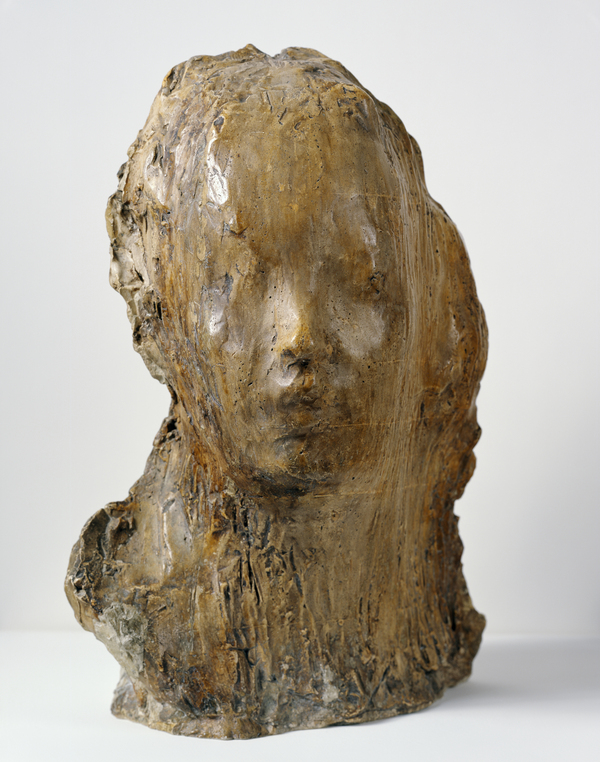
The version photographed here belongs to the National Galleries of Scotland. Dated 1906, it is made of plaster, gesso and varnish, and stands a little over 46 centimetres high. Its sitter was Alfred William Mond, whose father commissioned the portrait.[1] Those particulars establish a person and an object. The difficulty of separating the person from his surroundings is the sculpture's continuing event.
Where the portrait loses its outline
A conventional bust gives the eye a relatively secure itinerary: face, hair, neck, shoulders, support. Rosso interrupts that journey. The face offers delicate points of recognition, but the surrounding mass does not settle into an equally complete account of anatomy or clothing. The eye keeps trying to finish a description that the sculpture keeps opening again.
This unevenness matters. If everything were equally indistinct, the head might simply seem difficult to see. Here, legibility is concentrated. The recognizable features encourage us to approach the child as someone, while the less resolved edges make that encounter feel precarious. We can hold the face in view without possessing a complete account of it.
A famous story gives this condition a setting. Rosso supposedly struggled with the commission until he caught sight of the boy looking through curtains, then completed the bust in a single sitting. The National Galleries of Scotland explicitly presents the episode as a legend. It also records the sculpture's first Paris exhibition title, Impression of a Child, in 1906.[1] The title is useful even if the studio anecdote cannot be treated as an eyewitness report: the work concerns an encounter as much as a likeness.
The Metropolitan Museum of Art, which owns a bronze version, describes the head as intended for a fixed viewing position.[2] That changes what incompleteness can mean. Walking around a portrait normally promises more information about the sitter. Rosso instead privileges a particular meeting of object and eye. The sculpture has physical depth, but its fullest recognition depends on how that depth gathers into a view.
In the Scottish photograph, the rough margins remain conspicuous even after the face becomes clear. They need not be decoded into a literal curtain to do their work. They make surrounding matter participate in the appearance of the child. What might ordinarily be treated as background presses close enough to complicate his silhouette.
A glimpse that could be made again
The difference between a brief impression and a quickly made object is crucial here. A sensation of suddenness does not prove that every stage of production happened suddenly. Nor does the word unfinished tell us whether a sculptor stopped too soon or deliberately preserved an unresolved surface.
Rosso's broader practice strongly supports the second possibility. The Kunstmuseum Basel's 2025 retrospective described his repeated casting and reworking of existing subjects, including his retention of seams and other traces of making. It identified Ecce Puer as his last new sculptural motif, rather than the end of his work on sculpture.[3] A composition could remain active through further versions.
Material therefore deserves precise attention. The Scottish object illustrated here is plaster, gesso and varnish; the Met's is bronze.[1][2] Rosso also made wax versions of his sculptures. Treating every photograph of Ecce Puer as though it showed the same wax head would erase the physical differences through which the image reaches us. A softened contour is an effect to examine, not sufficient evidence of a soft material.
Photography belonged to that examination. Basel's account describes Rosso testing lighting, framing and viewing angles with his camera, modifying casts and photographing them again. He also exhibited photographs alongside sculpture.[3] The camera helped him reconsider what the object could become in a view. Antonia Reeve's museum photograph above is modern documentation, not one of Rosso's own photographic experiments.[1]
Earlier interpreters found a strongly emotional child in this uncertain surface. In the Museum of Modern Art's 1963 exhibition announcement, Margaret Scolari Barr associated the work with tenderness and nostalgia for childhood, and related its vertical incisions to the curtain story.[4] That is a persuasive historical reading, but it does not give us direct access to Alfred's feelings. The sculpture can suggest vulnerability without documenting whether the boy felt shy, frightened or simply curious.
My reading begins with that limit. The less securely the portrait encloses its subject, the harder it becomes to reduce him to a single expression. The child is recognizable, yet the encounter remains incomplete. Rosso gives our attention something definite to return to without resolving everything around it.
Look once more at the boundary. The mass has not become lighter, and the plaster has not moved. What changes is our ability to gather a face from it. Ecce Puer makes that small achievement of looking feel as temporary as the glimpse it preserves.
Sources
- National Galleries of Scotland, “Ecce Puer [Behold the Boy],” GMA 1274 — Scottish object, curtain legend, exhibition title and photograph credit.
- The Metropolitan Museum of Art, “Behold the Child,” 1990.304 — bronze version, 1906 commission and intended fixed viewing position.
- Kunstmuseum Basel, “Medardo Rosso: Inventing Modern Sculpture,” 2025 — exhibition sections on repetition, process, photography and Ecce Puer as the final new motif.
- The Museum of Modern Art, Medardo Rosso exhibition press release, October 2, 1963, especially page 3 — Margaret Scolari Barr's interpretation of the child and the incised surface; archival PDF.