A hand rises from a sleeve, its fingers extended. There is no shoulder, face or second hand to complete the figure. Yet the gesture feels sufficient: someone seems to be addressing the space in front of it.
The Cleveland Museum of Art's Arm Reliquary of the Apostles, made around 1190 in Hildesheim, Germany, encloses an arm bone attributed to an unidentified saint. Gilt silver, enamel and oak form its outward body. At 51 centimeters high, it gives a small surviving portion of a person a conspicuous presence.[1] Its artistic problem is unusually intimate: how can a fragment reach the living?
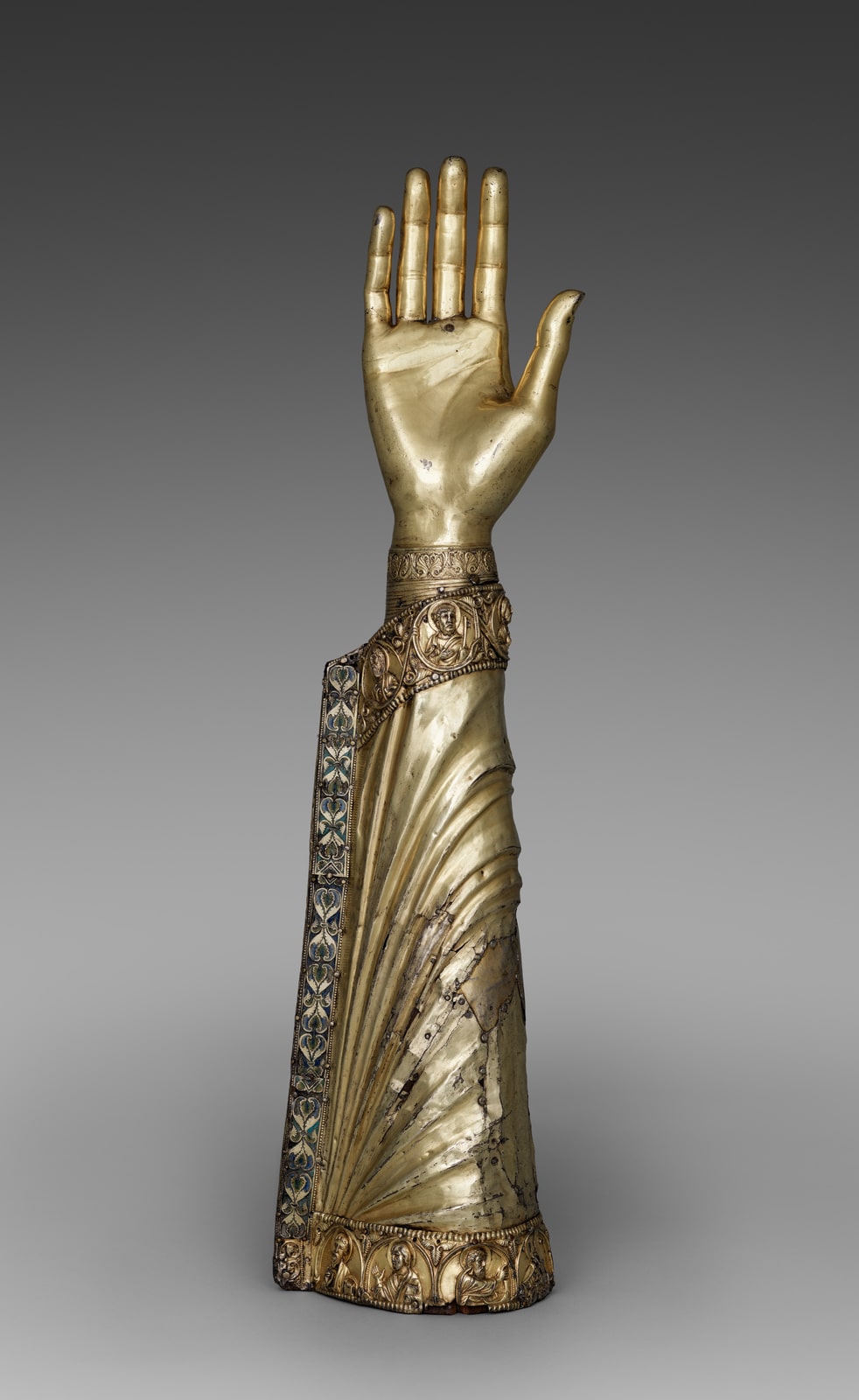
The sleeve matters almost as much as the hand. Its folds turn hard metal into the suggestion of cloth gathered around a wrist. The decorated borders make this a dressed presence. Looking upward from the base, we encounter ornament, clothing and finally a gesture, as though the object were gradually becoming capable of an exchange.
A body that could act
In medieval Christianity, a relic might be bodily remains or an object associated with a holy person. Its significance rested on belief in saints' continuing power to intercede for the living. Barbara Drake Boehm's account for the Metropolitan Museum of Art explains why lavish containers were appropriate: precious materials honored something believers considered more valuable still.[2]
That relationship reverses the first impression of a museum visitor attracted by glittering metalwork. The visible craftsmanship served the hidden thing. A plain fragment could carry an importance that its appearance could never communicate on its own.
An arm supplied a particular kind of expression. Art historian Holger A. Klein connects the popularity of arm reliquaries from the twelfth century onward with their use during services and processions. Clerics could employ them in gestures of blessing and contact, making the saint's presence tangible to worshippers.[3] The sculpted hand belonged to an action involving other hands.
This is where the object exceeds a commemorative likeness. A portrait offers a face to remember; an arm offers a gesture to perform. Lifted and directed toward a congregation, it could give bodily form to the belief that a saint remained active. Its incompleteness becomes useful. Attention gathers around the part that can reach outward.
The Cleveland hand also rewards a quieter encounter. Look at the space beside the thumb, and then at the broad, exposed palm. They give the upper part an openness quite different from the weight of the sleeve below. To my eye, the hand appears available to another person even before its ritual use is explained.
Two distances of looking
A related Arm Reliquary at The Met Cloisters, made in the Meuse Valley around 1230, clarifies how such objects could serve different viewing distances. Its silver sleeve contains two openings, formerly covered with crystal, through which the sacred remains could be seen. The museum distinguishes that close view on an altar from the more distant sight of the arm carried in procession, its hand raised in blessing.[4]
Up close, an opening promises access to the contents. From farther away, the silhouette carries the encounter. These are complementary invitations: attend to the small material trace; recognize the larger bodily gesture. The goldsmith had to accommodate both the person examining a precious object and the person seeing it pass through a crowd.
Visibility could also change over an object's lifetime. The Walters Art Museum's Arm Reliquary of Saint Pantaleon dates to the late thirteenth century, but its small door with glass shields and the crystal at the sleeve's edge were added in the fifteenth. An incomplete inscription names Pantaleon; the museum describes the arm bone it formerly held as reputedly his.[5]
Those additions make the container a record of decisions about access. A surviving reliquary need not represent one finished medieval moment. Later hands could alter the terms of looking while retaining the arm's older outline. The saint's sculpted body acquired a history of its own.
The shape cannot settle the contents
There is a temptation to treat these forms as exceptionally clear labels: an arm outside must mean an arm inside. Klein cautions against that assumption. Arm reliquaries could contain material from several saints, remains from other parts of a body, or contact relics. The correspondence found in Cleveland's example was not a universal rule.[3]
Even its title requires care. The Cleveland reliquary takes its name from the apostles depicted along its borders. That decoration suggests an apostolic association, but it does not establish the identity of the person whose bone it encloses.[1][3] We can describe the artwork confidently while leaving the attribution of its contents unresolved.
This limit makes the sculpture more interesting. Its form could do something beyond announcing an inventory: it could give many kinds of sacred material the expressive possibility of a hand. My reading is that the arm's power lies in this passage from possession to encounter. A community might hold a fragment; the reliquary offered a way to feel addressed by it.
Return to the open hand. The face remains absent, and the concealed bone cannot explain the gesture by itself. Between them stands the goldsmith's contribution: a sleeve, a wrist and extended fingers, making room for a relationship with someone no longer bodily whole.
Sources
- Cleveland Museum of Art, “Arm Reliquary of the Apostles,” accession 1930.739 — date, origin, materials, dimensions, contents, decoration and photograph.
- Barbara Drake Boehm, “Relics and Reliquaries in Medieval Christianity,” The Metropolitan Museum of Art, 2001, revised 2011 — relic veneration and the purpose of precious containers.
- Holger A. Klein, “Arm Reliquary of the Apostles,” Treasures of Heaven, hosted by Columbia University — ritual use, varied contents and the limits of identification.
- The Metropolitan Museum of Art, “Arm Reliquary,” c. 1230, accession 47.101.33 — viewing windows and the distinction between altar display and processional visibility.
- The Walters Art Museum, “Arm Reliquary of Saint Pantaleon,” accession 57.688 — inscription, attributed relic and fifteenth-century additions to a late-thirteenth-century object.