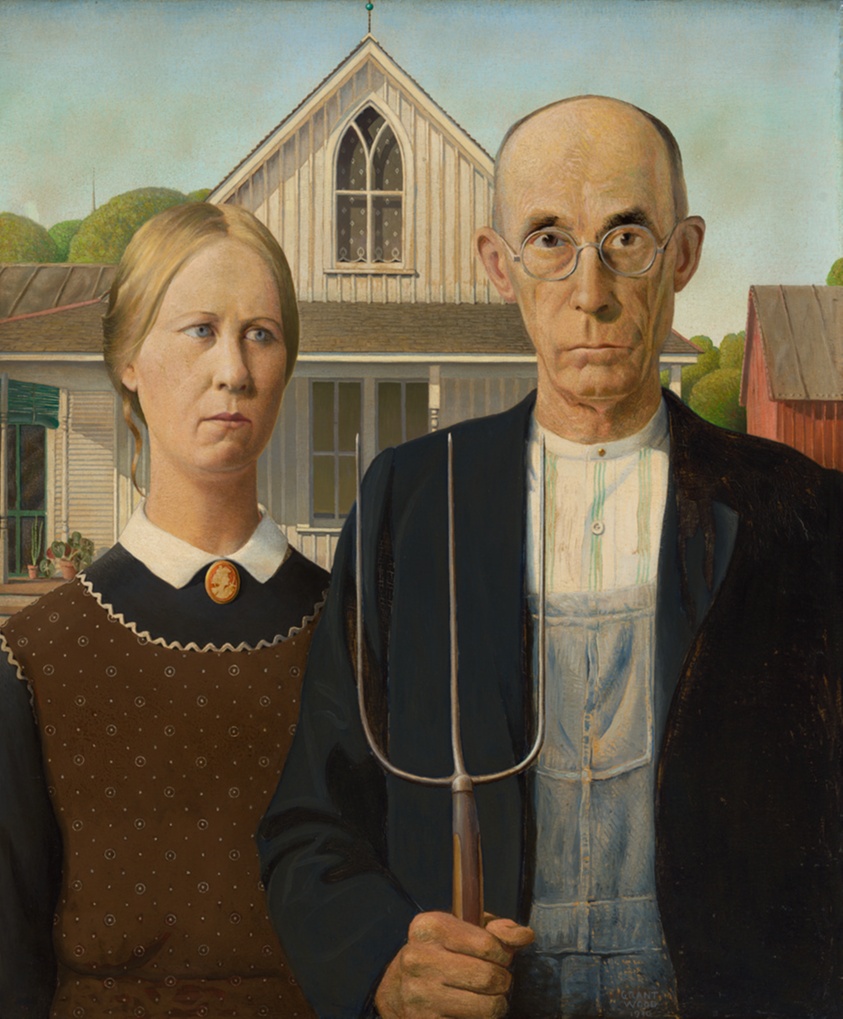
American Gothic is usually introduced as an icon of Midwestern austerity. That is true but incomplete. Its deeper durability comes from structure: Grant Wood built a painting that behaves like an image template, not a one-time narrative. The work gives viewers a stable frame (front-facing pair, rigid verticals, house façade, pointed window), then leaves just enough ambiguity inside that frame for endless recasting.
That is why the painting never really exits circulation. It keeps returning in election graphics, magazine covers, parody posters, local tourism campaigns, and social media edits—not because people remember one art-history lecture, but because the picture is unusually good at carrying new social roles while still remaining instantly legible.
Image context: the hero image reproduces Grant Wood’s American Gothic (1930). The painting itself is the article’s direct analytical object, so the image functions as both orientation and evidence for the composition arguments below.
1) The frame is strict; the story is open
Wood completed the painting in 1930 as oil on beaverboard, and the Art Institute of Chicago acquired it the same year.[1][2] From the start, the picture paired formal rigidity with narrative uncertainty. The figures stand close but do not interact. The man looks out, the woman looks sideways. The pitchfork points up like a heraldic sign, while fabric patterns and siding lines repeat across the surface.
This creates an unusual viewing contract: composition gives certainty, psychology withholds it. We know where to look, but we are not told exactly what relation we are witnessing—husband and wife, father and daughter, solidarity, distance, pride, defensiveness, satire, or all of them in rotation.[1][3][5]
In practical terms, that ambiguity is reusable. A later generation can replace the faces, clothes, or props and still keep the core signal: “this is a statement about social identity under scrutiny.”
2) Architecture does more than set the scene
The house behind the figures was inspired by the small Carpenter Gothic residence in Eldon, Iowa (often called the American Gothic House), which still stands and is now interpreted through a dedicated visitor center.[4][5] The painted window is not neutral background detail; it is a shape engine for the whole image.
The arch echoes in the figures’ elongated bodies, in the upright tines of the pitchfork, and in the disciplined, almost portrait-studio staging. In other words, the architecture does compositional work. It turns a local building type into a visual grammar that reads as “American seriousness,” even for viewers who do not know Iowa history.
Because the structure is so clear, the painting can survive heavy cultural reuse without collapsing into noise. Most parodies fail after one cycle because their underlying form is weak. American Gothic keeps working because its geometry is stronger than any single joke attached to it.
3) Regionalism and performance, not simple nostalgia
Grant Wood is commonly grouped with U.S. Regionalism, especially during the Depression-era search for distinctly American visual languages.[3][6] But reading American Gothic as pure rural celebration misses how staged it is. Wood reportedly used his sister Nan and family dentist Byron McKeeby as models, posed separately, then synthesized them in studio.[5][6]
That method matters. The painting is not documentary journalism; it is constructed social theater. The figures feel “real” precisely because they are stylized into types. The work therefore does two things at once:
- offers a recognizable national image during economic stress,
- and leaves enough stiffness, distance, and theatricality that viewers can read irony back into it.
This double register explains why critics and audiences have long disagreed about tone. Is it affectionate? severe? mocking? defensive? The answer is less a single verdict than a design feature: Wood made an image that can host conflict without losing coherence.
4) Why the picture scales so well in 2026 visual culture
Today’s image systems reward three traits: immediate recognizability, low cognitive load, and remix compatibility. American Gothic has all three.
- Immediate recognizability: the silhouette is identifiable in a fraction of a second.
- Low cognitive load: only a few major forms carry the message.
- Remix compatibility: swap faces/objects/text overlays and the composition still reads.
That combination is exactly what makes internet-era visual memes travel. But unlike many born-digital meme formats, American Gothic arrives with historical depth and institutional legitimacy, so each reuse borrows both familiarity and authority.
This is also why its museum life and pop life reinforce each other rather than cancel out. Institutional display keeps the original available as reference; mass parody keeps the template socially active.
5) The high-value takeaway for readers and curators
A useful way to read American Gothic now is to treat it as infrastructure for public identity, not merely as a “famous American painting.” Once viewed that way, the work clarifies a broader art-world question: which images survive because they are historically important, and which survive because their formal design keeps generating new social meaning?
Wood’s painting survives on both counts. It is historically anchored in 1930 U.S. culture, and formally engineered for replay. That dual status—archive object and live template—is what makes it one of the few museum works that can move from gallery wall to civic argument to meme feed without becoming visually empty.
Sources
- Art Institute of Chicago, American Gothic (Grant Wood, 1930)
- Art Institute of Chicago API, artwork record 6565
- Encyclopaedia Britannica, “American Gothic (painting by Grant Wood)”
- American Gothic House Center (Eldon, Iowa), site history/context
- Wikipedia, “American Gothic”
- TheArtStory, “Grant Wood Artist Overview and Analysis”
- Wikipedia, “Grant Wood”