
Maria Martinez's black-on-black pottery can be misread if it is approached only as a finished museum object. The surface is so resolved that it invites a quick label: elegant, modern, monochrome. But the work is not a black vessel plus decoration. It is a chain of knowledge that begins before a pot is visible and ends only after clay, burnishing, painted slip, fuel, smoke, and oxygen have done their separate jobs. The archival footage below is valuable because it lets that chain return to time.
Martinez, also known as Po've'ka Montoya Martinez, was a Tewa artist from San Ildefonso Pueblo. The National Museum of Women in the Arts gives her dates as 1887-1980 and stresses that she learned pottery in the traditional way, by watching older women in her family rather than through formal art-school instruction.[2] That point is not a romantic detail. It tells us how expertise moved: through observation, repetition, touch, judgment, and a community memory of where clay comes from and how it behaves.
The blackware that made Maria and Julian Martinez internationally known was both revival and invention. A Smithsonian account connects their experiments to archaeological fragments and to Edgar Lee Hewett's interest in recreating older Pueblo pottery, but it also makes clear that the Martinezes moved beyond a simple reconstruction.[3] They made a new ceramic language from local materials, old knowledge, and modern conditions of display. Smarthistory frames Maria Martinez as one of the best-known Native potters of the twentieth century and argues that her work helped reframe Native ceramics as fine art rather than anonymous ethnographic material.[4]
That reframing came with a market. By the mid-1920s, according to the National Museum of Women in the Arts, the Martinezes' blackware was popular outside the pueblo, their signed pots circulated as art objects, and Maria Martinez's reputation extended into museums and major exhibitions.[2] The Smithsonian account adds the public geography of that circulation: sales to tourists and collectors in Santa Fe, including the Palace of the Governors and the Santa Fe Indian Market.[3] None of this makes the work less Pueblo. It makes the work historically specific. Black-on-black pottery entered a twentieth-century world of collectors, museums, tourist economies, and Native artists negotiating visibility on unequal terms.
The collaboration should stay in the foreground. The Denver Art Museum's educational material describes a Pueblo division of labor in which women shaped and polished pots while men painted designs, and it places Maria and Julian within that practice.[5] The division matters, but it should not flatten the art into a simple two-name formula. Maria's forming and burnishing were not neutral preparation. Julian's painted designs were not an add-on. The black-on-black effect depended on the relation between polished surface and matte design, then on firing conditions that turned the vessel black. The finished pot is a collaboration among people, materials, and fire.
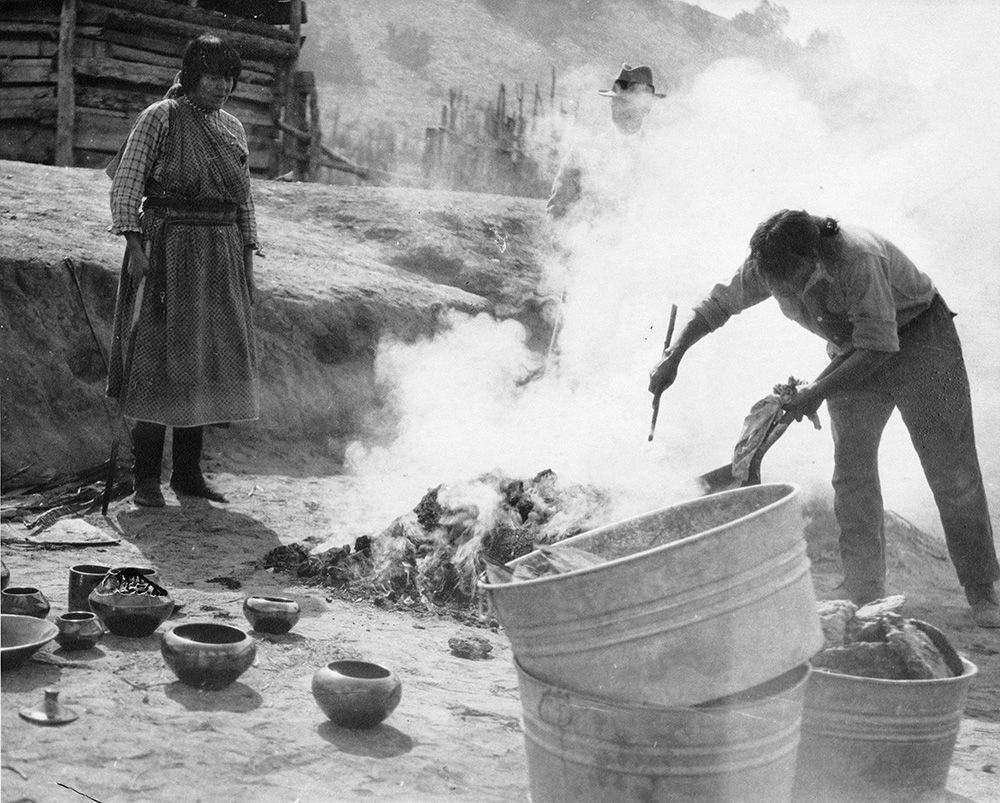
The Archival Film
The embedded clip is travelfilmarchive's YouTube upload Indian Pottery (1940s).[1] The title is broad in the way many older educational or travel films are broad, so it should be watched critically. Its usefulness here is not that it provides a complete cultural history of San Ildefonso pottery. Its usefulness is that moving images preserve posture, pace, handling, and sequence. They show pottery as work in time.
Watch first for slowness. The film's strongest evidence is not a single dramatic gesture. It is the repeated pressure of hands, the controlled movement around the vessel, and the sense that speed would be a mistake. A pot begins as clay, but not as raw clay in the abstract. The National Museum of Women in the Arts describes Maria Martinez mixing clay with volcanic ash, building walls with coils, scraping and smoothing with a gourd, and polishing with a stone before Julian painted designs with liquid clay.[2] The footage makes that list more legible because it gives the work a bodily scale.
This is where the surface stops looking like a color and starts looking like a process. Black-on-black pottery is often reproduced in still photographs under museum lighting, where the vessel can seem almost metallic. The archival film resists that illusion. It shows a pot being handled before it becomes an icon. It asks the viewer to imagine the polished surface as a record of repeated contact and the matte design as a decision made on top of that polish. The difference between shine and flatness is not just optical. It is the result of preparation, timing, and the behavior of slip under fire.
The fire is the part a still photograph can most easily hide. In the cover image, smoke is not background atmosphere; it is part of the technology. The Smithsonian account explains that Maria and Julian experimented with firing until they learned how reducing oxygen in the pit could turn the pottery surface black, while design differences emerged through the relation between polished and matte clay surfaces.[3] The archival film and photograph therefore belong together. One shows hands and vessel. The other reminds us that the last stage of the surface was a controlled environmental event.
That matters because the word "finish" can make art sound static. In this case, finish is an achievement of sequence. Clay must be gathered and prepared. Coils must rise evenly enough to hold shape. The surface must be smoothed, scraped, and burnished before painting. The painted design must sit in the right relation to the vessel's form. The firing must then transform the pot without destroying it. The black shine is not a skin applied at the end. It is a consequence of many earlier decisions being held together under pressure.
What The Footage Corrects
The film also corrects a habit of isolating Maria Martinez as a solitary genius while forgetting the structure around her. She was an extraordinary artist, and the museums are right to name her. But the art becomes clearer, not smaller, when collaboration is visible. Julian Martinez's painting, family labor, San Ildefonso knowledge, market demand, archaeological interest, and museum collecting all shaped the conditions in which the work could be made and recognized.[2][3][5]
The danger is to replace one simplification with another. It would be wrong to describe black-on-black pottery as a timeless survival untouched by modernity. It would also be wrong to describe it only as a market adaptation made for outside buyers. The achievement is more exact than either story. Maria and Julian Martinez used Pueblo techniques and local knowledge to answer a modern moment in which Native art was being collected, categorized, bought, exhibited, and judged by institutions that often preferred objects without living makers attached. Signing pots, selling to collectors, and appearing in museums did not remove the work from Pueblo practice. They changed its public address.
Smarthistory's account is useful here because it names the shift in status: Martinez's vessels helped viewers see Native ceramics as fine art.[4] But that status came after process, not before it. The art did not become important because museums later accepted it. Museums accepted it because the work could carry refinement, innovation, authorship, and cultural continuity at once. The black-on-black surface made that argument without needing loud contrast. It made a subtle object visible across distance.
This is why archival video is the right form for this post. A still image can honor the vessel. A museum label can fix maker, date, medium, and collection. A written source can clarify chronology and market context. The moving image does something different. It lets a viewer see that Maria Martinez's art was not merely designed. It was paced. It was built through small adjustments that look ordinary only if the viewer has never tried to make clay behave.
The clip should not be treated as neutral evidence. Its framing comes from a mid-century film culture that often generalized Native artists and Pueblo communities for outside viewers. Still, watched alongside museum and Smithsonian sources, it gives back a crucial fact: blackware was work before it was a collectible image. The pot's shine is not detached from the hand. Its darkness is not detached from smoke. Its modern art status is not detached from Julian's designs, family collaboration, Pueblo practice, and the public worlds where those vessels traveled.
By the time Maria Martinez received major institutional recognition, including the National Museum of Women in the Arts' noted Renwick Gallery exhibition in 1978, the black-on-black surface had already carried decades of labor, looking, buying, teaching, and imitation.[2] The archival film lets us return to the earlier claim. Before the pot is famous, it is handled. Before it is black, it is prepared for fire. Before it is a museum object, it is a collaboration between hand, smoke, and shine.
Sources
- travelfilmarchive, "Indian Pottery (1940s)" - YouTube video embedded in this post.
- National Museum of Women in the Arts, "Maria Martinez" - artist profile and object discussion of Martinez's materials, process, public recognition, and blackware collaboration with Julian Martinez.
- Smithsonian American Women's History Museum, "Fragments of Ancient Pottery Inspired Maria Martinez" - account of Maria and Julian Martinez's black-on-black pottery, archaeological inspiration, firing experimentation, and public market.
- Smarthistory, "Puebloan: Maria Martinez, Black-on-black ceramic vessel" - art-historical overview of Martinez's role in reframing Native ceramics as fine art.
- Denver Art Museum, "Plate" - educational object page discussing Maria and Julian Martinez, Pueblo pottery roles, and early black-on-black ceramic practice.
- Wikimedia Commons, "File:Maria and Julian Martinez pit firing blackware pottery (c.1920).jpg" - archival photograph used as the article image.