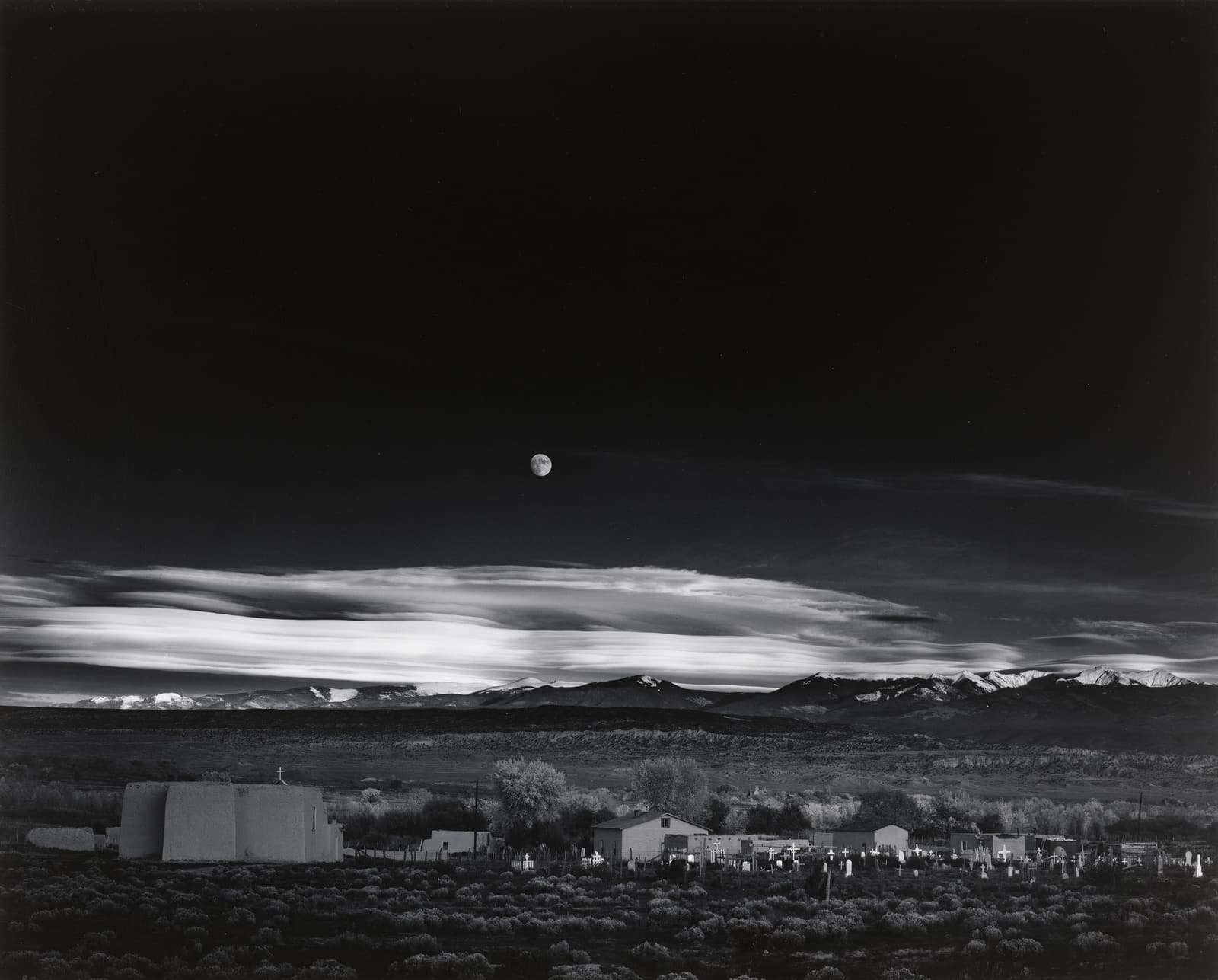
Ansel Adams's Moonrise, Hernandez, New Mexico is often introduced as a miracle of timing: the photographer stops the car, the light is nearly gone, the moon hangs above a small village, and the cemetery crosses catch the last sun. That story is true, but it can make the photograph sound too accidental. The stronger reading begins one step later. Moonrise is not only a lucky negative. It is a photograph that Adams kept remaking in the darkroom until the sky became almost theatrical, the moon became a small hard note, and the illuminated crosses became the hinge between earth and heaven.[1][3]
That two-stage making is why the print still feels alive after so many reproductions. The field exposure gave Adams the raw event. The later prints gave the event its durable pressure. The Ansel Adams Gallery's account stresses both halves: Adams made the exposure on November 1, 1941, after a disappointing day of photographing, but printing the negative required careful dodging and burning to balance the image's contrasts.[1] Cleveland Museum of Art describes the same instant as a race against fading light, with Adams calculating exposure mentally when he could not find his meter.[3] The photograph's authority comes from that collision: fast perception outside, slow judgment inside.
The Negative Caught A Clock
The subject looks still, but the photograph is built around a vanishing interval. The moon is high enough to feel cosmic, the clouds are still reflective, the mountains hold a pale rim, and the village has not yet disappeared into dusk. The most vulnerable element is the cemetery. If the sun falls a little farther, the white crosses stop glowing. If Adams waits, the picture loses the strange vertical conversation between moon and grave marker.
That is why the exposure story matters technically without becoming trivia. Cleveland's collection note says Adams saw the setting sun on the cemetery crosses, snow-capped mountains in the distance, and luminous clouds, then had only moments to set up.[3] LACMA's collection record anchors the medium as a gelatin silver print and identifies one later print from 1948, which is already a reminder that Moonrise circulated not as a single transparent object but as a negative interpreted through later printing decisions.[2] MoMA's record gives the work's canonical museum identity: Ansel Adams, Moonrise, Hernandez, New Mexico, 1941.[4]
The negative therefore caught a clock, not a finished image. It preserved relationships that could be developed, intensified, and reweighted: moon to sky, cross to mountain, building to land, cloud to horizon. Adams did not need the camera to solve every relationship at the roadside. He needed the negative to hold enough information for the print to become articulate.
The Print Makes The Sky Speak
The sky is the photograph's most famous decision. In reproduction, it can look almost black, a vast surface that presses downward without stars. That darkness is not simply what the scene "was." It is a tonal argument. A lighter sky would make the village more descriptive and the mood less severe. A weaker sky would let the clouds become scenery. Adams's mature prints make the sky behave like a chamber: immense, silent, and dense enough to make the moon feel both small and absolute.
The Ansel Adams Gallery notes that different areas of the image required different enlarger exposure through dodging and burning, and that Adams later said no two prints were exactly alike.[1] That line is central to the work's medium. A painting can be revised on its surface; a photograph is often assumed to be fixed by the shutter. Moonrise shows why that assumption fails. In gelatin silver printing, the negative is a score. The print is the performance. Adams's darkroom work does not betray the photograph's truth; it locates the expressive truth inside what the negative makes possible.
This is also why the image is a useful antidote to shallow ideas of "straight photography." Cleveland identifies Adams as a practitioner of unmanipulated straight photography, but the museum's own account immediately pairs spontaneity with technical command.[3] The point is not that nothing happened after exposure. The point is that the expressive changes remain photographic: exposure, development, paper, contrast, local printing, and tonal scale. Adams was not adding a moon or inventing a cemetery. He was deciding how the captured light should be made legible.
Why The Crosses Need The Dark
The white cemetery crosses are tiny, but they carry the picture's emotional charge. They are not sentimental close-up symbols; they are small units of reflected light in a large system. Their scale matters. If they were larger, the photograph would risk becoming an obvious meditation on death. Because they are small, they work structurally. They answer the moon without competing with it.
The dark sky makes that answer possible. It creates a field in which small bright forms become events. The moon is one event. The clouds are another. The crosses are the earthly reply. The village buildings sit between them, not quite sacred and not quite ordinary. In that arrangement, Adams turns a New Mexico roadside view into a diagram of attention without using diagrammatic means. Everything remains a place: Hernandez, the mountains, the cemetery, the evening air. Yet the print makes the place feel tuned.
The image's later institutional life reinforces that balance between place and print. LACMA identifies a 1948 gelatin silver print with specific image dimensions; Cleveland holds a 1970s print; the Whitney records another gelatin silver print with its own sheet and mount dimensions; Wikimedia's file record traces a 1941 photograph with a 1942 publication history and points to museum records as source context.[2][3][4][5] Those records show how Moonrise exists through prints, collections, and reproductions, not through a single universal object.
The Medium Is The Message, But Not As A Slogan
Calling Moonrise a darkroom masterpiece should not reduce it to technical bravura. The technique matters because it clarifies a feeling that was already latent in the scene. The photograph's force is not "look what Adams could do to a negative." It is "look how a negative can become a place where time, light, death, and weather are held in one tonal order."
That order depends on restraint. Adams could have made the moon dominate. He could have printed the village more legibly. He could have softened the contrast until the image became scenic. Instead, the print keeps refusing easy entry. The viewer starts with the sky because it is enormous, then finds the moon, then drops to the clouds and mountains, then discovers the crosses. The photograph teaches the eye to descend.
That descent is the real technique. Field exposure gave Adams a rare alignment. Printing turned alignment into hierarchy. The darkroom did not merely improve Moonrise; it supplied the photograph's grammar. The sky is not background. The crosses are not detail. The moon is not decoration. Each is a tonal decision, and together they make the image feel less like a captured sunset than like a carefully printed threshold.
Sources
- The Ansel Adams Gallery, "Moonrise, Hernandez, New Mexico" product and image-history page, covering the 1941 exposure story, darkroom printing, and later print variation.
- Los Angeles County Museum of Art, collection record for Ansel Adams, Moonrise, Hernandez, New Mexico, 1941, printed 1948, including medium and dimensions.
- Cleveland Museum of Art, collection record for Ansel Adams, Moonrise, Hernandez, New Mexico, 1941, including the exposure account and gelatin silver print information.
- Whitney Museum of American Art, collection record for Ansel Adams, Moonrise, Hernandez, New Mexico, 1941, including medium, dimensions, and accession details.
- Wikimedia Commons, file page for Moonrise, Hernandez, New Mexico.jpg, including image provenance, publication notes, and the downloaded image asset used here.