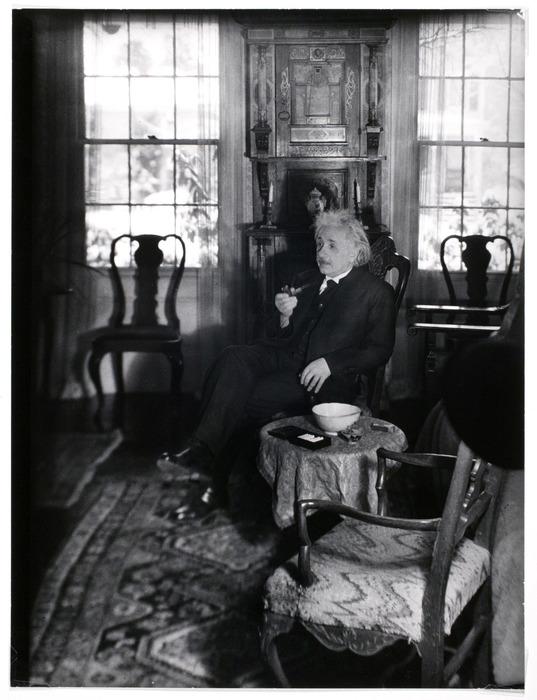
Albert Einstein occupies surprisingly little of the photograph. Windows rise on either side of a carved cabinet; chairs and a patterned rug fill the foreground. Seated with his pipe, he shares the room with its furniture. Lotte Jacobi’s 1938 portrait, reproduced here from the International Center of Photography, gives a famous thinker an unusually generous amount of surrounding space.[1]
That space changes the encounter. The eye can wander before returning to the face. Einstein’s presence gathers force without filling the frame, and the room seems to continue beyond the business of being photographed. It is a useful entrance to Jacobi’s career: she worked among celebrated people, yet the names on her pictures are only the beginning of what there is to see.
Born in 1896 in Thorn, then in West Prussia and now Toruń in Poland, Jacobi entered a profession already established within her family. After studying photography and film in Munich, she took over the family studio in Berlin in 1927. Its address on Joachimsthalerstrasse placed it in the city’s western cultural district, among the artists and performers who would become her subjects.[2]
The studio supplied an infrastructure for looking: equipment, a working address, clients, and a setting in which the photographer could meet people whose public appearances were themselves carefully made. Her sitters included Lotte Lenya, Kurt Weill, Käthe Kollwitz, and members of the Mann family.[2][5] A portrait photographer in that company encountered actors accustomed to performing and artists accustomed to controlling images. The sitting brought two forms of authorship into the same room.
Jacobi’s pictures also belonged to a commercial world. The Jewish Museum’s account of her work emphasizes the illustrated press and its growing appetite for celebrities, as well as photography’s relative openness to women as a profession during the Weimar period.[3] Intimacy could circulate. An expression that seemed private could become the public face through which thousands of readers recognized someone.
This gives her portraiture an interesting tension. A relaxed appearance remains a photographic achievement, shaped by distance, surroundings, and the moment selected. The viewer may feel admitted to a person’s company, but that feeling cannot establish everything about the encounter. A portrait can make familiarity persuasive while leaving the sitter’s thoughts inaccessible.
Jacobi’s interests already extended beyond the studio. During her 1932–1933 journey through the Soviet Union, facilitated by photographic agencies in Berlin and Moscow, she photographed workers, farmers, traders, and cultural and political figures. The surviving material includes pictures from Tajikistan and Uzbekistan. The University of New Hampshire describes this as an investigation of industrialization and modernization through photojournalism.[4]
The archive also reveals how much a career’s visibility depends on what gets printed. According to UNH, most of the photographs from that journey remained unprinted until a later collaboration with the university. The digital collection draws primarily on negatives, while its descriptions combine Jacobi’s notes with recollections recorded decades afterward.[4] The famous portraits traveled along one route to an audience; thousands of other exposures waited for another. An artist’s reputation can be a narrower thing than her work.
Nazi persecution broke the continuity of the Berlin business. After 1933, Jacobi used pseudonyms to conceal her Jewish identity in her professional work. In 1935 she fled Germany and opened a studio in New York, where she photographed American and émigré cultural figures.[2][3] The move carried considerable experience across the Atlantic while requiring a working life to be established again.
Recognition followed in the United States. The International Center of Photography records her first solo American exhibition in 1937 and her inclusion in the Museum of Modern Art’s Twentieth Century Portraits in 1942.[5] These exhibition settings gave photographs another kind of attention, allowing viewers to consider relationships among pictures as well as the identities of individual sitters.
Her later experiments widened the question of what a photograph could contain. In the works she called “photogenics,” she dispensed with the camera. The ICP describes a flashlight directed toward photographic paper, with glass or twisted cellophane interrupting its beam. Light became something she could shape directly into an image.[5]
The connection to portraiture is suggestive, although it need not become a claim that every part of her career followed one plan. Both practices depend on deciding how light meets a surface. With a sitter, that surface carries a recognizable person and all the associations attached to a name. In a photogenic, recognition loosens its hold. The photographer can attend to an edge, a density, or a passage of brightness without asking it to describe a face.
Jacobi moved to Deering, New Hampshire, in 1955, opening a studio where she also showed other artists’ work.[5][6] Her archive at UNH includes 47,000 negatives, prints, portfolios, correspondence, and other records.[6] Its scale offers a corrective to the compact roll call of famous names that often introduces her. Keeping a studio, experimenting with materials, supporting other artists, and preserving work were substantial parts of the same life.
Return to Einstein’s portrait, and the surrounding room has something to teach about that larger career. The famous face attracts attention; Jacobi’s arrangement gives attention somewhere else to go. Staying with the picture means looking beyond the reason we first recognized it.
Sources
- International Center of Photography, “Albert Einstein, physicist, Noble Prize winner, Princeton, N.J.,” 1938, accession 45.1986 — photograph, medium, dimensions, location, and collection credit.
- Berlinische Galerie, “Lotte Jacobi” — birthplace, photographic training, Berlin studio, portrait subjects, and flight from Nazi Germany.
- The Jewish Museum, “Focus on the Soul: The Photographs of Lotte Jacobi,” 2004 exhibition — the illustrated press, professional opportunities for women, pseudonyms, and the New York studio.
- University of New Hampshire, “Photography USSR – Central Asia (1932–1933)” — the journey’s subjects, photographic agencies, later printing, digitization, and cataloging evidence.
- Meredith Fisher, “Lotte Jacobi,” International Center of Photography, adapted from Reflections in a Glass Eye, 1999 — American exhibitions and the making of cameraless photogenics.
- University of New Hampshire, “Lotte Jacobi Collection,” UNHInnovation — the Deering studio, exhibitions of other artists, and the contents of the photographer’s archive.