A pale painting can be crowded with events. A pencil presses into wet paint. Thick oil color emerges through the weave of cloth. A hardened ground cracks, loses small pieces, and receives fresh material. These actions leave different kinds of surfaces, even when a reproduction makes them look similarly quiet.[4][5][6]
Dansaekhwa, usually translated as “monochrome painting,” gathers such practices under one name. The term offers an entrance into Korean abstraction, but color alone is a poor guide to what happens inside it. Looking through the work of Park Seo-Bo, Ha Chong-Hyun, and Chung Sang-hwa, the more revealing question is how each surface came into being.
A shared name, assembled over time
Dansaekhwa emerged as a loosely connected tendency in South Korea during the 1970s. Art historian Yeon Shim Chung cautions against treating it as a neatly constituted school. In her account, exhibitions and criticism helped establish connections among artists whose individual practices retained their differences.[2]
The label itself has a history. For its 2012 survey, Korea's national museum explicitly adopted Dansaekhwa in place of several competing descriptions of monochrome painting. That curatorial decision consolidated a name for work already made over decades.[3] A museum can make an artistic tendency easier to recognize while also making its boundaries look firmer than they once were.
This matters when standing before a restrained painting. The movement's name tells us where to begin asking questions; the object still has to answer them. Similar palettes do not establish identical processes, intentions, or experiences of time.
Park Seo-Bo: the pencil disturbs the paint
Park's Écriture No. 10–72 of 1972, in the M+ collection, combines oil paint and pencil on a canvas almost 2.6 meters wide. The museum describes pencil marks running systematically in horizontal rows through the still-wet surface. As the pencil moves, it displaces paint and obscures individual lines.[4]
The word Écriture suggests writing, and the repeated movement can recall a hand practicing script. Yet here the hand leaves a worked surface rather than a message to decode. Drawing and painting occupy the same physical moment: the pencil makes its mark while changing the material around it.
Kunstsammlung Nordrhein-Westfalen describes intersecting and partially canceling lines in Park's Écriture No. 11–77. It also connects his practice to spiritual development.[7] That context adds to the material account. Concentration has a visible form: a movement performed again and again until individual gestures enter a larger rhythm.
Ha Chong-Hyun: the support becomes an obstacle
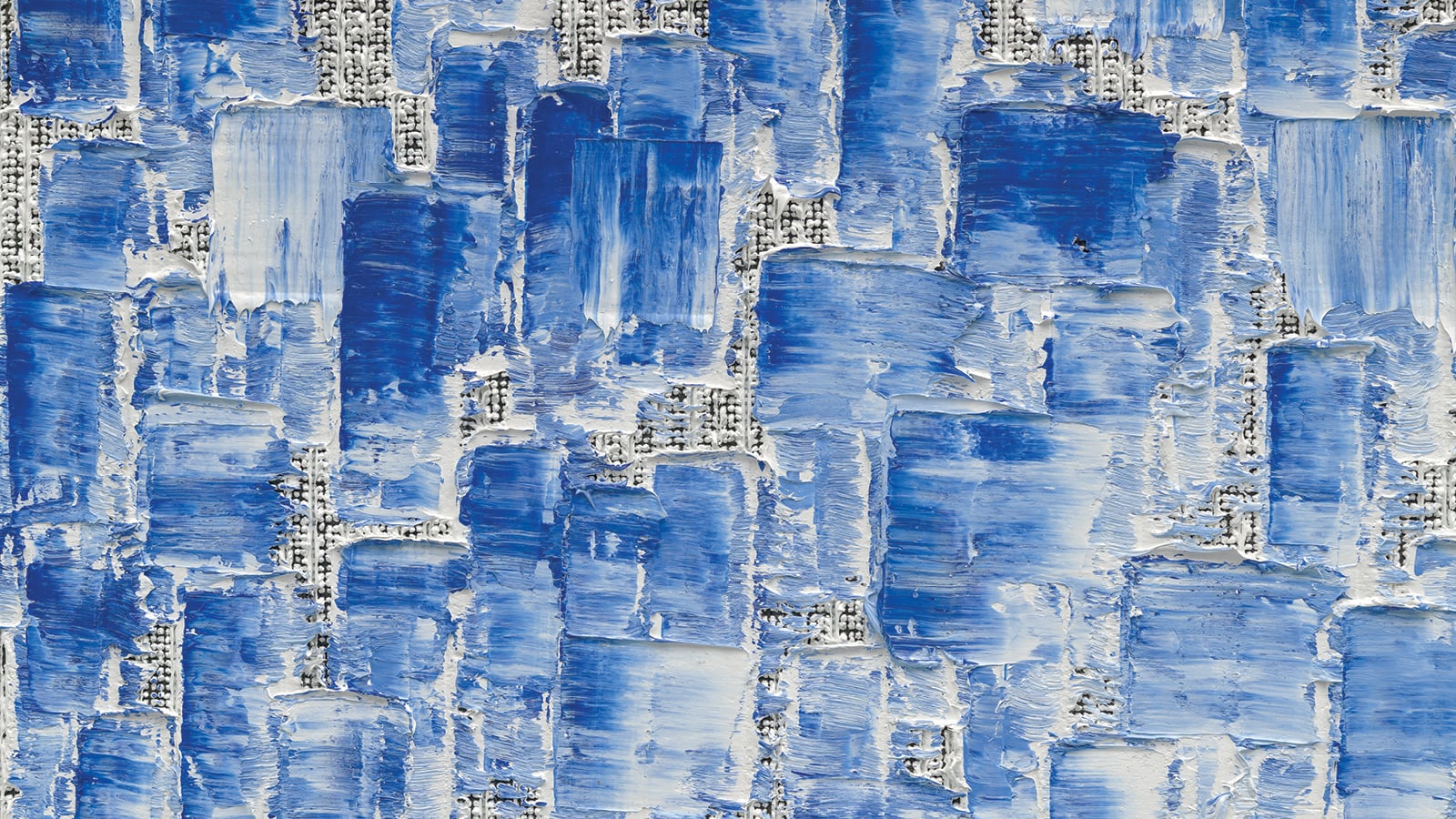
Ha's Conjunction series, begun in 1974, changes the direction from which a painting is made. He applies thick oil paint to the back of burlap and presses it through the coarse weave. The Asian Art Museum identifies this pressure from behind as the series' defining method.[5]
Cloth now regulates the paint's arrival. Its threads interrupt the passage, so the support helps shape what the viewer eventually encounters. A painting's apparent front carries evidence of an action performed on its hidden side. Thinking through that reversal makes the surface feel less settled: paint has had to get somewhere.
The material also belongs to a particular history. The museum connects Ha's use of industrial burlap with sacks used to ship rice to South Korea after the war.[5] That association gives the cloth a social context without making every painting a picture of deprivation.
The photograph above shows a detail of Conjunction 25-19, a work from 2025 featured on the museum's retrospective page.[1] Blue and white passages leave islands of coarse weave exposed. Its date matters: this is a later continuation of Ha's inquiry, with color extending the story beyond the restrained palettes associated with Dansaekhwa's beginnings.
Chung Sang-hwa: a grid made by breaking
Chung's process gives regularity an unexpectedly strenuous origin. According to MMCA's account of his practice, he built a substantial kaolin ground on canvas, let it harden, and folded the support along lines marked on its reverse. The folding produced cracks. He then peeled away small sections of the ground and filled the exposed spaces with layers of acrylic paint.[6]
A grid produced this way records a sequence of disruptions and additions. Its cells emerge through handling, fracture, removal, and replacement. The orderly result carries the memory of a surface repeatedly taken apart.
The museum traces the development of this method through Chung's years in Kobe and Paris during the 1970s and 1980s.[6] That itinerary also keeps the story open: Korean abstraction developed through particular lives and movements between places, as well as through shared local conditions.
What quiet leaves out
Spiritual interpretations have a place in this history, but they need company. Yeon Shim Chung argues that exhibitions emphasizing nature and formal restraint could mute the sociopolitical circumstances around these works, including repression and rapid urban change.[2] Her criticism asks us to restore historical context without assigning every abstract mark a single political meaning.
The paintings also reward a more elementary change of attention. Follow an indentation. Notice where cloth remains visible. Consider whether a grid was drawn, folded, or rebuilt. These are ways of looking for differences that the broad word monochrome tends to smooth away.
Park's pencil, Ha's pressure, and Chung's fractured ground make repetition physically distinct. The restrained surface becomes more interesting as its making grows more specific. What first looked quiet begins to keep time.
Sources
- Asian Art Museum, “Ha Chong-Hyun: Retrospective” — exhibition page and photograph identifying Conjunction 25-19, 2025, detail, with credit to An Chunho.
- Yeon Shim Chung, “The Storied Space of Korean Dansaekhwa: The 1992 and 2012 Exhibitions,” M+ Matters, 28 June 2014, especially pp. 1 and 4–7 — the tendency's formation, exhibition narratives, and social context.
- National Museum of Contemporary Art, Korea, “Dansaekhwa: Korean Monochrome Painting,” March 2012 press release — the survey and its explicit adoption of the term Dansaekhwa.
- M+, Park Seo-Bo, Écriture No. 10–72, 1972, object 2015.86 — medium, dimensions, and pencil marks displacing wet paint.
- Asian Art Museum, “Ha Chong-Hyun: Retrospective,” press release, 20 April 2026 — Conjunction's 1974 beginning, pressure from behind, and the history of burlap sacks.
- National Museum of Modern and Contemporary Art, Korea, “Chung Sang Hwa,” 2021 — kaolin ground, folding, removal, acrylic refilling, and the development of the grid in Kobe and Paris.
- Kunstsammlung Nordrhein-Westfalen, Park Seo-Bo, Écriture No. 11–77, 1977 — intersecting pencil lines, sustained working process, and spiritual context.