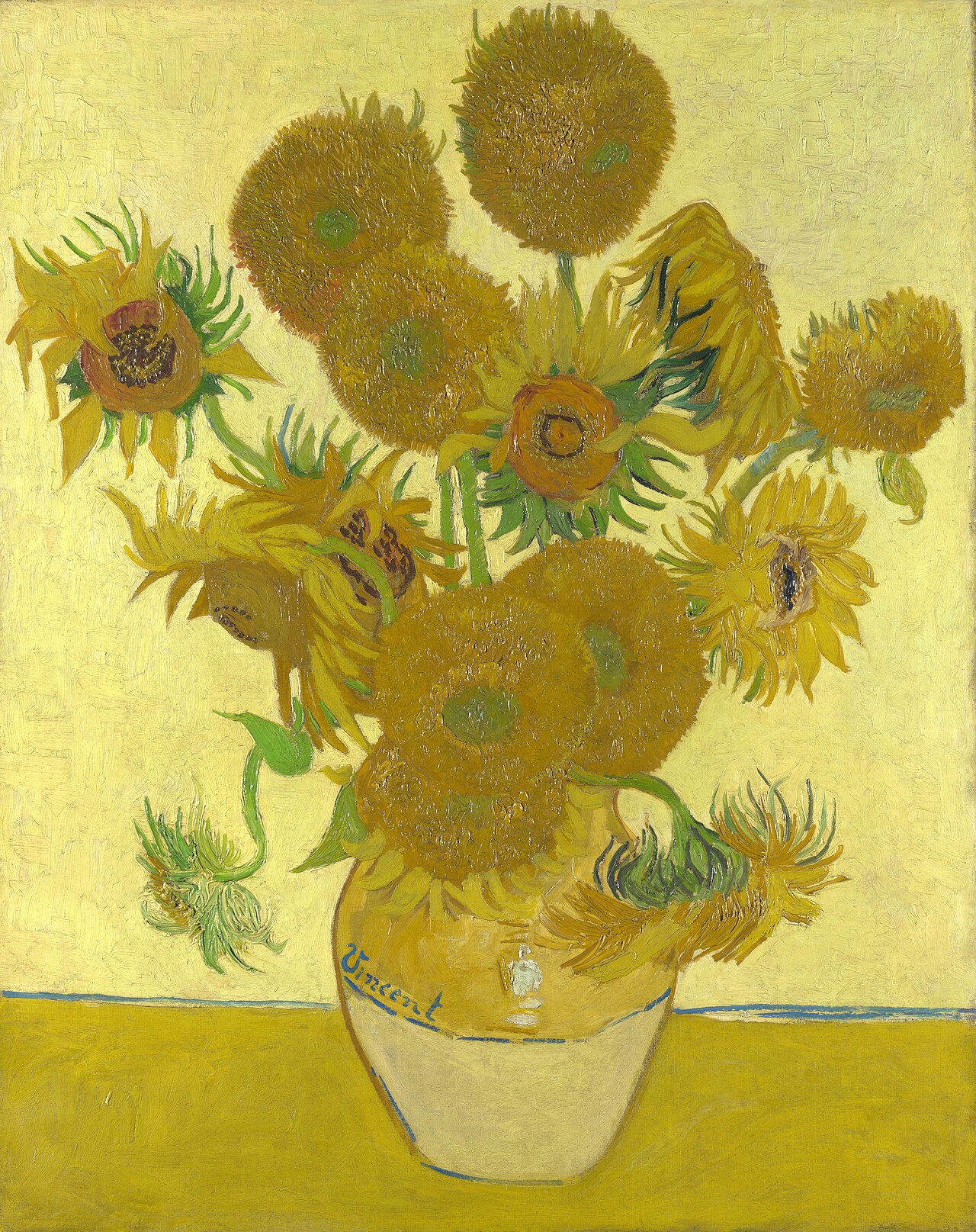
Van Gogh’s Sunflowers in London (NG3863, 1888) is often described as pure visual joy. But technically, it is closer to a high-risk color system tuned right to the edge: a narrow palette, aggressive yellows, selective greens and blues, and paint handling that makes the bouquet feel alive rather than decorative.[1][2][3] The result is one of modern painting’s clearest examples of a paradox: the same material choices that create radiance also create long-term vulnerability.[2][4][5]
The painting is constrained on purpose, not “simple”
The London Sunflowers is oil on canvas, 92.1 × 73 cm, painted in Arles in 1888 as part of Van Gogh’s room-decoration project ahead of Gauguin’s visit.[1][6] In letters, Van Gogh framed the sunflower works as a deliberate yellow construction, not a casual still life.[2][6]
The key technical point is palette discipline. Van Gogh wrote that the sunflower pieces were painted with “the three chrome yellows, yellow ochre and Veronese green and nothing else.”[6] National Gallery technical notes and related analysis support this broad structure: multiple chrome-yellow varieties dominate, with supporting roles from greens and blues.[2][3]
That matters because this is not one yellow repeated 100 times. It is a controlled spread of yellows with different saturation and behavior, set against neighboring hues to force optical vibration at close range and coherence at distance.
Layer logic: where volume comes from
A lot of the painting’s “heat” is layer engineering. Technical notes on the Sunflowers pair (London and Amsterdam) describe Van Gogh’s use of opaque passages, mixed greens, ultramarine accents, and localized glaze behavior in specific flower centers.[2] Even when viewers remember the work as flat yellow, the structure is actually stratified:
- broad yellow fields set the luminosity floor,
- darker and cooler accents create depth around seed heads and stems,
- high-contrast strokes lock attention into local turbulence,
- the bouquet silhouette stays legible from several meters away.
So the eye reads two speeds at once: macro stability (a vase with flowers) and micro instability (every petal seems to flicker). The technical achievement is not realism; it is controlled perceptual load.
Chrome yellow is both the engine and the risk
Chrome yellow was a 19th-century industrial pigment family with multiple formulations and hues.[3][5] Van Gogh embraced it precisely because it delivered high-intensity yellows, but he also recognized many modern pigments were unstable over time.[3]
Scientific studies on Van Gogh materials and Sunflowers specifically show why conservators worry. Research tied to Sunflowers found chemical alteration of some chrome-yellow passages, especially sulfur-rich forms more prone to light-driven reduction, producing Cr(III)-containing degradation products and raising long-horizon color-shift risk in susceptible zones.[4] Related Van Gogh pigment studies reinforce that different chrome-yellow chemistries age differently and should not be treated as a single stable material class.[5]
In plain terms: the painting’s famous yellows are not one inert block. They are a chemically diverse system with uneven durability.
Why this technical story changes how to look at the work
If you know only the icon, Sunflowers can feel like a single emotional note (“bright”). If you know the materials, the painting reads differently:
- It is an optimization problem. Van Gogh pushes color intensity while keeping form readable.
- It is a time-based object. Appearance is not fixed; conservation history and pigment chemistry matter.[2][4]
- It is a modernity painting about materials, not only subject. The flowers symbolize life-cycle change, but the pigments themselves also live through change.[1][4]
That double temporality is why the painting still feels contemporary. We are not just looking at sunflowers in 1888; we are looking at an object that keeps negotiating with light, chemistry, and care.
Sources
- National Gallery, London, object page — Vincent van Gogh | Sunflowers | NG3863
- National Gallery, London, in-depth technical page — The Sunflowers (materials and cross-section notes)
- Google Arts & Culture (National Gallery story), Vincent Van Gogh: Chrome yellow
- PubMed record (Angew. Chem. Int. Ed., 2015), Evidence for Degradation of the Chrome Yellows in Van Gogh's Sunflowers (PMID 26482035)
- Heritage Science (2019), The examination of Van Gogh’s chrome yellow pigments in ‘Field with Irises near Arles’ using quantitative SEM–WDX
- Van Gogh Letters, letter 740 (to Arnold Koning, Jan 1889)
- Heritage Science (2021), The geometry of colors in van Gogh’s Sunflowers (F454/F457/F458 comparative framing)
- Wikimedia Commons file record for NG3863 image metadata (Still Life: Vase with Fifteen Sunflowers, F454/JH1562)