Katarzyna Kobro's sculpture is easiest to misunderstand if it is treated as a small Constructivist object with missing volume. The point is not that she made sculpture thinner, lighter, or more elegantly geometric. The point is that she changed the medium's operating unit. Instead of treating sculpture as a self-contained mass placed inside a room, she treated it as a measured event between form and room, plane and body, inside and outside.
That is why the surviving Spatial Compositions still feel sharper than their modest size can explain. MoMA's gallery note calls them radically open structures made from intersecting sheet-metal planes and emphasizes Kobro's concern with the relation between space contained within the sculpture and space outside it.[1] That phrase is the technical key. Kobro did not carve openings into a solid mass. She began from openness and used planes to tune it.
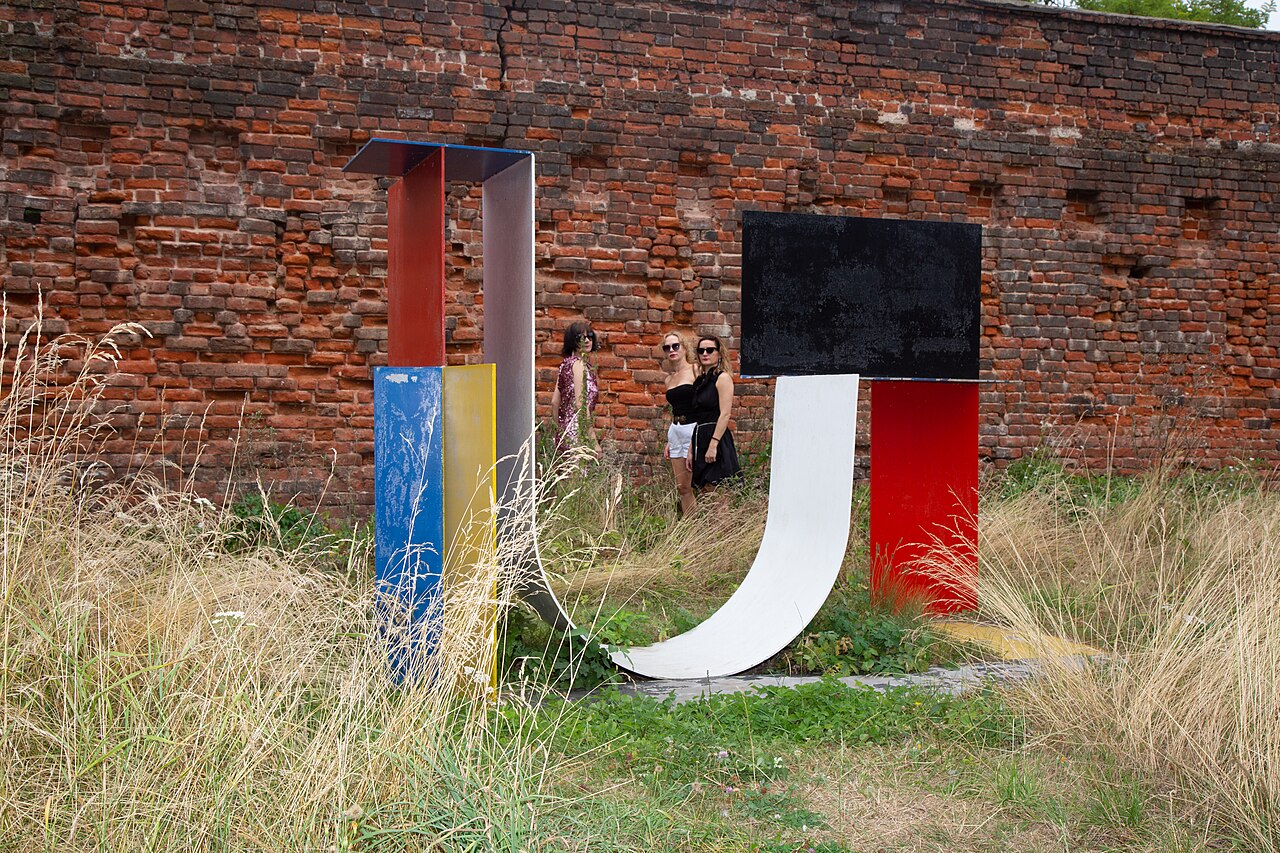
Image context: the lead image is not a generated reconstruction or a diagram. It is a real photograph of an enlarged 1986 public replica in Elblag, made at 5:1 scale after a 1929 Spatial Composition held through the Muzeum Sztuki tradition.[5] Because the article is about how Kobro's forms negotiate surrounding space, the outdoor photograph helps rather than distracts: it shows how the sculpture refuses to end at its own edges.
Mass Is The Old Habit
Traditional sculpture often begins with mass. Stone, bronze, wood, or plaster gives the viewer a body to circle, a silhouette to recognize, and an interior we can only infer. Even when modern sculpture breaks figure or surface, it can still behave like a compact object commanding space from a center. Kobro's argument moves in the opposite direction. She makes the center unstable. She lets space enter the work rather than merely surround it.
Culture.pl's biography is useful here because it preserves the resistance her work first met. In the mid-1920s, Polish critics looked at her spatial sculptures and complained that they did not satisfy the expected task of modeling a solid mass.[3] The criticism was obtuse, but it also identified the break accurately. Kobro had made works that could not be judged by the old sculptural test because she was trying to change the test.
Her own writing makes the shift explicit. Culture.pl quotes Kobro's 1929 statement that sculpture is not literature, symbolism, or psychological emotion, but the shaping of form in space; it also records her insistence that sculpture enters space and space enters sculpture.[3] That does not mean the work is vague or atmospheric. It means its material logic depends on relation. A plane matters because of where it sits against another plane, how it frames a void, how its color sets a measure, and how a viewer's movement changes the sequence.
Planes Replace Weight With Measure
The Spatial Compositions achieve openness through a disciplined vocabulary: bent or flat planes, right angles, color zones, intervals, and proportional spacing. MoMA describes Spatial Composition (5) as one of the few surviving examples, made of open intersecting sheet metal and loaned from Muzeum Sztuki in Lodz.[1] The scarcity matters because so much of Kobro's work was lost or destroyed during World War II.[1][3] But the formal lesson remains legible even through the fragmentary record: the work does not ask how much matter can be gathered. It asks how little matter can organize a spatial field.
This is where the technique becomes more rigorous than it first appears. A colored plane in Kobro is not a decorative patch. It is a spatial count. Red, yellow, blue, black, white, and metal do not simply enliven a construction; they separate directions and help the eye register intervals.[3] The viewer reads a sequence: one plane blocks, another opens, another turns, another marks a pause. The work becomes rhythm without needing literal motion.
Muzeum Sztuki's exhibition page on avant-garde sculpture clarifies why that rhythm cannot be separated from the body. The museum frames Kobro's project around relations among space, movement, and the body, noting her idea that motor dynamism can be captured through rhythms of movement and stops in space and time.[4] In other words, the sculpture is not only seen from a fixed frontal point. It presumes a moving viewer. The work's technique is inseparable from walking, turning, and recalibrating distance.
The Room Becomes Part Of The Medium
Kobro's most radical move is to make surrounding space active without dissolving sculpture into environment. Her constructions still have edges, colors, and material decisions. They are not empty gestures. Yet the edges do not seal the work off from the room. MoMA's phrasing about inside and outside space captures the balance: the sculpture contains space, but not as a private interior; it establishes a relation with the space outside it.[1]
That relation is why scale matters. The photographed Elblag replica is much larger than the original work it echoes, and the Wikimedia source identifies it as a 5:1 enlargement of a famous sculpture from 1929.[5] Enlarging Kobro can be risky if it makes the work look like civic decoration. But it also demonstrates something true about her thinking. A Kobro sculpture does not rely on precious small-object intimacy. Its logic can expand because its real medium is relation: plane to plane, color to color, body to environment.
The same point explains why her work belongs near architecture without becoming architecture. Kunstmuseum Den Haag notes that Kobro and Wladyslaw Strzeminski developed related ideas from Unism, forging color, plane, line, and space into a total unity; she translated this into spatial objects of wood and metal while he worked through painting.[2] That pairing helps situate the work, but Kobro's sculpture is not a miniature building. It is closer to a test model for how space might be organized when sculpture stops pretending to be an isolated monument.
Openness Was A Social Idea Too
It would be too narrow to read Kobro's openness only as formal innovation. Her circle wanted art to reorganize modern life, not merely refine museum taste. Kunstmuseum Den Haag places Kobro and Strzeminski among international avant-garde networks that included Malevich, Pevsner, De Stijl artists, and the Polish a.r. group, which helped form the modern art collection that reached the Lodz museum in 1931.[2] Those affiliations matter because Kobro's spatial language was part of a larger struggle over what abstraction could do in public culture.
Culture.pl records that Kobro and Strzeminski's 1931 book, Spatial Composition: The Calculation of Space-Time Rhythm, extended ideas beyond painting into sculpture and architecture.[3] Muzeum Sztuki's later exhibition makes the same afterlife visible by placing Kobro beside artists concerned with space, corporality, movement, and the viewer's bodily reception of sculpture.[4] That continuity is important. Kobro was not making beautiful emptiness. She was testing how ordered forms might coordinate perception, motion, and daily surroundings.
The ambition has a utopian edge, and it should be read with care. The dream of rationally organizing life through art can harden into program or ideology. Kobro's surviving works are stronger than that because they keep the experience physical. You do not simply agree with a theory when you stand near them. You discover that a plane which looked like a boundary from one angle becomes an aperture from another. You discover that color can measure distance. You discover that empty space is not empty when form has taught you how to see it.
Why The Technique Still Feels New
Kobro died in Lodz in 1951 after a career damaged by war, poverty, illness, and postwar marginalization.[3] Many works were lost, some had to be reconstructed from photographs, and her reputation recovered unevenly.[3] That history should not turn the sculpture into a story of absence alone. The surviving and reconstructed record still carries a precise technical intelligence.
What makes Kobro contemporary is not simply that later Minimalist and geometric artists also worked with open forms. MoMA's gallery note says many later artists had little direct exposure to her sculptures because they remained behind the Iron Curtain, yet their experiments with open geometric forms point to the prescience of her emphasis on shaping space.[1] That is the right word: prescience. Kobro saw early that sculpture could stop being a mass that occupies space and become a system that organizes spatial experience.
Her medium was sheet metal, color, interval, and proportion. But her technique was relation. She made planes behave like measures, voids behave like material, and the viewer's movement behave like part of the composition.[1][3][4] That is why the work still feels alive. It does not ask us to admire emptiness. It asks us to notice that space is already full of pressures, routes, distances, and pauses, and that sculpture can make those invisible structures briefly exact.
Sources
- The Museum of Modern Art, "Katarzyna Kobro, Shaping Space" - gallery note on Kobro's open sheet-metal Spatial Compositions, the relation between inside and outside space, wartime losses, and later relevance to open geometric sculpture.
- Kunstmuseum Den Haag, "Katarzyna Kobro & Wladyslaw Strzeminski" - exhibition page on Kobro and Strzeminski's avant-garde networks, Unism, wood and metal spatial objects, a.r. group, and the Lodz modern art collection.
- Culture.pl, "Katarzyna Kobro" - biography covering Kobro's training, lost and reconstructed works, 1920s criticism, writings on sculpture and space, and the 1931 space-time rhythm publication.
- Muzeum Sztuki w Lodz, "Composing the Space. Sculptures in the Avant-garde" - exhibition page connecting Kobro's work to space, movement, body, rhythm, and the viewer's physical reception of avant-garde sculpture.
- Wikimedia Commons, "File:Kobro - Elblag.jpg" - photographic source page for the article image, identifying the 1986 Elblag replica made at 5:1 scale after Kobro's 1929 Spatial Composition.