Betye Saar's art begins with a deceptively simple act: keeping things that the world has already used, damaged, sold, sentimentalized, or made dangerous. A window frame, a piece of printed advertising, a charm, a family photograph, a small figure, a scrap of lace, a box, a key, a bell. In another artist's hands, these might become nostalgia. In Saar's hands, they become instruments.
That distinction is the point of an artist profile. Saar is often introduced through one famous political work, The Liberation of Aunt Jemima, or through the autobiographical force of Black Girl's Window. Both are essential, but the fuller career is not just a sequence of strong objects. It is a method for making memory active. Saar turns collecting into a ritual grammar: found things are chosen, arranged, armed, protected, and made to answer the histories that once tried to fix their meanings.[1][2][4]
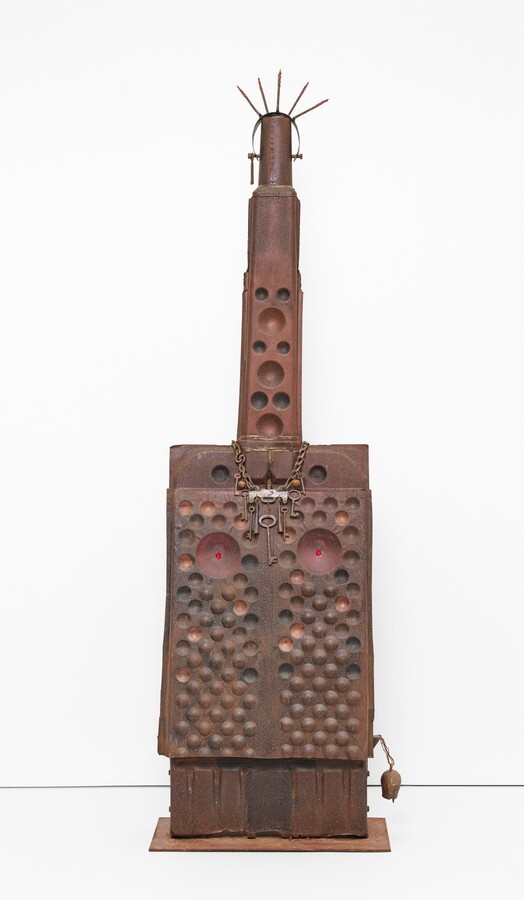
Image context: this is a real museum artwork photograph, not a diagram, chart, or generated visual. The tall body, keys, chains, circular markings, and ritualized presence of The Trickster show why Saar's assemblage cannot be reduced to salvage. The object looks made from prior lives, but it also looks watchful, reorganized, and newly authoritative.[5][6]
The first lesson was that junk could carry power
Saar's biography matters because her materials did not arrive as neutral studio supplies. The Smithsonian American Art Museum connects her childhood visits to Watts, where she saw Simon Rodia's Watts Towers being constructed out of broken glass, bottle tops, and other discarded material, to her later attraction to assemblage.[1] That influence is worth holding onto because it changes how we read the work. Saar did not learn from found objects only that art could be made cheaply. She learned that overlooked matter could be built into an environment with mythic pressure.
Her early path was not direct. SAAM notes that she studied design at UCLA, later pursued printmaking and graphic design, and only became a full-time artist after her prints began winning competitions.[1] The printmaking background is not incidental. It gave Saar a vocabulary of repetition, image transfer, framing, and symbolic compression before the boxes and windows took over.
The shift came in the late 1960s, after exposure to Joseph Cornell's box constructions.[1] But Saar's relation to Cornell is best understood as a starting condition, not a dependency. Cornell's boxes often make memory feel private, dreamlike, and sealed. Saar's boxes and windows are more confrontational. They may be intimate, but they are rarely sealed off from race, gender, family loss, folklore, advertising, spiritual systems, or American public life.[1][3]
The window became a self-portrait with history pressing against it
Black Girl's Window, made in 1969, is the hinge. MoMA identifies the work as a wooden window frame containing paint, cut-and-pasted printed and painted papers, a daguerreotype, a lenticular print, and a plastic figurine.[2] That inventory sounds factual, but it also reveals Saar's crucial move. She did not simply frame an image; she made the frame part of the image's meaning. A window is a boundary, a threshold, a display surface, and a barrier. It lets a person look out and be looked at.
MoMA's exhibition on Black Girl's Window describes the work as autobiographical and as the artistic language through which Saar's print practice moved into assemblage.[3] The lower figure, hands pressed against the panes, makes the self visible as a body held at a boundary. Above that figure, symbols, family references, celestial imagery, and historical fragments gather in separate compartments.[2][3] The work does not present identity as one unified portrait. It presents identity as a set of panes: inherited, occult, racial, familial, remembered, and interpreted.
That structure is one reason Saar's art resists the easy category of political collage. Politics enters the work, but it does not flatten the work. In Black Girl's Window, personal memory and social history are not rivals. They meet in the same frame. The window turns autobiography into a public apparatus: the viewer sees a girl, a boundary, a symbolic sky, and a history of looking that is not innocent.[2][3]
Saar did not collect stereotypes; she disarmed and rearmed them
The political edge sharpened after 1968. SAAM states that Martin Luther King Jr.'s assassination prompted Saar to make works based on racial slurs in advertising and stereotypes preserved by white folklore.[1] The National Gallery of Art makes the same mechanism plain: Saar uses discarded objects, tchotchkes, figurines, and Jim Crow-era advertisements, recycling them in a way that challenges high-art hierarchies and addresses racism and sexism.[4]
That is the core of The Liberation of Aunt Jemima, made in 1972. NGA points to it as a key example of her use of art to confront racial stereotypes, and a U.S. Department of State artist profile describes the familiar advertising figure transformed through broom, shotgun, and syrup-label imagery.[4][7] The title's force lies in the verb. Saar does not merely expose the Aunt Jemima image as racist. She stages a liberation of the figure from the commercial and folkloric role designed for her.
This is where Saar's assemblage method becomes especially sharp. If she had simply painted a denunciation, the racist image would remain an object of critique at a distance. By incorporating the image into an assemblage, she forces the viewer to confront its material life: how such images circulated, sat on shelves, entered kitchens, taught children, sold products, and normalized subservience as comfort.[4][7] Saar's response is not erasure. It is transformation under pressure.
That transformation is never decorative. The found object keeps some trace of its prior harm. Saar does not cleanse it into innocence. She changes its agency. In the best-known Jemima work, and in the larger group of stereotype-based assemblages, the old commercial image becomes a site of refusal rather than obedience. The object is made to testify against the world that produced it.[1][4][7]
Ritual kept the political work from becoming only protest
Saar's art would be simpler if it moved only along the line from racist image to political reversal. It does more than that. NGA emphasizes that travel to Haiti, Mexico, and Africa influenced her approach and infused the work with spiritualism; it also describes her process as ritualistic.[4] That matters because ritual gives the assemblages a different kind of time. They are not only arguments about history. They are arrangements meant to concentrate force.
The National Gallery's The Trickster shows this mature power. The object is a mixed-media assemblage from 1994, almost seven and a half feet tall according to the NGA dimensions, with a rust-colored vertical body, keys, chains, circular marks, and upward-flaring rods.[5] NGA's article on Black artists identifies the sculpture as an antique heater adorned with bells, chains, and vintage keys, and connects it to Eshu, the Yoruba trickster deity who protects while also engaging in mischief.[6]
That description is useful because it clarifies what Saar means by found-object power. A heater is a practical object: industrial, domestic, maybe obsolete. Keys suggest access, custody, secrecy, and passage. Chains carry memory of constraint, but also connection. Bells can warn, mark ritual, or summon attention. Saar does not dissolve these meanings into one allegory. She lets them press against one another until the sculpture behaves like a guarded threshold.[5][6]
Seen beside Black Girl's Window, The Trickster shows the continuity in Saar's practice. Both works are thresholds. One is a window where personal history and symbolic signs gather around a Black female figure. The other is a tower-like guardian made from objects that seem to remember use, passage, protection, and danger. Across decades, Saar keeps returning to the same problem: how to make a thing hold more than one time at once.[2][5][6]
The small object can carry public history
Saar's scale is often psychological before it is physical. Even when a work is small, it can feel crowded with consequence. That is because assemblage changes the viewer's pace. A painting may allow one sweeping look. A Saar assemblage often asks for searching: what is this object, where did it come from, why is it next to that image, what system of belief or commerce once touched it, and what has changed now that it sits in this new order?
That kind of looking matters in contemporary art because it refuses the fantasy that history lives only in archives, monuments, and official images. Saar finds history in things that could be handled, bought, inherited, stored, discarded, or misremembered.[1][4] Her work insists that domestic matter is not outside politics. Advertising is not outside myth. Family memory is not outside public violence. Spiritual systems are not outside modern art.
The result is a body of work that feels unusually alive to both harm and protection. Saar does not ask damaged images to disappear. She asks what can be done with them after they are recognized. She does not treat found objects as mute evidence. She composes them until they begin to answer.
That is why Saar's assemblages still feel current. They offer a model of artistic resistance that is neither pure denunciation nor easy healing. The object remains complicated. The past remains present. The viewer has to keep looking. But inside that difficulty, Saar creates a form of agency: memory arranged as refusal, ritual arranged as critique, and collected fragments made strong enough to stand guard.
Sources
- Smithsonian American Art Museum, "Betye Saar" - artist biography covering Saar's Watts childhood influence, design and printmaking training, Cornell-related assemblage shift, and stereotype-based works after 1968.
- Museum of Modern Art, "Betye Saar, Black Girl's Window, 1969" - object record with medium, dimensions, acquisition details, and collection context.
- Museum of Modern Art, "Betye Saar: The Legends of Black Girl's Window" - exhibition page on the relation between Saar's early print practice, family history, mysticism, and the 1969 assemblage.
- National Gallery of Art, "Betye Saar" - artist page summarizing Saar's discarded-object assemblage practice, Jim Crow-era material, spiritual influences, and social-justice themes.
- National Gallery of Art, "Betye Saar, The Trickster, 1994" - artwork record and source page for the cover image, including medium, dimensions, accession number, provenance, and visual description.
- National Gallery of Art, "16 Black Artists to Know" - article describing The Trickster as an antique-heater assemblage connected to Eshu, with bells, chains, and vintage keys.
- U.S. Department of State Art in Embassies, "Betye Saar" - artist profile describing Saar's assemblage practice, political use of stereotyped advertising images, ritual objects, and The Liberation of Aunt Jemima.