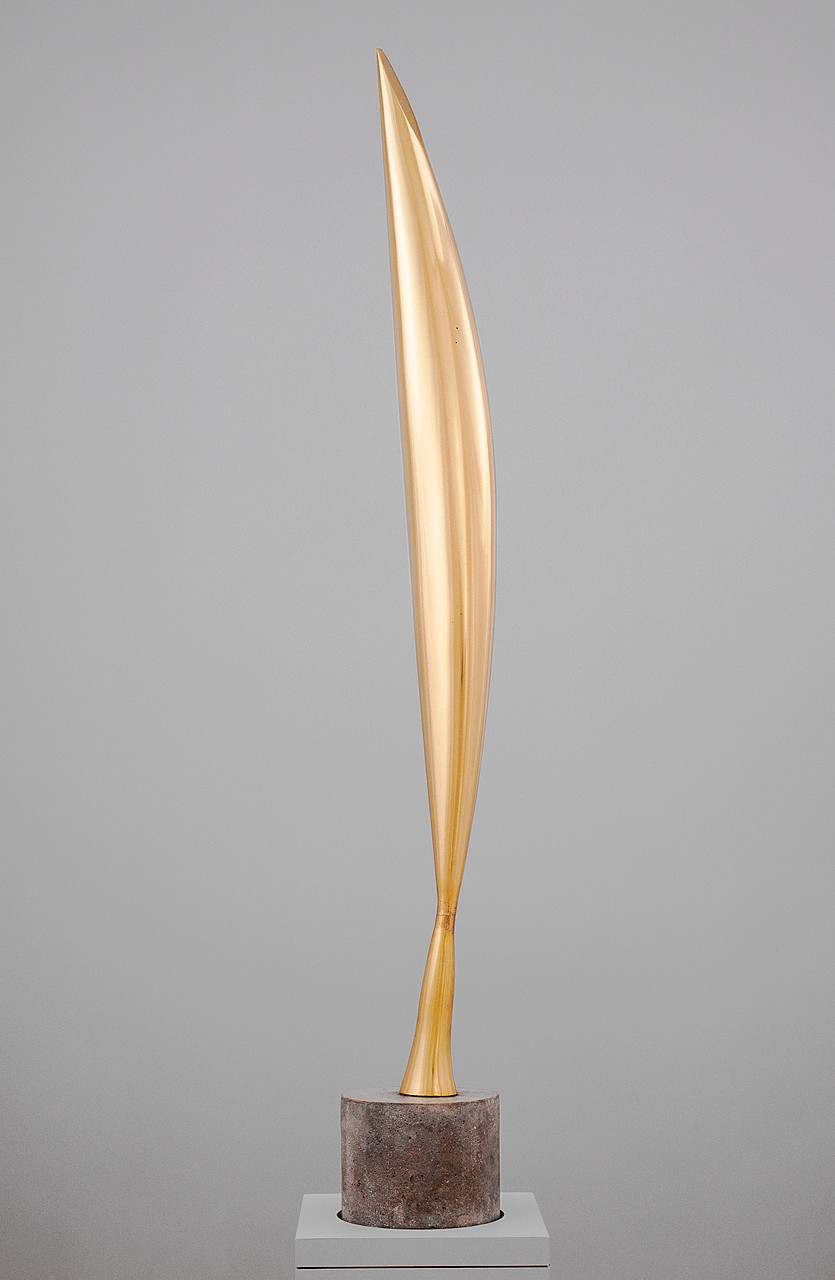
Constantin Brancusi's Bird in Space looks almost too simple to describe: a slender vertical body, swelling slightly, tapering toward a point, balanced above a base. The title says bird, but the sculpture refuses the ordinary evidence. No wings. No feathers. No feet gripping a branch. No beak except, in some versions, the faintest slanting terminal suggestion. What remains is not a bird stripped down to a logo. It is flight made into a pressure system.[1][2]
That is why the work still feels so fresh. Brancusi did not abstract a bird by making it vague. He abstracted it by deciding which parts of birdness were distractions. The Met's 1923 marble version says the problem plainly: Brancusi concentrated on movement rather than physical attributes, eliminating wings and feathers, elongating the body, and reducing head and beak to a slanted oval plane.[2] The sculpture is therefore not an evasion of representation. It is a stricter answer to representation's question: what must remain for the mind to feel flight?
Image context: this post uses one real museum photograph of Brancusi's Bird in Space from the Guggenheim collection, not a generated image, diagram, chart, or reconstruction. The photograph matters because the argument turns on visible physical facts: polished brass, vertical lift, a narrowed foot, and the way the sculpture seems to borrow light from the room.[1]
The Bird Is Mostly Gone
The first shock of Bird in Space is subtraction. A conventional bird sculpture usually begins by proving likeness: plumage, anatomy, wing spread, talons, head angle. Brancusi moves in the opposite direction. The Philadelphia Museum of Art's record gets the paradox exactly: the work "looks like nothing we would recognize as a bird," yet its simplified form conveys what mattered to the artist as the essence of the thing rather than its external appearance.[4]
That claim can sound like textbook modernism until the eye tests it. The sculpture does not simply become a clean vertical shape. Its body swells and narrows like stored motion. The contour is not a straight spear. It is a living asymmetry held under extreme discipline. If the form were more literal, the viewer would read bird. If it were more geometric, the viewer would read design. Brancusi keeps it in between, where the mind supplies lift because the object refuses almost every other clue.
The result is an image of flight before flight becomes narrative. There is no sky, no takeoff, no landing, no flock, no destination. The sculpture holds the instant when a body seems to have exchanged weight for direction. That is why its stillness is not calm. It is compressed.
Polish Turns Surface Into Air
The Guggenheim version used here as the cover is polished brass, dated 1932-40, and rises 59 7/16 inches including its base.[1] MoMA's 1928 version is bronze, 54 inches high, while the Met's 1923 version is marble.[2][3] Those material differences matter because each version solves flight differently. Marble absorbs light and gives the form a quieter, more bone-like continuity. Bronze and brass turn the surface into a moving event.
Polish is not decoration in Bird in Space. It is part of the sculpture's engine. The Philadelphia Museum notes that the pristine shine of polished bronze reflects the room back, making the sculpture "practically disappear."[4] That is a sharp observation because disappearance is not weakness here. Reflection prevents the form from behaving like a sealed object. The surface keeps changing as the viewer, light, and room change. The bird does not move, but its skin refuses to stay still.
This is where Brancusi's simplification becomes less austere than it first appears. The object is spare, but the visual event is not. A polished Bird in Space gathers windows, bodies, walls, shadows, and flashes into its vertical field. It makes the room participate in the illusion of flight. The sculpture is less a bird in air than an object that turns air into visible instability.
The Base Is Part Of The Lift
It is easy to crop Bird in Space mentally and remember only the bright vertical form. That is a mistake. The base is not a display convenience; it is part of the work's grammar. MoMA's 2018 Brancusi exhibition page emphasizes that he made bases for many sculptures as complex constructions that became part of the work, and that he often moved works from base to base or placed them directly on the studio floor.[6]
In Bird in Space, the base gives lift somewhere to begin. The Guggenheim photograph shows a narrow golden foot meeting a cylindrical stone support.[1] The contact is tiny, almost implausible. The base has weight, texture, and earthbound density; the bird-form has polish, verticality, and release. The sculpture stages flight not by hiding gravity, but by making gravity visible underneath the ascent.
That matters because the work is not only about upwardness. It is about the negotiation between launch and support. The body would look too sleek, almost too weightless, if it simply floated in reproduction. The base returns effort to the image. It says that flight is not the absence of matter. Flight is matter reorganized until it points beyond itself.
A Series, Not A Single Answer
The museums disagree in details because they are describing different objects in a series. The Met identifies its version as 1923 marble and says the series includes seven marble sculptures and nine bronze casts.[2] MoMA's collection page identifies its 1928 bronze as a distinct work with its own dimensions and object number.[3] Guggenheim holds a polished brass version dated 1932-40.[1] The National Gallery of Art's version, in white marble on a multipart base, gives another answer to the same problem.[5]
This multiplicity is not secondary. Bird in Space gains force because Brancusi returned to the problem again and again. Each version asks how little anatomy can remain before flight disappears, how much taper can be stretched before elegance becomes mere needle, how a base can launch rather than merely hold, and how material changes the emotional temperature of ascent.
The series also protects the work from being reduced to one perfect industrial object. Brancusi's forms are famously smooth, but they are not generic. MoMA's exhibition account stresses his dependence on both ancient techniques and contemporary technologies, and his habit of activating works through movement and recombination in the studio.[6] The birds belong to that workshop intelligence. They are polished, but not anonymous. They look inevitable only because Brancusi kept revising the conditions under which inevitability could appear.
The Customs Case Understood The Problem Backwards
The legal history of Bird in Space is famous because it makes the work's visual argument almost comically explicit. MoMA's account of Brancusi v. United States explains that a 1926 version shipped from Paris to New York for an exhibition was denied entry as art because it did not look enough like a bird; officials classified it under utilitarian metal goods and imposed a 40 percent duty.[7] The trial asked whether the work could count as sculpture if it no longer imitated a natural object in the old way.[7]
That dispute is useful, but not because it supplies a heroic anecdote about modern art winning. It shows how the sculpture exposes a bad habit of looking. The officials treated resemblance as the test of art. Brancusi had made a work whose whole force depended on rejecting resemblance as the easiest and least interesting test. The issue was never whether the object looked like a bird. The issue was whether it could make flight more intense by refusing bird anatomy.
The court eventually accepted that newer art could portray abstract ideas rather than imitate natural objects.[7] Still, the stronger judgment belongs to the sculpture itself. It had already answered the question in form: if a line can rise, if polish can dissolve mass, if a base can become launch, and if a title can redirect perception without dictating it, then art has more ways to be truthful than resemblance.
Flight As A Discipline
The lasting power of Bird in Space is that it makes lightness feel disciplined. Nothing flutters. Nothing spreads. Nothing narrates a moment of escape. Instead, Brancusi makes every decision narrow: the outline, the foot, the base contact, the reflective skin, the title, the refusal of detail. Flight becomes not freedom from constraint, but freedom produced by constraint.
That is why the sculpture still resists the easy category of "pure abstraction." It is not pure in the sense of being detached from the world. It is answerable to birds, bodies, tools, stone, metal, light, and rooms.[1][2][6] What it removes is not reality. It removes the obvious signs that would let the viewer stop too soon.
Seen this way, Bird in Space is not a sleek modern object pretending to transcend matter. It is matter made alert. Its beauty comes from the instant when weight, polish, and balance almost stop behaving like weight, polish, and balance. Brancusi made flight stand still, but he did not freeze it. He made it wait inside the form, already rising.
Sources
- Solomon R. Guggenheim Museum, "Constantin Brancusi | Bird in Space" - official object and image page for the polished brass 1932-40 version used as the cover photograph, including medium and dimensions.
- The Metropolitan Museum of Art, "Constantin Brancusi, Bird in Space" - official object page for the 1923 marble version, including series context, form description, medium, dimensions, and rights note.
- The Museum of Modern Art, "Constantin Brancusi, Bird in Space, 1928" - collection page for MoMA's bronze version, including medium, dimensions, object number, gallery context, and Brancusi artist note.
- Philadelphia Museum of Art, "Constantin Brancusi, Bird in Space, 1924" - object page describing the polished bronze surface, black marble base, reflective disappearance effect, and multiple versions over four decades.
- National Gallery of Art, "Bird in Space by Constantin Brancusi" - object page for the marble version, with close formal description of the elongated form and stacked base.
- The Museum of Modern Art, "Constantin Brancusi Sculpture" - 2018 exhibition page on direct carving, bronze casting, Brancusi's bases as part of the work, studio recombination, materials, movement, and modern context.
- MaryKate Cleary, "But Is It Art? Constantin Brancusi vs. the United States," MoMA Inside/Out (July 24, 2014) - account of the customs dispute, 40 percent duty, testimony, and changing legal recognition of abstraction.