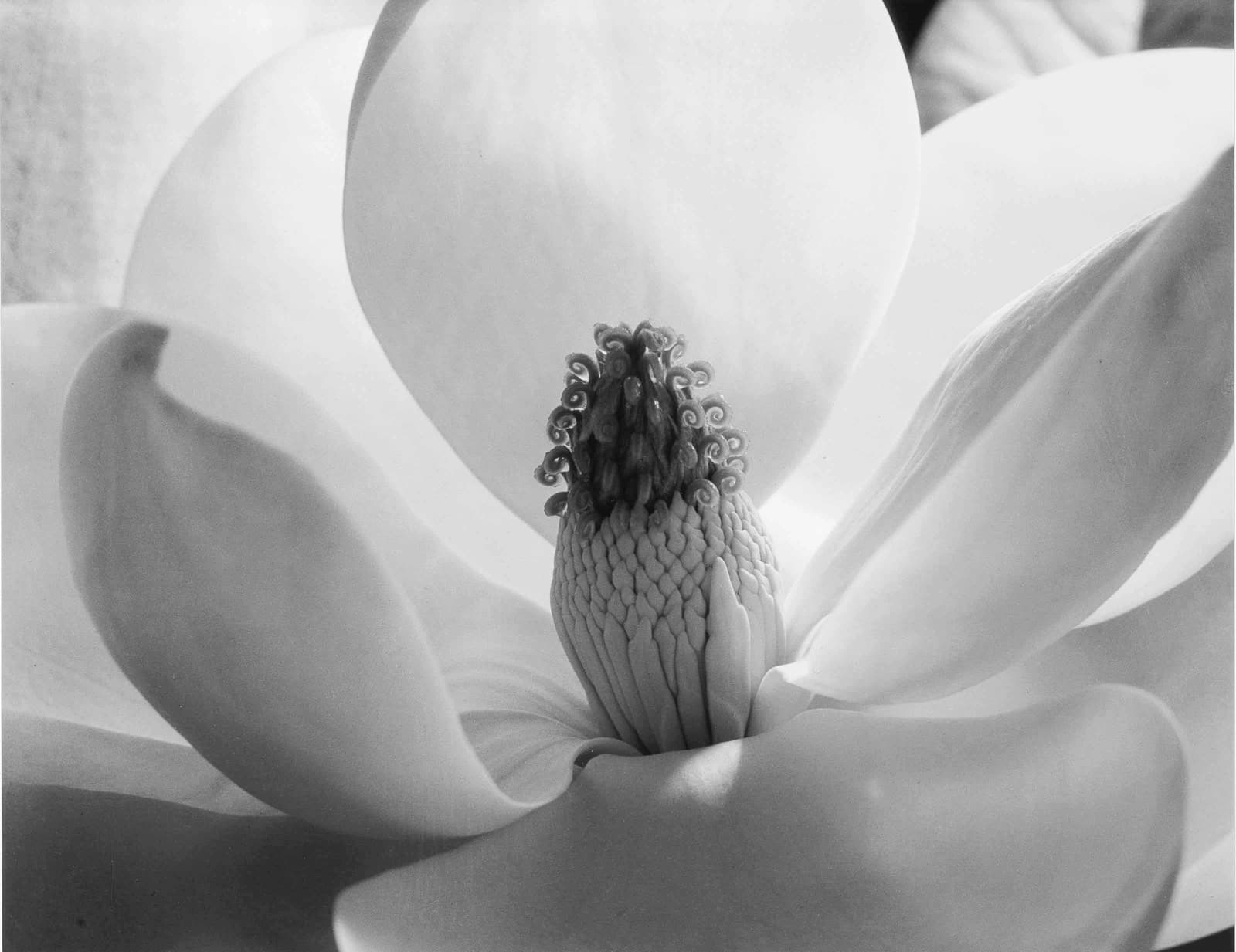
Imogen Cunningham's Magnolia Blossom is easy to admire for the wrong reason. A flower fills the frame; the petals are luminous; the central form rises with almost sculptural precision. The picture can seem simply beautiful, as if the camera had leaned close to nature and found elegance already waiting there. But the photograph's real force is stricter than that. Cunningham does not present the magnolia as a decorative specimen. She makes it behave like an architectural interior, a system of curved planes, soft walls, tonal thresholds, and concentrated attention.[1][2]
That is why the photograph still feels modern almost a century after 1925. The subject is organic, but the image is not loose. The petals do not flutter into atmosphere. They curve around the center like load-bearing forms. The central cone is botanical fact and visual column at once. The frame cuts away stems, leaves, garden context, and outdoor weather until the flower no longer reads as an object in a landscape. It becomes the landscape.[1][3]
Image context: the lead image is a real photographic reproduction of Cunningham's 1925 work, not a diagram, chart, or generated visual. It belongs here because the article turns on what the photograph itself makes visible: pale petal surfaces, hard-won focus, and a composition so tight that a blossom becomes a room for looking.[6]
The crop turns scale inward
The Los Angeles County Museum of Art's object note describes the photograph as a close, tightly cropped composition that enhances the feeling of being enfolded within the magnolia petals.[1] That word "enfolded" is the key. Cunningham's crop does not merely bring the viewer nearer. It changes the scale contract. We are not looking at a flower from outside, as one might in a botanical plate or garden view. We are placed inside the bloom's spatial logic.
The effect depends on what the picture refuses to show. There is no full stem, no vase, no table, no hand arranging the flower, no clear edge of the plant as a whole. The photograph strips away the usual cues that tell a viewer how large the object is and where the viewer stands in relation to it. The petals become planes rather than parts. One rises behind the center as a pale vertical shield; another sweeps across the foreground like a low ledge; the right-hand petal angles inward as if closing the room.
That inward scale is what keeps the picture from becoming mere floral prettiness. A decorative flower picture usually lets the viewer possess the bloom as a complete thing. Cunningham denies that completeness. The magnolia exceeds the frame on nearly every side, so the viewer has to assemble the flower from partial surfaces and intervals. The image is intimate, but not soft in the sentimental sense. It is intimate because it withholds distance.
Sharp focus makes the flower less fragile
The High Museum's description places Magnolia Blossom inside Cunningham's break from Pictorialist softness toward sharply detailed close-up studies of plants and organic forms in the early 1920s.[3] That shift matters in the picture itself. The photograph does not use blur to make nature dreamy. It uses clarity to make nature strange.
Look at the center. The magnolia's reproductive structure is described with enough precision that it almost resists metaphor: layered lower forms, vertical ridges, small curling tips at the top, a dense column rising out of the petals.[1] Yet the surrounding petals are not reduced to scientific illustration. Their tones are so carefully modulated that they read as surfaces under light, each one slightly different in texture, curve, and density. The result is a photograph that holds two forms of attention at once: botanical specificity and abstract design.
Getty's retrospective material helps explain why that combination mattered in Cunningham's career. After moving to San Francisco in 1917, she turned away from soft-focus images and began making sharply delineated pictures, cultivating a garden while raising three young sons and turning plants and flowers into sustained subjects.[2] The garden detail is not incidental. These botanical studies were made close to domestic life, but they do not read as private hobby pictures. Cunningham converts a nearby plant into a modernist problem: how can a photograph use exact description without becoming passive record?
Her answer is control. The flower is not picturesque because it is rare or exotic. It is forceful because the camera makes relation visible: petal against petal, center against surrounding curve, light against silver tone, proximity against abstraction.
The photograph is modernist without becoming cold
In 1932, Cunningham helped found Group f/64 with Ansel Adams, Edward Weston, Sonya Noskowiak, Willard Van Dyke, John Paul Edwards, and Henry Swift, a Bay Area group named after the aperture setting associated with deep sharpness and committed to sharply focused modern photography.[2] Magnolia Blossom predates that formal group moment, but it already carries the logic that made the group legible. It trusts the camera's capacity for precision. It lets ordinary organic form become visually radical through framing and focus rather than through theatrical manipulation.[2][3]
That precision could easily have become chilly. It does not. The LACMA note is helpful because it calls the picture both "nature as art" and a study in form, tone, and texture.[1] The two claims belong together. Cunningham's flower is not modern because it abandons feeling for design. It is modern because feeling passes through design. The viewer's sense of tenderness comes from the curve of the petals, but the curve has been arranged by the frame into a visual pressure system.
The tonal range is especially important. In reproduction, the photograph can seem almost white at first glance, but it is not blankly bright. Pale grays separate petal from petal. A darker passage at lower left anchors the foreground. The central cone gathers the deepest detail without becoming heavy enough to destroy the surrounding light. Cunningham lets the gelatin silver print produce a world where softness is built from minute differences, not from blur.[1][4]
A flower becomes an argument about photography
The Whitney collection record and SFO Museum's exhibition account are terse but useful together: one identifies Magnolia Blossom as a 1925 gelatin silver print, while the other places Cunningham's plant photographs inside a broader practice of detailed, sharp-focused images of plants, architecture, portraits, and straight photography.[4][5] That matters because the photograph's subject can tempt viewers to underestimate it. Flowers have often been treated as gentle, feminine, decorative, or minor. Cunningham turns that expectation against itself.
The picture is not minor in ambition. It asks whether a plant can carry the same formal seriousness as architecture, sculpture, or abstraction. The answer is yes, but not because the flower is disguised as something else. Cunningham does not erase its botanical identity. She intensifies it until petals and center become the means by which photographic modernism thinks through scale, surface, and attention.
This is also why the photograph is different from a purely scientific close-up. A scientific image might aim to identify the magnolia, compare its parts, or document morphology with maximum informational clarity. Cunningham is doing something adjacent but not identical. She makes the flower legible and then uses that legibility to create a visual experience that exceeds identification. The viewer may learn something about the structure of a magnolia, but the deeper lesson is about photography's power to reorganize the ordinary world without falsifying it.
Why Magnolia Blossom holds
What lasts in Magnolia Blossom is the way it makes closeness rigorous. The photograph brings the viewer near, but it does not dissolve into lyric atmosphere. It fills the frame, but it does not become crowded. It uses a flower, but it does not settle for charm.[1][3]
Cunningham's achievement is to make the magnolia both itself and more than itself. It remains a plant, with petals, central structure, texture, and light. At the same time, it becomes an interior, a study in tonal architecture, a test of sharp-focus modernism, and a quiet argument for photography as fine art.[1][2][4][5] The flower does not need drama outside the frame. The drama is the frame: how much a camera can reveal when it gets close enough to make beauty stop being easy.
Sources
- Los Angeles County Museum of Art, "Imogen Cunningham, Magnolia Blossom, 1925" - collection entry with medium, dimensions, and curatorial note on tight crop, inward focus, form, tone, texture, and West Coast modernism.
- J. Paul Getty Museum, "Imogen Cunningham: A Retrospective" - exhibition resource on Cunningham's move from soft-focus work to sharply delineated botanical photographs, her garden studies, and the 1932 founding of Group f/64.
- High Museum of Art, "Magnolia Blossom" - collection page describing Cunningham's early Pictorialist background, her early-1920s turn toward sharp close-up plant studies, and the photograph's embrace of the medium's technical capacities.
- Whitney Museum of American Art, "Imogen Cunningham, Magnolia Blossom" - collection record identifying the 1925 gelatin silver print and its exhibition context within early twentieth-century American modernism.
- SFO Museum, "A Cultivated Aesthetic: Works by Imogen Cunningham 1920-1970" - exhibition page on Cunningham's sharp-focused plant, architecture, and portrait photographs, straight photography, and Group f/64 context.
- Wikimedia Commons, "File:Magnolia Blossom, 1925, by Imogen Cunningham.jpg" - source page for the article image, identifying the work, date, author, original file dimensions, and public-domain status in the United States.