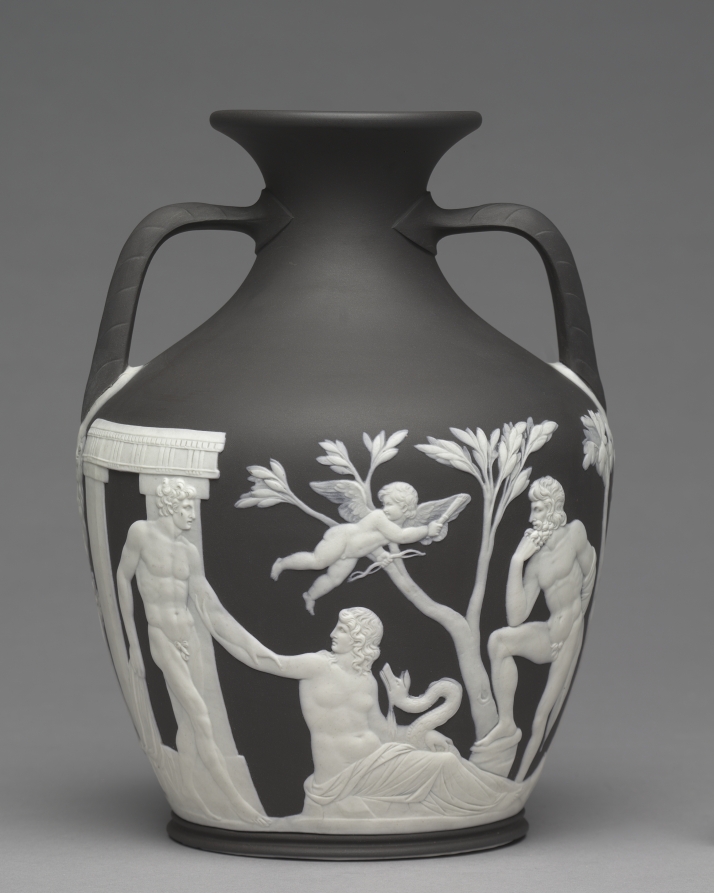
The white figures seem comfortably at home on the dark vase. Their limbs, drapery and surrounding trees form a band of scenes around a gently tapering body. The Cleveland Museum of Art identifies this Portland Vase, made around 1790 by Josiah Wedgwood and Sons, as one of the early ceramic editions of a celebrated Roman glass vessel.[1] Its composure conceals a practical problem: how to keep the figures on the pot.
The crucial word in Cleveland's description of the medium is applied. These pale forms were attached to the surface.[1] Their survival depended on what happened after the modeling was finished. To follow the making of jasperware is to look at each delicate edge as a meeting between materials that had to endure the kiln together.
Color inside the clay
Jasperware belongs to the stoneware family. Wedgwood's own material history describes a dense white body, developed by late 1774, that can take color throughout its substance.[2] The familiar blue-and-white effect begins with a colored ceramic ground and contrasting relief. A figure has thickness; its outline is also a physical edge.
Blue is only part of the story. The Queen Victoria Museum and Art Gallery emphasizes both jasperware's unglazed finish and the range of colors made possible by different oxides and stains. Plates, vases and everyday objects could share the technique while changing the relationship between ground and ornament.[3] On the Portland copy, the near-black background gives the pale bodies unusual intensity. Small variations in their relief become easy to follow against the uninterrupted darkness.
That surface invites a slower kind of looking. Follow the boundary of a shoulder or a fold of cloth: the color contrast identifies the form, while the modeled surface gives it volume. The decoration has to work as both a picture and a shallow sculpture.
Rebuilding a carved image
The Roman model used a different operation. Its white outer glass layer was carved away to expose the dark layer beneath. Wedgwood's ceramic version built up the pale ornament instead. The V&A dates the copying project from 1786 and the launch of its first editions to 1790.[4]
The distinction changes what a faithful copy demands. Keeping the silhouette and arrangement does not preserve the original sequence of work. A hollow vessel, projecting handles and small relief figures must become parts of a new ceramic object.
Corning Museum of Glass's record of its own early copy makes those operations explicit: the vessel was thrown, its decoration molded and applied, and its surface ground and polished. Corning identifies that example as number three of the first edition.[5] The mold provided a means of repeating detail, but the finished object still required assembly and finishing. Reproduction contained a succession of skilled acts.
The V&A describes the body being thrown on a wheel and then turned to refine its shape before handles and figures were added. Even the original handles' asymmetry was deliberately followed.[4] Fidelity extended to the small irregularities that a casual imitation might have tidied away.
The kiln could undo the picture
Surviving trials make the difficulty visible. The V&A records a failed version in which expanding gases produced bubbles, and another in which the reliefs failed to adhere and broke away during firing. Its collection includes these experimental vessels and records of the work.[4]
Those failures change how the successful vase reads. A crisp figure tells us that someone modeled it well; an attached figure also tells us that the assembly survived. The kiln was a stage in making the image, with the power to disrupt its surface and separate its parts. The finished decoration depends on both achievements.
Making clay suggest glass
Adhesion was only one challenge. The source object was glass, with optical effects that opaque ceramic could not simply inherit. Colonial Williamsburg's record of an early Wedgwood copy explains a further adjustment: black slip was painted onto portions of the applied decoration to suggest translucency. Its white figures were sprig molded—formed separately in molds—and applied to the black jasper body.[6]
This is a particularly revealing detail. Dark material added to a pale relief could help suggest the effect of light passing through glass. The illusion required decisions about tone as well as shape. An apparently unified white-on-black design could contain local adjustments intended to make one material recall another.
The method also makes the idea of an exact copy more interesting. Accuracy can require a new procedure at nearly every step. The resemblance belongs to the finished encounter with the viewer; the workshop has to negotiate the differences.
Later editions extended that encounter. Princeton University Art Museum notes that subsequent Portland copies often used blue grounds, while some editions made between 1870 and 1885 returned to black. It also stresses that the figures' historical or mythological meaning remains debated.[7] A maker could reproduce their gestures with extraordinary care without settling their story.
The Cleveland vase rewards attention at that smaller scale: a limb, a fold, the edge where pale relief meets darkness. Each is a piece of modeling and part of an assembled vessel. Once the process becomes visible, the figures' calm acquires another meaning. They have stayed in place.
Sources
- Cleveland Museum of Art, “Portland Vase,” accession 1918.823 — date, maker, applied jasperware decoration, dimensions and museum photograph.
- Wedgwood, “Care guide to Jasperware,” section “What is Jasper and what is it made of?” — development of the stoneware body and coloration throughout the clay.
- Queen Victoria Museum and Art Gallery, “Jasperware,” 2019 exhibition — unglazed finish, relief decoration and range of body colors.
- Victoria and Albert Museum, “Josiah Wedgwood's Portland Vase,” updated April 17, 2024 — Roman cameo glass, the copying project, forming sequence, experimental vessels and firing failures.
- Corning Museum of Glass, “Copy of the Portland Vase,” accession 92.7.2 — first-edition example with thrown body, molded and applied decoration, grinding and polishing.
- Colonial Williamsburg Foundation, “Portland Vase,” accession 1991-160 — sprig-molded relief and painted black slip used to suggest translucency.
- Princeton University Art Museum, “Copy of the Portland Vase,” object y1981-41 — later editions, background colors and uncertainty about the scenes' meaning.