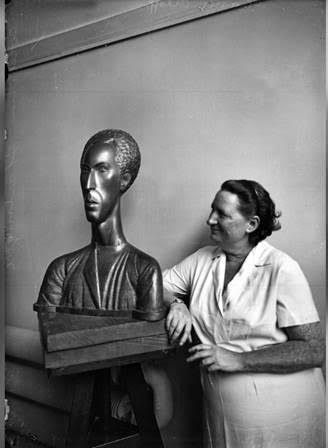
A long neck rises from a jacket of angular folds. Above it, a narrow face looks past the camera. In Albert Harlingue's 1935 photograph, Chana Orloff rests an arm beside her sculpted portrait of the painter Reuven Rubin, turning her own face toward it. The head seems unusually alert for something that cannot move.[1]
The bust's wide shoulders make the slender neck more conspicuous; the sharply defined eyes interrupt the smooth face. Those choices give the portrait its poise. Orloff's career grew around the possibility that simplification could make someone more particular. A bearing or an emphatic contour could carry character without requiring every crease of skin. The question was how much to change while keeping the person recognizably there.
Born into a Jewish family in what is now Ukraine in 1888, Orloff moved with her family to Palestine in 1905. Sewing helped support them. When she reached Paris in 1910, she entered the couture house of Paquin as an apprentice. The following year she gained admission to the École des arts décoratifs and attended the academy associated with Marie Vassilieff. Her first sculpture, according to the family museum, portrayed her grandmother from a photograph.[2]
A family face, already mediated by a camera: the task was to invent volume from a flat image. Her change of profession began with skilled hands and someone she knew.
Portraiture became a livelihood. After her husband, the Polish poet Ary Justman, died of influenza in 1919, Orloff raised their son Élie, known as Didi. During the following decade she became a sought-after portraitist. The family museum's account places this work alongside her participation in the avant-garde magazine SIC: professional success and artistic experiment occupied the same working life.[2]
Her audience also crossed between media. The Institut national d'histoire de l'art records a commission for forty-one drawings of cultural figures, published in the 1923 album Figures d'aujourd'hui. Her sculpted portraits eventually numbered more than three hundred. A network of artists, writers and patrons supplied subjects, but it also supplied readers, collectors and introductions. Making people visible was a practical means of establishing her own visibility.[3]
The results could be physically substantial. The Centre Pompidou's bronze M. Widhopff, a portrait of the painter David Ossipovitch Widhopff, stands just over a metre high. Its collection record dates it to around 1923 and identifies the Alexis Rudier foundry. That record also documents the state's purchase in 1946. A portrait could move from the artist's immediate social world into a national collection, carrying an individual acquaintance into a different kind of public life.[4]
It is tempting to sort such work into a clean opposition: fashionable likeness or adventurous modern sculpture. The evidence resists that division. In a French Ministry of Culture account, researcher Selena Gisca describes Orloff's work as moving close to realism and, at times, Cubism, while noting the difficulty critics had fitting her into a group. Her independence of style could become an obstacle to classification even as her portraits found buyers.[5]
Success acquired an address. In 1926, Auguste Perret built her a house and studio in the Villa Seurat in Paris. INHA notes that she had already portrayed the architect. A professional relationship had become a place to live and work: the portraitist who gave other people durable form could now commission a setting for her own practice.[3]
The war broke that continuity. Persecuted as a Jew, Orloff fled Paris with Didi and reached Switzerland. When she returned after the war, she found the studio devastated. In 1945 she submitted a claim for her missing property. Inventories and photographs, including professional images made by Marc Vaux, became tools for identifying the sculptures that had disappeared.[5]
One was L'Enfant Didi, carved in wood in 1921. The Musée d'art et d'histoire du Judaïsme records that it was looted from the studio in March 1943, surfaced at a New York auction house in 2008, and finally returned to the artist's studio on January 26, 2023. The subject was her only child. The object was also a particular piece of carved wood whose history could not be replaced by another likeness of him.[6]
Orloff herself resumed exhibiting: INHA documents a Paris show at the Galerie de France in 1946 and an exhibition at New York's Wildenstein the following year. Her later career included public monuments in Israel.[3] Yet the return of Didi, decades after her death in 1968, gives the portrait a different measure of endurance. Recognition had once meant finding a person's character in a sculpture. For her descendants, it also meant recognizing a missing sculpture as their family's own.[6]
In Harlingue's photograph, Orloff looks toward the head she has made; Rubin's sculpted gaze travels elsewhere. The two directions give the picture a quiet independence. She has finished looking closely enough to make him, and the portrait is ready to have a life of its own.
Sources
- Ateliers-musée Chana Orloff, museum homepage — Albert Harlingue's 1935 photograph of Orloff beside her portrait of Reuven Rubin.
- Ateliers-musée Chana Orloff, “Who Was Chana Orloff?” — family biography, sewing, artistic education, early portraiture and family life.
- Institut national d'histoire de l'art, “Chana Orloff, une femme artiste ukrainienne (1)” — portrait commissions, the Villa Seurat studio and postwar exhibitions.
- Centre Pompidou, “M. Widhopff,” accession AM 827 S — sitter, approximate date, bronze, dimensions, foundry and acquisition record.
- French Ministry of Culture, “« À la trace » dans les pas de Chana Orloff,” November 15, 2023 — stylistic context, wartime flight and the documentary search for stolen works.
- Musée d'art et d'histoire du Judaïsme, “L'Enfant Didi, itinéraire d'une œuvre spoliée de Chana Orloff, 1921–2023,” exhibition press release — the sculpture's creation, theft, rediscovery and return (PDF).