A hat comes off. A pose changes. A face that began solemnly allows itself a smile. Duke University Libraries identifies this movement from formality toward ease as a recurring pleasure of Hugh Mangum's portraits: successive exposures can preserve a sitter trying different ways of appearing before the camera.[1] The finished likeness was only one possibility among several. The surviving negative lets us linger over the alternatives.
Mangum's gift was partly the ability to make room for those alternatives. Working in the American South during the rise of Jim Crow, he photographed a clientele that crossed racial and economic divisions.[3] His pictures are compelling because their subjects remain particular: someone poised, someone amused, someone withholding a little. Their expressions resist being reduced to illustrations of an era.
The apparatus helped. Mangum's Penny Picture camera had a movable back that shifted the negative horizontally and vertically, allowing separate exposures to occupy different portions of one glass plate.[2] A support used economically became, in its afterlife, a way to see portraiture unfolding. Several small pictures can carry more uncertainty, and more life, than a single definitive face.
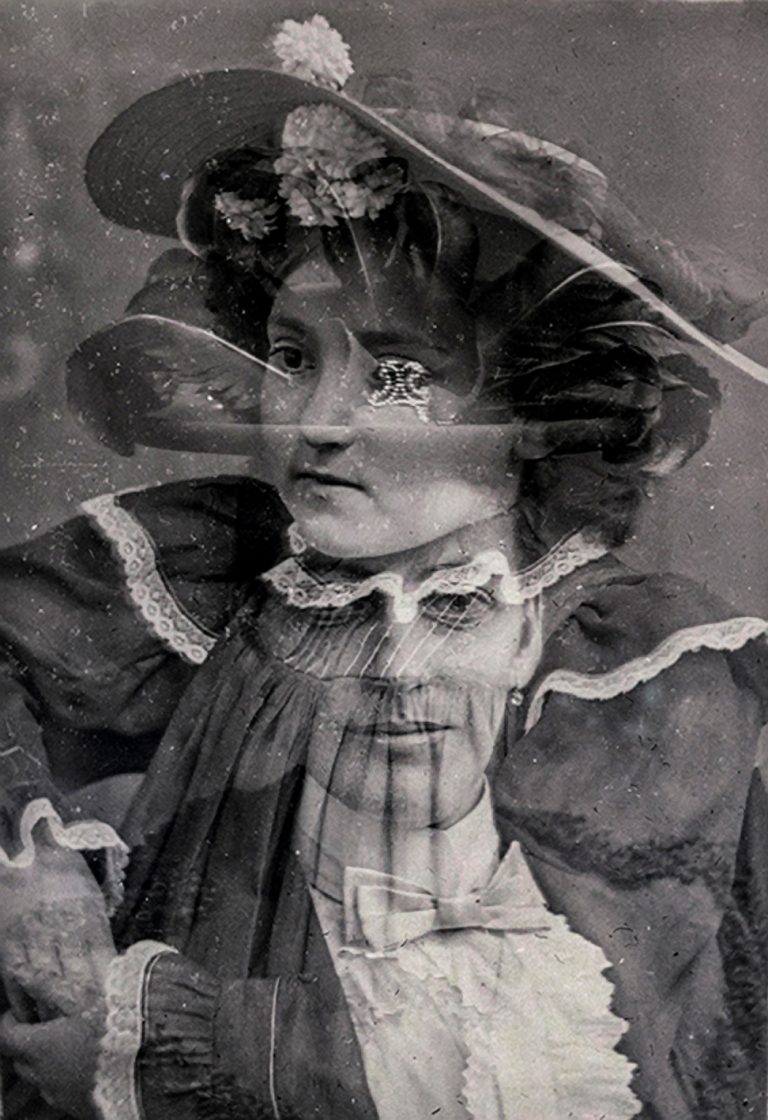
In the photograph reproduced here, faces actually overlap: the brim of a flower-trimmed hat crosses another likeness, and lace competes with facial contours.[3] These superimposed exposures differ from the neighboring pictures on a divided plate. The effect is disorienting, but it offers no reliable account of the sitters' relationship or Mangum's intention. The eye keeps trying to separate what the photographic surface holds together.
Born in Durham, North Carolina, in 1877, Mangum pursued art before making photography his profession. The account assembled by curators Margaret Sartor and Alex Harris records his art studies at the Methodist Female Seminary in Durham and later at Salem College. By 1897 he was making studio portraits; in 1899 he began working as an itinerant portraitist.[2] This was an artistic ambition fitted to a traveling business.
Duke's history describes a photographer riding trains through North Carolina, Virginia, and West Virginia, advertising locally and establishing temporary studios for periods ranging from days to months. On the inside of his traveling trunk's lid, he recorded destinations and dates.[1] That modest ledger offers an apt counterpoint to the pictures: routes and appointments behind the apparent ease of a face.
Every move also meant practical adjustments. In Sarah Edwards's account of the 2019 Nasher Museum exhibition, Sartor stresses the difficulty of making portraits when a photographer repeatedly encounters a new working environment, including unfamiliar light. Edwards also reports that Mangum listed his occupation as artist in the 1900 census.[4] His commercial practice and his artistic identity occupied the same working day.
Looking at the repeated sittings, it is tempting to imagine a photographer coaxing everyone into happiness. That would flatten the work. A sober pose can be an achievement too: a chosen degree of distance, a refusal to entertain, a carefully maintained composure. We cannot recover the words exchanged outside the frame. We can attend to the differences that the exposures preserve.
The low cost of penny pictures may have encouraged experimentation; Duke presents that connection as a possibility.[1] It is an appealing explanation because it gives the business model a role in the pictures' vitality. If a sitting allows another attempt, the sitter can revise a gesture. A small change in the terms of making a photograph can enlarge the range of selves available within it.
When different people occupy neighboring portions of a plate, another kind of meaning appears. Sartor and Harris describe these negatives as an unintended record of successive customers.[2] Viewed whole, the plate lets us move between lives that a set of separately trimmed portraits would keep apart. The photographic surface preserves a relationship created by the work of the studio.
That relationship needs careful reading. Separate exposures on shared glass do not establish that the subjects posed together, knew one another, or enjoyed equal treatment beyond the studio. In Edwards's report, Harris explains that people can appear to sit together even though Mangum photographed them separately.[4] The distinction makes the plates more interesting: their visual proximity is real, while the social story we might build from it remains incomplete.
The Nasher's exhibition account emphasizes the breadth of Mangum's clientele under segregation.[3] This supports a meaningful claim about whom his portrait business served. It cannot supply the unnamed sitters' biographies. Duke notes how few images have firm identifications of people or places.[1] Preserving that gap is part of respecting the pictures. A face deserves more than a plausible story assigned to it by a later viewer.
Mangum died in 1922. His negatives remained in the family's tobacco barn for decades; the building and the plates escaped demolition in the 1970s.[3] Their survival introduced another author of their appearance: time. The portraits now reach us through material that was stored, damaged, rescued, conserved, and reproduced.
Sartor and Harris explain that Duke's digital capture used color to record information in the deteriorating negatives, although Mangum had made black-and-white images. For their book and subsequent exhibition, the curators retained that color information and enlarged selected photographs, making damage and fragility more conspicuous.[5] The color belongs to the surviving photographic object; it does not restore the colors of the clothes or rooms before Mangum's camera.
This presentation adds a second encounter to the original sitting. Mangum worked with a person arranging a face and body for a photograph. Later viewers encounter that arrangement through an object whose condition has changed. A blemish can interrupt a gaze or compete with a contour. It becomes part of what we see without becoming part of what the photographer intended.
The most rewarding way to look is to hold both encounters in view. Notice the sitter's posture, then the border of the exposure; the expression, then the material carrying it. Allow a neighboring portrait to change the rhythm of looking without inventing a friendship between strangers. Mangum's surviving work gives us the rare pleasure of seeing people try out an image of themselves. We can meet that effort with attention while leaving the rest of their lives open.
Sources
- Duke University Libraries, “History & Context,” Hugh Mangum Photographs — travel, temporary studios, the trunk ledger, changing poses, and limits of identification.
- Margaret Sartor and Alex Harris, “Discovering Mangum,” Where We Find Ourselves — artistic education, early career, and the Penny Picture camera's movable back.
- Nasher Museum of Art at Duke University, “Where We Find Ourselves: The Photographs of Hugh Mangum, 1897–1922,” 2019 exhibition — clientele, survival of the negatives, and source of the archival photograph.
- Sarah Edwards, “Lost in a Durham Barn for Fifty Years, Hugh Mangum's Photos Form a Vivid Portrait of the Jim Crow South,” INDY, March 27, 2019 — interviews with Sartor and Harris on studio conditions, Mangum's artistic identity, and separate sittings sharing a plate.
- Margaret Sartor and Alex Harris, “Developing Mangum,” Where We Find Ourselves — digital capture, color information in damaged negatives, and curatorial decisions about reproduction and scale.